Text to imagePortraitStyle guide
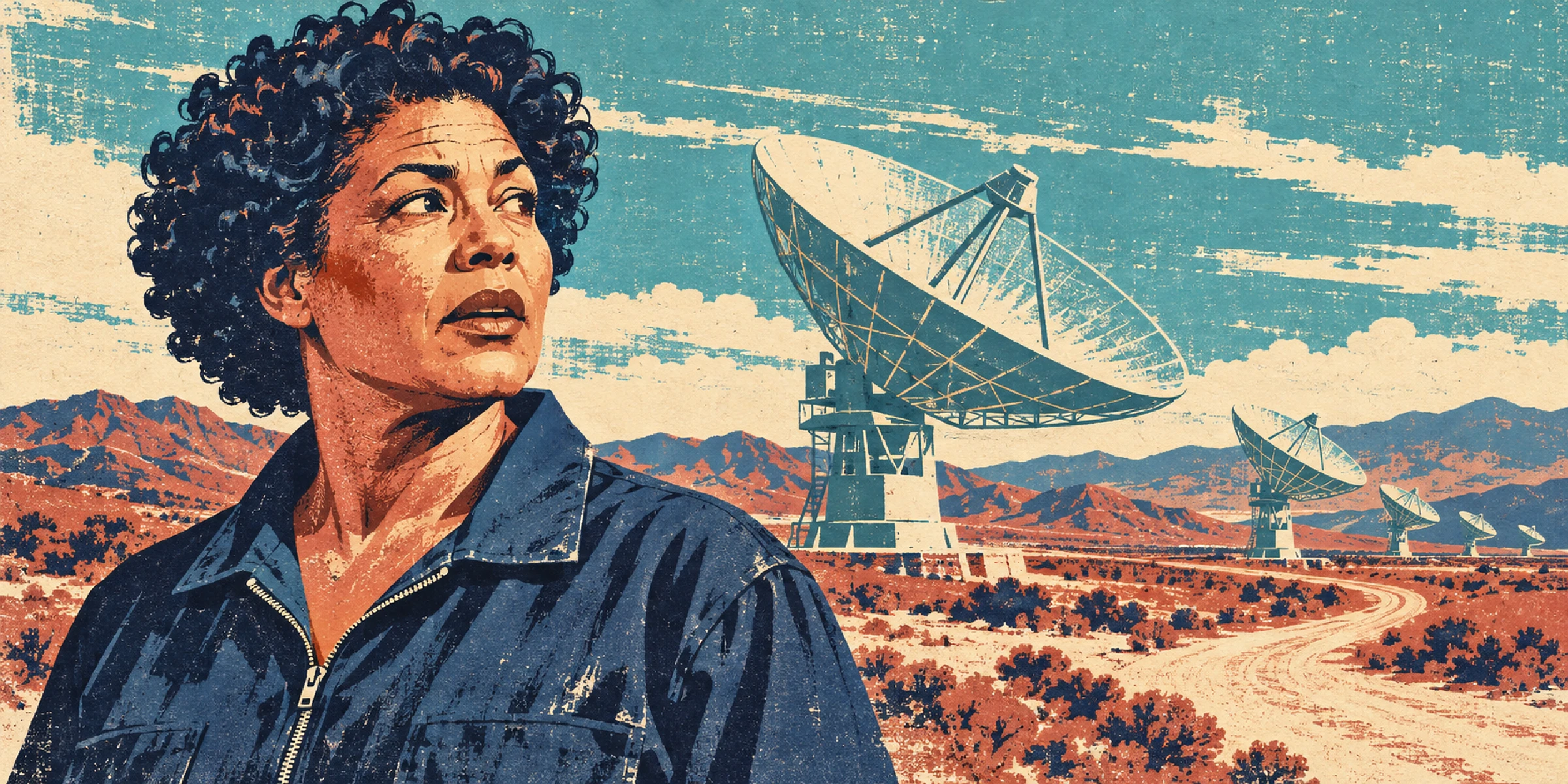
Woman beside the Desert Antennas
An environmental portrait of a short-haired woman looking across the desert. Beside her large foreground face, a maintenance road and dish antennas lead through the basin; bold screenprinted shapes and broken ink edges give the person and landscape a shared rhythm.
Remix this referenceWoman beside the Desert Antennas
- Form language
- Build a graphic screenprint from decisive interlocking masses, alternating broad wedges with curved bands; incidental shapes may vary naturally.
- Contour
- Let stencil boundaries carry most edges, with a few blunt keylines and occasional coarse edge bites instead of a continuous outline.
- Mark-making
- Use sparse dragged ink streaks and irregular squeegee skips within larger shapes; vary their length and spacing without filling every surface.
- Surface rendering
- Opaque ink layers create stepped tonal changes; selective overprints deepen intersections, while slight registration slips expose lively slivers.
Priority
Preserve decisive shape rhythms as the defining graphic screenprint treatment.
What to avoid & what to check
Exact prompt for this example
MODULE OWNERSHIP
subject: Subject count, type, stable proportions and landmarks, resting face geometry, hair shape, physical materials, garment construction and permanent marks. No emotion, movement, color assignment or rendering recipe.
expression: Facial soft-tissue displacement and pupil direction, muscle coordination, regional intensity, asymmetry and onset/peak/release. No head/body pose, stable appearance, skin color or rendering.
gesture: Head/neck/body/limb orientation, joint movement, support, contact and pose-caused occlusion using existing anatomy. No eye/pupil movement, emotion, identity, props inventory or camera.
props: Prop count, type, construction, physical material and scale relative to the subject. Holding/contact belongs to gesture, position to composition, color to palette.
scene: Environment elements, terrain, backdrop/floor presence and structural detail. No canvas positions, camera, lighting, assigned colors or render texture.
camera: Projection, focal-length impression, camera elevation/yaw/roll, viewing distance and crop. No actor pose, world placement, lighting or canvas aspect ratio.
composition: Normalized 0-100% canvas positions, scale in frame, depth/overlap, focal hierarchy and margins. No joint pose, camera projection, rendering, subject/prop inventory or emotion.
palette: Color anchors, hue/saturation/value ranges, colors assigned to parts and approximate color coverage. No illumination direction, shading algorithm, physical material or layout.
lighting: Light-source direction/softness/intensity, ambient illumination, physical shadow direction/length and highlight position. Absence of directional illumination is allowed. No shading technique, palette or material changes.
style: Reusable form abstraction, contour weight/taper/edge quality, medium and mark scale/density/direction, surface rendering and tonal transition technique. No fixed subject proportions, anatomy, identity, expression, pose, palette, light-source direction, camera or layout.
output: Image count, aspect ratio, size, file/alpha requirements and global lettering/logo/watermark restrictions. No background scenery, crop, style, identity or pose.

SUBJECT
inventory: One original middle-aged human woman, actor A; no other people or animals.
geometry: An elongated face with broad cheek planes, a substantial nose, a squared chin and a sturdy neck.
resting-face: Naturally hooded upper lids, thick low-set brows and a fuller lower lip establish her resting features.
appearance: Dense cropped curls and a cotton-twill coverall with a fold-down collar and plain metal front zipper.

PRIORITY


AVOID


CHECK


EXPRESSION — ACTOR A
brows: One brow lifts slightly through its inner half; the other stays nearly level.
lids: Upper lids open modestly beyond rest; lower lids retain a soft, uncompressed edge.
cheeks: Cheeks remain relaxed without a smile-driven lift.
nose: Nose wings remain at rest, with no wrinkle or flare.
mouth: Lips separate into a small uneven gap, with the corners remaining loose.
jaw: The jaw releases just enough to support the slight lip opening.
gaze: Both pupils point rightward toward a distant point, with consistent binocular alignment.
coordination: The brow and upper-lid lift lead the response; the mouth follows with a quieter release.
timing: Catch the onset of recognition, before the eyes widen fully or the mouth forms speech.

PRIORITY


AVOID


CHECK


GESTURE
head: A turns her head rightward with a slight upward chin lift; the neck stays comfortably extended.
torso: Her torso remains oblique, with the nearer shoulder gently dropped rather than squared to the viewer.
limbs: Her arms hang loosely beside the torso.
contact: Her hands make no contact and her upper body does not lean on a support; the shoulder silhouette leaves the jaw unobstructed.

PRIORITY


AVOID


CHECK


PROPS
inventory: No separate props.
construction: No prop construction applies.

PRIORITY


AVOID


CHECK


SCENE
inventory: An arid radio-observatory basin with dish antennas, a winding maintenance road, low ridges and open sky.
structure: Shallow ribbed antenna bowls stand on squat pivot towers; the road follows the basin's natural folds. No dedicated bodily support structures.

PRIORITY


AVOID


CHECK


CAMERA
projection: Rectilinear perspective with a moderate wide-lens impression and restrained facial distortion.
viewpoint: Use an eye-level viewpoint with no roll and a slightly oblique viewing axis.
crop: A close upper-torso portrait crop includes only the upper arms, excludes hands, and retains the full hair silhouette and generous landscape.

PRIORITY


AVOID


CHECK


COMPOSITION
placement: A occupies the left third at large scale; the antenna sequence travels through the open right-hand span.
depth: The face leads, a nearby dish follows, and the road threads between progressively smaller distant dishes.
spacing: Let the shoulder meet the lower edge; keep air above the curls and clear gaps between the receding dishes.

PRIORITY


AVOID


CHECK


PALETTE
colors: Use warm paper cream, brick red, midnight blue and muted turquoise, with restrained saturation overall.
assignment: Brick red carries the face and earth; blue carries hair and coverall; turquoise distinguishes sky and antennas.
balance: Cream remains broadly present, blue supplies the strongest dark anchor, and turquoise stays comparatively quiet.

PRIORITY


AVOID


CHECK


LIGHTING
sources: Broad sunlight arrives from the upper right, supported by gentle ambient sky illumination.
shadows: Nose and collar shadows fall down-left; antenna towers cast moderately extended shadows in the same direction.
highlights: Light catches the right forehead plane, nose bridge and upper rims of the antenna bowls.

PRIORITY


AVOID


CHECK


STYLE GUIDE
form-language: Build a graphic screenprint from decisive interlocking masses, alternating broad wedges with curved bands; incidental shapes may vary naturally.
contour: Let stencil boundaries carry most edges, with a few blunt keylines and occasional coarse edge bites instead of a continuous outline.
mark-making: Use sparse dragged ink streaks and irregular squeegee skips within larger shapes; vary their length and spacing without filling every surface.
surface-rendering: Opaque ink layers create stepped tonal changes; selective overprints deepen intersections, while slight registration slips expose lively slivers.

PRIORITY
Preserve decisive shape rhythms as the defining graphic screenprint treatment.

AVOID


CHECK


OUTPUT
format: One finished image, 2:1 landscape aspect ratio, 2400 × 1200 pixels, opaque PNG.
restrictions: Deliver one opaque PNG at 2400 × 1200 pixels in a 2:1 aspect ratio; no lettering, logos or watermarks.

PRIORITY


AVOID


CHECK


FINAL INTEGRATION
expression + style: Keep the small facial changes legible through the print's abstraction without adding finer realism.
camera + composition + scene: Let the environmental journey enrich the portrait while preserving the person's visual prominence.
Model information comes from image provenance. The same prompt may produce a different result.