Text to imageSpace & architectureStyle guide
Tilting a Panel in the Rehearsal Hall
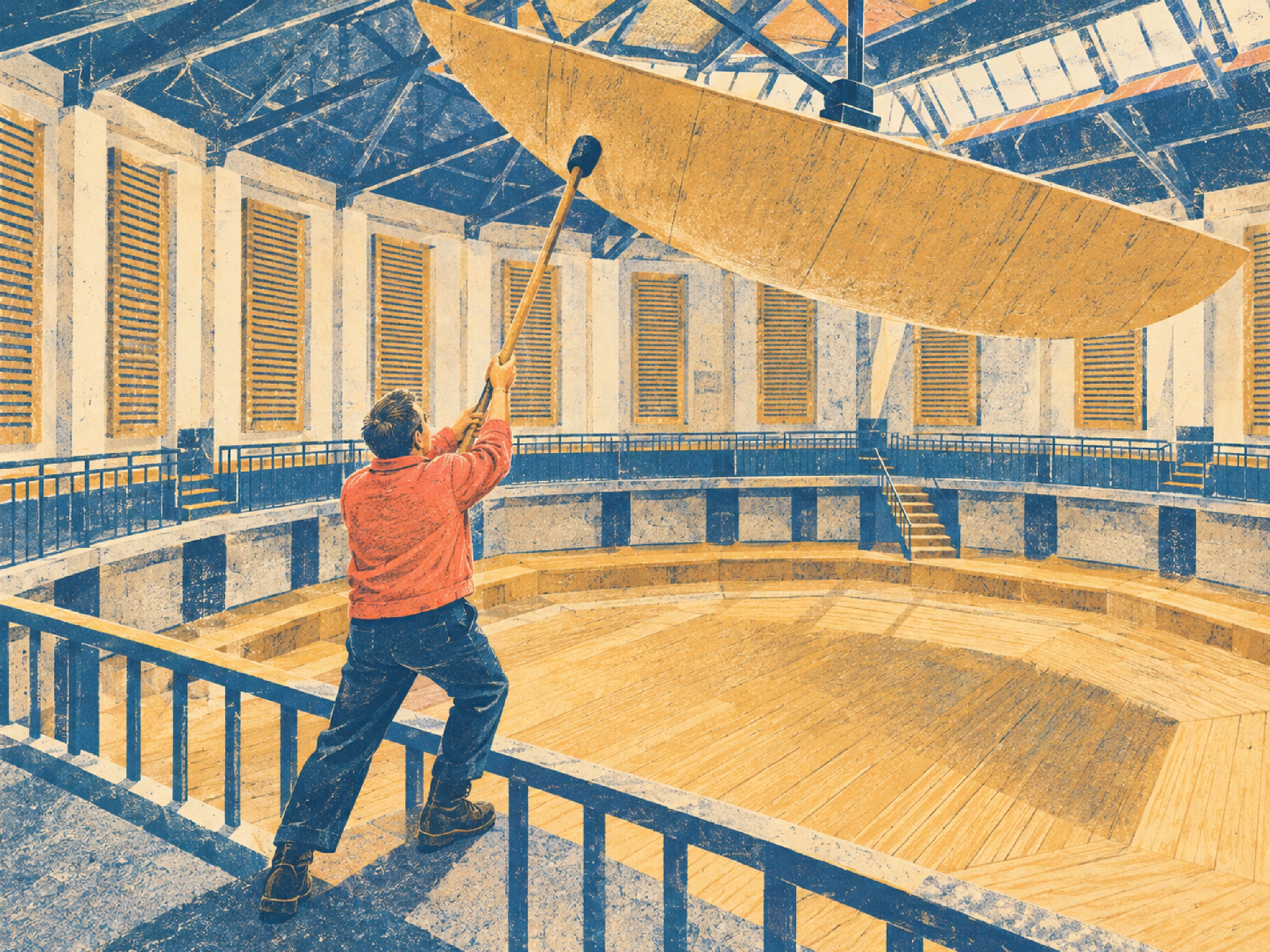
In a hall layered with a recessed rehearsal floor and perimeter gallery, a technician tilts a suspended acoustic panel using a long pole. Grainy ink and playful registration offsets weave architecture and action into a lively riso illustration.
Remix this referenceTilting a Panel in the Rehearsal Hall
- Form language
- Build forms from broad cut shapes, gently faceted curves and unequal repeating units; secondary details may vary naturally.
- Contour
- Use rough, occasionally broken contours; let selected print layers slip past their edges with playful registration offsets.
- Mark-making
- Combine irregular ink grain with loose dragged streaks and sparse hand-drawn ticks; vary marks rather than applying uniform noise.
- Surface rendering
- Use translucent spot-ink overlaps and broken screened tones; uneven ink deposits soften boundaries and expose paper within printed areas.
Priority
Keep riso print character visible through grain, overlapping ink layers and selective registration
What to avoid & what to check
Exact prompt for this example
MODULE OWNERSHIP
subject: Subject count, type, stable proportions and landmarks, resting face geometry, hair shape, physical materials, garment construction and permanent marks. No emotion, movement, color assignment or rendering recipe.
expression: Facial soft-tissue displacement and pupil direction, muscle coordination, regional intensity, asymmetry and onset/peak/release. No head/body pose, stable appearance, skin color or rendering.
gesture: Head/neck/body/limb orientation, joint movement, support, contact and pose-caused occlusion using existing anatomy. No eye/pupil movement, emotion, identity, props inventory or camera.
props: Prop count, type, construction, physical material and scale relative to the subject. Holding/contact belongs to gesture, position to composition, color to palette.
scene: Environment elements, terrain, backdrop/floor presence and structural detail. No canvas positions, camera, lighting, assigned colors or render texture.
camera: Projection, focal-length impression, camera elevation/yaw/roll, viewing distance and crop. No actor pose, world placement, lighting or canvas aspect ratio.
composition: Normalized 0-100% canvas positions, scale in frame, depth/overlap, focal hierarchy and margins. No joint pose, camera projection, rendering, subject/prop inventory or emotion.
palette: Color anchors, hue/saturation/value ranges, colors assigned to parts and approximate color coverage. No illumination direction, shading algorithm, physical material or layout.
lighting: Light-source direction/softness/intensity, ambient illumination, physical shadow direction/length and highlight position. Absence of directional illumination is allowed. No shading technique, palette or material changes.
style: Reusable form abstraction, contour weight/taper/edge quality, medium and mark scale/density/direction, surface rendering and tonal transition technique. No fixed subject proportions, anatomy, identity, expression, pose, palette, light-source direction, camera or layout.
output: Image count, aspect ratio, size, file/alpha requirements and global lettering/logo/watermark restrictions. No background scenery, crop, style, identity or pose.

SUBJECT
inventory: A is one adult sound technician; no additional people.
geometry: A has ordinary adult proportions, a sturdy torso and a short neck.
resting-face: No readable resting facial geometry is specified.
appearance: Short cropped hair, a canvas work jacket with a plain collar, straight work trousers and sturdy ankle boots.

PRIORITY


AVOID


CHECK


EXPRESSION — ACTOR A
brows: Leave brow displacement unprescribed.
lids: Leave eyelid opening and tension unprescribed.
cheeks: Leave cheek lifting and compression unprescribed.
nose: Leave nasal wrinkling and nostril action unprescribed.
mouth: Leave lip shape and mouth-corner displacement unprescribed.
jaw: Leave jaw opening and muscular tension unprescribed.
gaze: Leave pupil direction unprescribed.
coordination: No facial coordination or asymmetry is prescribed.
timing: Neutral apex; no facial change, onset or release is prescribed.

PRIORITY


AVOID


CHECK


GESTURE
head: A tips the head upward toward the panel.
torso: A leans back slightly beneath the raised arms, bracing the body over a staggered stance.
limbs: Both arms extend overhead with softly bent elbows; one knee bends while the other leg supports the body.
contact: Both hands grip the pole at separated heights; its padded tip presses the panel upward as the panel tilts on its pivot.

PRIORITY


AVOID


CHECK


PROPS
inventory: One adjustable acoustic reflector several body widths across, and one adjustment pole longer than A is tall.
construction: A shallow curved plywood panel with an overhead pivot mount; a wooden pole with a padded contact tip.

PRIORITY


AVOID


CHECK


SCENE
inventory: An octagonal rehearsal hall with a recessed floor, perimeter gallery, access steps, tall wall louvers and roof lights.
structure: The gallery wraps around the sunken floor; exposed roof trusses bridge the room, and deep wall bays contain the louvers.

PRIORITY


AVOID


CHECK


CAMERA
projection: Moderately wide perspective with clear convergence and little edge distortion.
viewpoint: View diagonally across the hall from gallery height behind A, looking gently downward with no roll; show the back of the head and keep the face outside view.
crop: Include the full technician and reflector; crop nearby architecture so the room continues beyond the image.

PRIORITY


AVOID


CHECK


COMPOSITION
placement: Place A below and left of center; the pole connects A to the broad reflector above and right.
depth: A cropped gallery edge overlaps the recessed floor; the technician-panel connection leads, followed by the surrounding hall.
spacing: Leave an open interval around the pole and hands; broad floor space balances the denser roof and gallery layers.

PRIORITY


AVOID


CHECK


PALETTE
colors: Paper cream, deep printer blue, warm ochre and lively coral; keep a small, expressive hue family.
assignment: Blue belongs to roof, gallery, trousers and boots; ochre to floor and reflector, coral to jacket, cream to walls.
balance: Cream and ochre occupy broad areas; deep blue provides value contrast, while coral remains a compact accent.

PRIORITY


AVOID


CHECK


LIGHTING
sources: Broad daylight enters from roof lights above right, supported by soft ambient illumination throughout the hall.
shadows: The reflector casts a broad soft shadow down and left; A's floor shadow follows the same direction.
highlights: Light catches the reflector's upper rim, the sleeves and the upper faces of the gallery rails.

PRIORITY


AVOID


CHECK


STYLE GUIDE
form-language: Build forms from broad cut shapes, gently faceted curves and unequal repeating units; secondary details may vary naturally.
contour: Use rough, occasionally broken contours; let selected print layers slip past their edges with playful registration offsets.
mark-making: Combine irregular ink grain with loose dragged streaks and sparse hand-drawn ticks; vary marks rather than applying uniform noise.
surface-rendering: Use translucent spot-ink overlaps and broken screened tones; uneven ink deposits soften boundaries and expose paper within printed areas.

PRIORITY
Keep riso print character visible through grain, overlapping ink layers and selective registration

AVOID


CHECK


OUTPUT
format: One finished image, 4:3 aspect ratio, 2400 × 1800 pixels, opaque PNG.
restrictions: No lettering, logos or watermarks.

PRIORITY


AVOID


CHECK


FINAL INTEGRATION
gesture + props + composition: Let visible contact connect the technician and equipment into a readable action within the spatial layers.
Model information comes from image provenance. The same prompt may produce a different result.