Text to imageArt stylesStyle guide
One Fish · Directional Mosaic
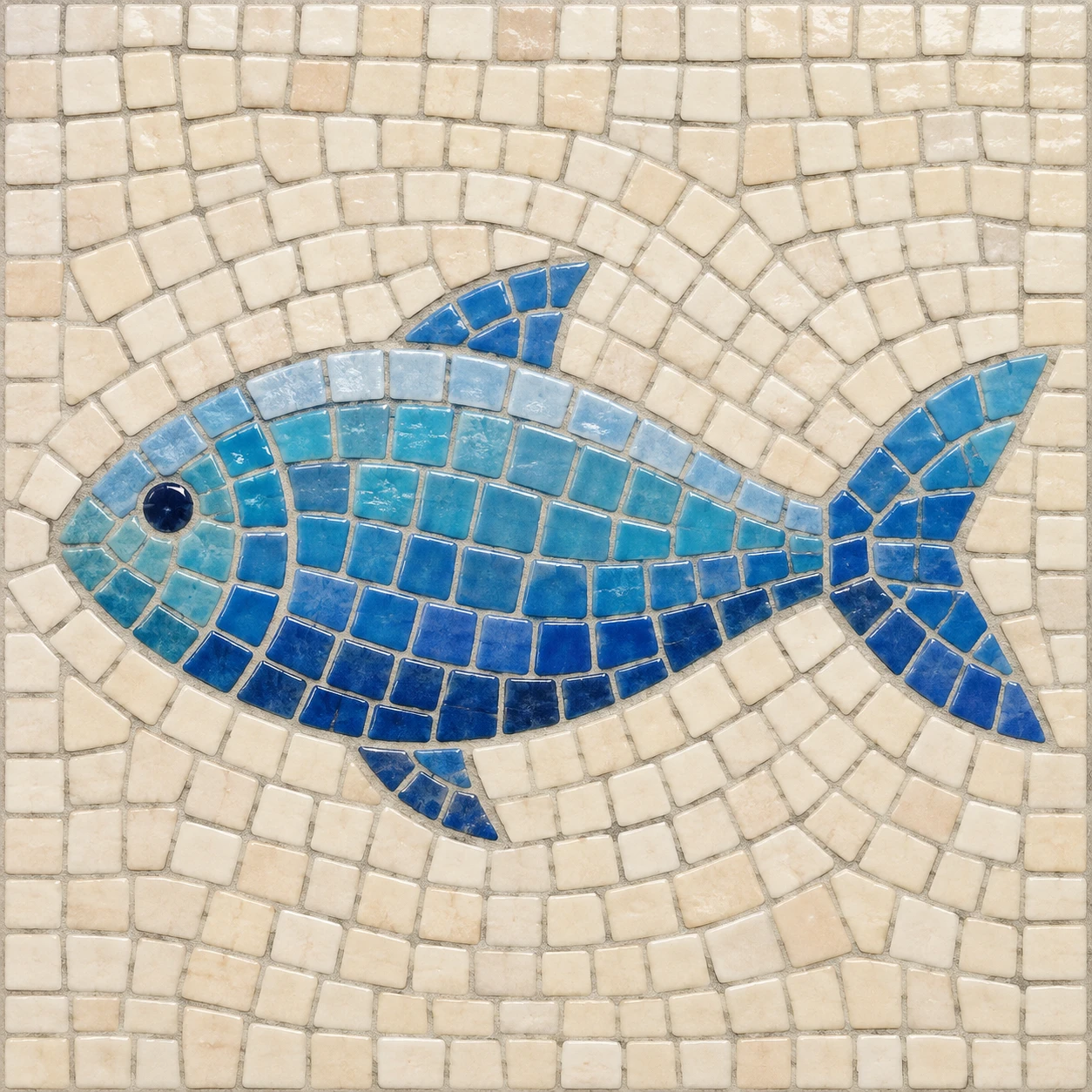
A mosaic reference that shapes a fish through rows of small tiles turning along its body and fins.
One Fish · Directional Mosaic
- Shape & line
- Build the fish from small irregular quadrilateral tiles. Turn successive tile rows around the rounded head and along the belly, then fan the rows outward into the two tail lobes; keep a narrow visible grout path between neighboring tiles.
- Color & light
- Use turquoise and medium blue across the body, place a lighter blue row along its upper edge and deeper blue rows along its belly, and make the eye one dark tile. Keep the background warm ivory and the lighting soft so color bands remain easy to read.
- Texture & material
- Give the ceramic tiles slightly uneven edges and softly glossy faces with occasional broad pale reflections. Recess the matte light-gray grout below the tile faces so short edge shadows reveal separate pieces without turning the surface into chunky relief.
- Composition
- Arrange the ivory background tiles in curved rows that echo the fish silhouette close to its edge and gradually straighten toward the panel borders. Preserve a continuous grout boundary around the fish, and leave enough background above and below for the directional tile flow to remain visible.
Priority
Prioritize tile rows that visibly turn with the fish's shape.
What to avoid & what to check
Avoid a uniform square grid or painted outlines that replace tile construction.
Check that the body curves and forked tail read through tile direction and continuous grout gaps.
Exact prompt for this example
SUBJECT
One blue fish rendered as a flat mosaic motif, with one rounded body, one forked tail, a small upper fin, a small lower fin, and one dark eye. The head points toward image-left and the tail extends toward image-right; each fin connects visibly to the body.

COMPOSITION
Use a straight-on view of a square mosaic panel. Center the horizontally oriented fish with generous pale background around its complete silhouette, keeping the head, fins, and tail clearly separated.

STYLE GUIDE
1. Shape & line
Build the fish from small irregular quadrilateral tiles. Turn successive tile rows around the rounded head and along the belly, then fan the rows outward into the two tail lobes; keep a narrow visible grout path between neighboring tiles.

2. Color & light
Use turquoise and medium blue across the body, place a lighter blue row along its upper edge and deeper blue rows along its belly, and make the eye one dark tile. Keep the background warm ivory and the lighting soft so color bands remain easy to read.

3. Texture & material
Give the ceramic tiles slightly uneven edges and softly glossy faces with occasional broad pale reflections. Recess the matte light-gray grout below the tile faces so short edge shadows reveal separate pieces without turning the surface into chunky relief.

4. Composition
Arrange the ivory background tiles in curved rows that echo the fish silhouette close to its edge and gradually straighten toward the panel borders. Preserve a continuous grout boundary around the fish, and leave enough background above and below for the directional tile flow to remain visible.

PRIORITY
Preserve the requested identity, count, action, composition and output settings. Apply the style rules within those constraints; a style reference must not replace the subject or layout. Within the style: Prioritize tile rows that visibly turn with the fish's shape.

AVOID
Avoid a uniform square grid or painted outlines that replace tile construction.

OUTPUT
Create one square image of a handmade mosaic panel, with no lettering, captions, signature, or watermark.

SELF-CHECK
Check that the body curves and forked tail read through tile direction and continuous grout gaps.
Model information comes from image provenance. The same prompt may produce a different result.