Text to imageLandscapeStyle guide
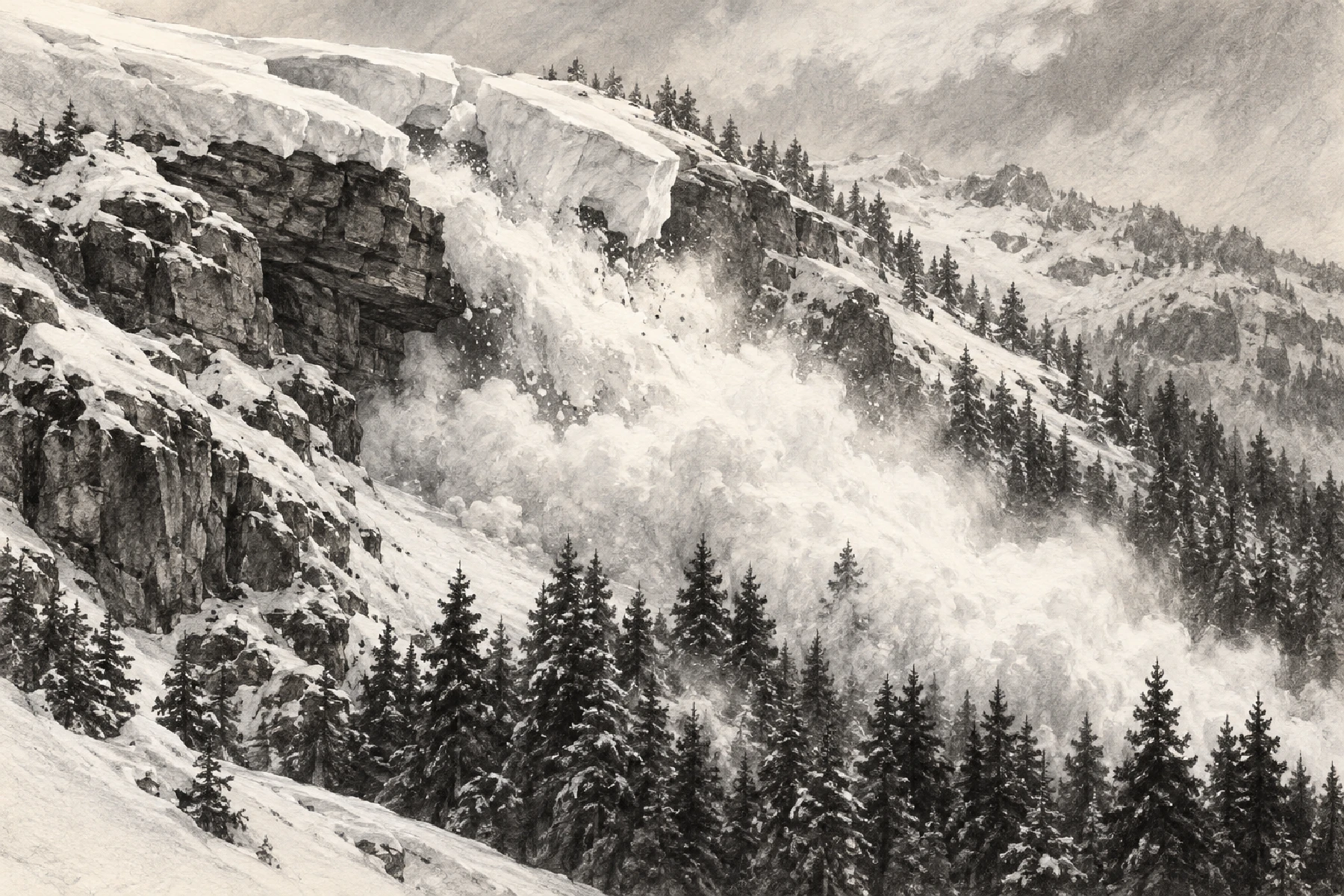
A Snow Cornice Breaking Above the Pines
Powder pours from a fractured snow cornice toward a pine-covered ridge. Rubbed charcoal and erased light bring the overlapping rock, snow, and forest into vivid relief.
Remix this referenceA Snow Cornice Breaking Above the Pines
- Form language
- Build observed masses from broad interlocking wedges, allowing small irregularities without diagrammatic precision.
- Contour
- Alternate broken charcoal edges with lost boundaries; sharpen only selected junctions using the stick's narrow edge.
- Mark-making
- Drag broad charcoal strokes, rub them with a rag, and lift irregular streaks with an eraser; let pressure vary naturally.
- Surface rendering
- Work smoky half-tones into toothy paper, retaining granular deposits beside luminous erased passages and occasional raw paper.
Priority
Keep observational charcoal, visible smudging, and erased light unmistakable.
What to avoid & what to check
Exact prompt for this example
MODULE OWNERSHIP
subject: Subject count, type, stable proportions and landmarks, resting face geometry, hair shape, physical materials, garment construction and permanent marks. No emotion, movement, color assignment or rendering recipe.
expression: Facial soft-tissue displacement and pupil direction, muscle coordination, regional intensity, asymmetry and onset/peak/release. No head/body pose, stable appearance, skin color or rendering.
gesture: Head/neck/body/limb orientation, joint movement, support, contact and pose-caused occlusion using existing anatomy. No eye/pupil movement, emotion, identity, props inventory or camera.
props: Prop count, type, construction, physical material and scale relative to the subject. Holding/contact belongs to gesture, position to composition, color to palette.
scene: Environment elements, terrain, backdrop/floor presence and structural detail. No canvas positions, camera, lighting, assigned colors or render texture.
camera: Projection, focal-length impression, camera elevation/yaw/roll, viewing distance and crop. No actor pose, world placement, lighting or canvas aspect ratio.
composition: Normalized 0-100% canvas positions, scale in frame, depth/overlap, focal hierarchy and margins. No joint pose, camera projection, rendering, subject/prop inventory or emotion.
palette: Color anchors, hue/saturation/value ranges, colors assigned to parts and approximate color coverage. No illumination direction, shading algorithm, physical material or layout.
lighting: Light-source direction/softness/intensity, ambient illumination, physical shadow direction/length and highlight position. Absence of directional illumination is allowed. No shading technique, palette or material changes.
style: Reusable form abstraction, contour weight/taper/edge quality, medium and mark scale/density/direction, surface rendering and tonal transition technique. No fixed subject proportions, anatomy, identity, expression, pose, palette, light-source direction, camera or layout.
output: Image count, aspect ratio, size, file/alpha requirements and global lettering/logo/watermark restrictions. No background scenery, crop, style, identity or pose.

SUBJECT
inventory: No figures, animals, or independent object subjects.
geometry: No independent subject geometry applies.
resting-face: No faces are present.
appearance: No independent subject appearance applies.

PRIORITY


AVOID


CHECK


PROPS
inventory: No separate props.
construction: No prop construction applies.

PRIORITY


AVOID


CHECK


SCENE
inventory: An alpine basin contains a fractured snow cornice, exposed rock strata, loose powder, and a dense pine ridge.
structure: A detached slab breaks into powder above the forest; the remaining snow lip overhangs a deeply undercut rock shelf.

PRIORITY


AVOID


CHECK


CAMERA
projection: Natural perspective with a restrained long-lens impression compresses the mountain layers.
viewpoint: Look across from the opposite slope, slightly below the cornice, with a level horizon.
crop: Include the broken ledge and descending powder; let the lower forest continue beyond the frame.

PRIORITY


AVOID


CHECK


COMPOSITION
placement: The fracture anchors the upper-left third; an open powder diagonal leads toward the forest across the lower right.
depth: Overlapping pine crowns interrupt the powder cloud, while the rock shelf remains legible behind its thinner edge.
spacing: Give the fracture the strongest emphasis, with spacious powder between the crowded rock and forest masses.

PRIORITY


AVOID


CHECK


PALETTE
colors: Use paper ivory, pale ash, graphite gray, and charcoal black in an essentially neutral range.
assignment: Reserve ivory for snow and powder, middle grays for rock, and the deepest blacks for pine interiors.
balance: Broad pale passages dominate, interrupted by concentrated dark forest and a smaller dark rock mass.

PRIORITY


AVOID


CHECK


LIGHTING
sources: Broad, soft daylight arrives from the upper left through thin cloud.
shadows: Diffuse shadows fall down and right; the sheltered underside of the cornice stays deeply shaded.
highlights: The exposed snow lip and upper edges of the powder carry the brightest light.

PRIORITY


AVOID


CHECK


STYLE GUIDE
form-language: Build observed masses from broad interlocking wedges, allowing small irregularities without diagrammatic precision.
contour: Alternate broken charcoal edges with lost boundaries; sharpen only selected junctions using the stick's narrow edge.
mark-making: Drag broad charcoal strokes, rub them with a rag, and lift irregular streaks with an eraser; let pressure vary naturally.
surface-rendering: Work smoky half-tones into toothy paper, retaining granular deposits beside luminous erased passages and occasional raw paper.

PRIORITY
Keep observational charcoal, visible smudging, and erased light unmistakable.

AVOID


CHECK


OUTPUT
format: One finished image, 3:2 landscape, 1800 × 1200 pixels, opaque PNG; no lettering, logos, or watermarks.
restrictions: One finished image, 3:2 landscape, 1800 × 1200 pixels, opaque PNG; no lettering, logos, or watermarks.

PRIORITY


AVOID


CHECK
Model information comes from image provenance. The same prompt may produce a different result.