Text to imageCharacterStyle guide
Baby Elephant · Inner-Bend Crease Compression
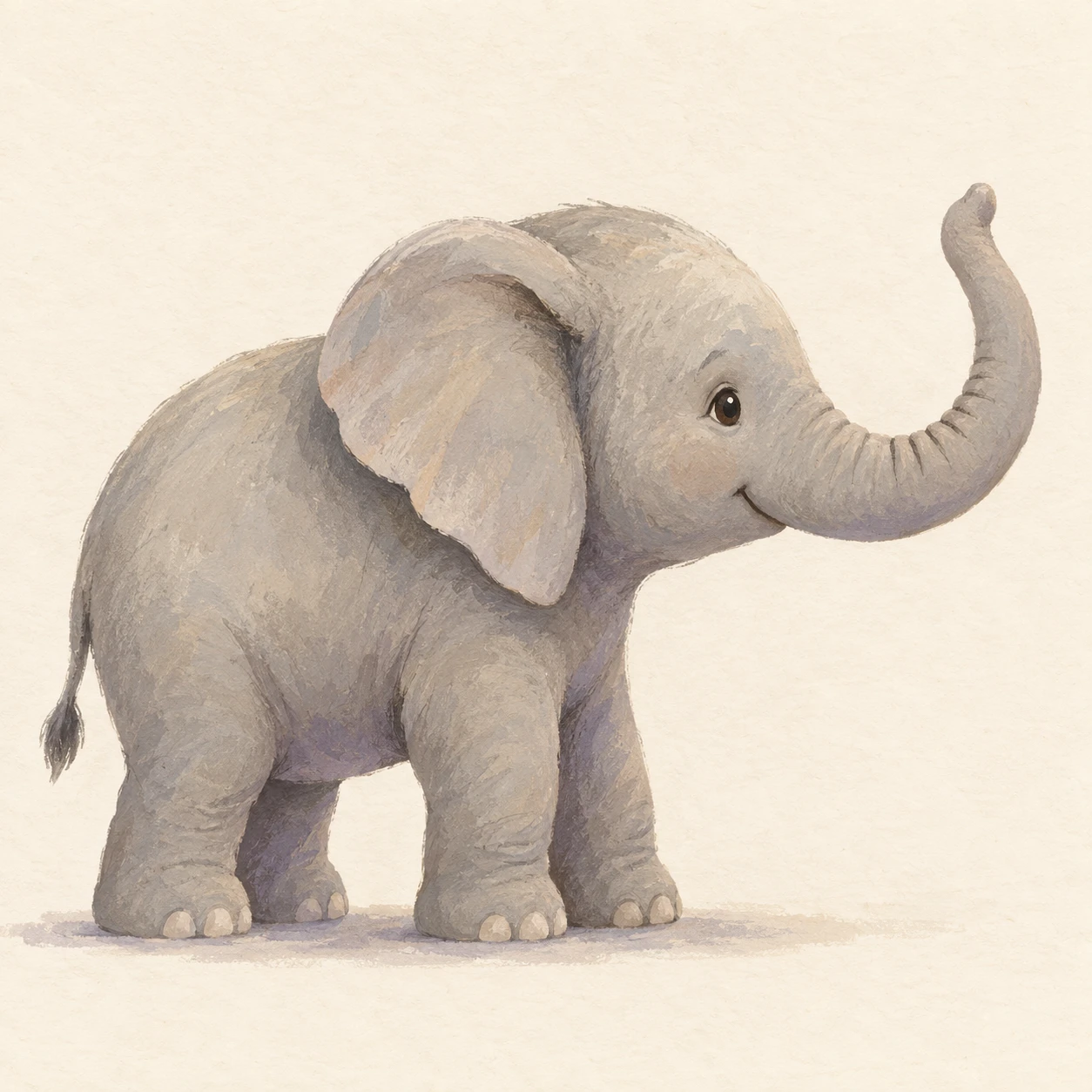
A baby elephant with an upward-bent trunk demonstrates short creases gathering inside a bend and a smooth, stretched outer contour.
Baby Elephant · Inner-Bend Crease Compression
- Shape & line
- Build the elephant from a rounded body, a broad ear, and short sturdy legs. Taper the trunk gradually toward its tip; along the concave, upper-left side of its upward bend, draw several short curved creases that gather most closely at the tightest turn. Keep the convex, lower-right outer contour smooth and continuous so compression and stretching are visibly different.
- Color & light
- Paint the skin warm gray against a pale cream background. Light the character softly from image-upper-left, adding muted lavender beneath the belly and trunk; deepen only the inner-bend creases enough to make them readable, without turning them into black stripes.
- Texture & material
- Use matte, opaque gouache shapes with slight brush variation and faint paper grain. Add soft pencil marks mainly at the compressed trunk creases and ear base, leaving the stretched outer bend broadly unmarked so the skin feels supple rather than ribbed.
- Composition
- Keep the raised trunk isolated against the plain background, preserving an open gap between its tip and the forehead. Make the bend large enough for its inner creases to read at thumbnail size, and keep the ear and body details quieter than this focal area.
Priority
Prioritize the contrast between gathered inner creases and the smooth outer bend.
What to avoid & what to check
Avoid evenly spaced rings around the trunk or a closed spiral that hides the bend.
Check that creases gather on the concave side while the convex contour stays smooth.
Exact prompt for this example
SUBJECT
One original baby elephant character stands in profile facing image-right. Its trunk extends from the face toward image-right, then bends upward into an open J shape, with the tip held away from the forehead. One visible ear, a small dark eye, and four short legs establish its identity.

COMPOSITION
Use a square, full-body side view at the elephant's eye level. Place the body slightly left of center and leave clear space on image-right for the raised trunk. Keep the complete trunk, feet, and ear inside the frame, with a simple ground shadow.

STYLE GUIDE
1. Shape & line
Build the elephant from a rounded body, a broad ear, and short sturdy legs. Taper the trunk gradually toward its tip; along the concave, upper-left side of its upward bend, draw several short curved creases that gather most closely at the tightest turn. Keep the convex, lower-right outer contour smooth and continuous so compression and stretching are visibly different.

2. Color & light
Paint the skin warm gray against a pale cream background. Light the character softly from image-upper-left, adding muted lavender beneath the belly and trunk; deepen only the inner-bend creases enough to make them readable, without turning them into black stripes.

3. Texture & material
Use matte, opaque gouache shapes with slight brush variation and faint paper grain. Add soft pencil marks mainly at the compressed trunk creases and ear base, leaving the stretched outer bend broadly unmarked so the skin feels supple rather than ribbed.

4. Composition
Keep the raised trunk isolated against the plain background, preserving an open gap between its tip and the forehead. Make the bend large enough for its inner creases to read at thumbnail size, and keep the ear and body details quieter than this focal area.

PRIORITY
Preserve the requested identity, count, action, composition and output settings. Apply the style rules within those constraints; a style reference must not replace the subject or layout. Within the style: Prioritize the contrast between gathered inner creases and the smooth outer bend.

AVOID
Avoid evenly spaced rings around the trunk or a closed spiral that hides the bend.

OUTPUT
Create one square illustration in opaque gouache with restrained pencil accents. Include no text, lettering, logos, borders, or diagram annotations.

SELF-CHECK
Check that creases gather on the concave side while the convex contour stays smooth.
Model information comes from image provenance. The same prompt may produce a different result.