Text to imageCafe & brandStyle guide
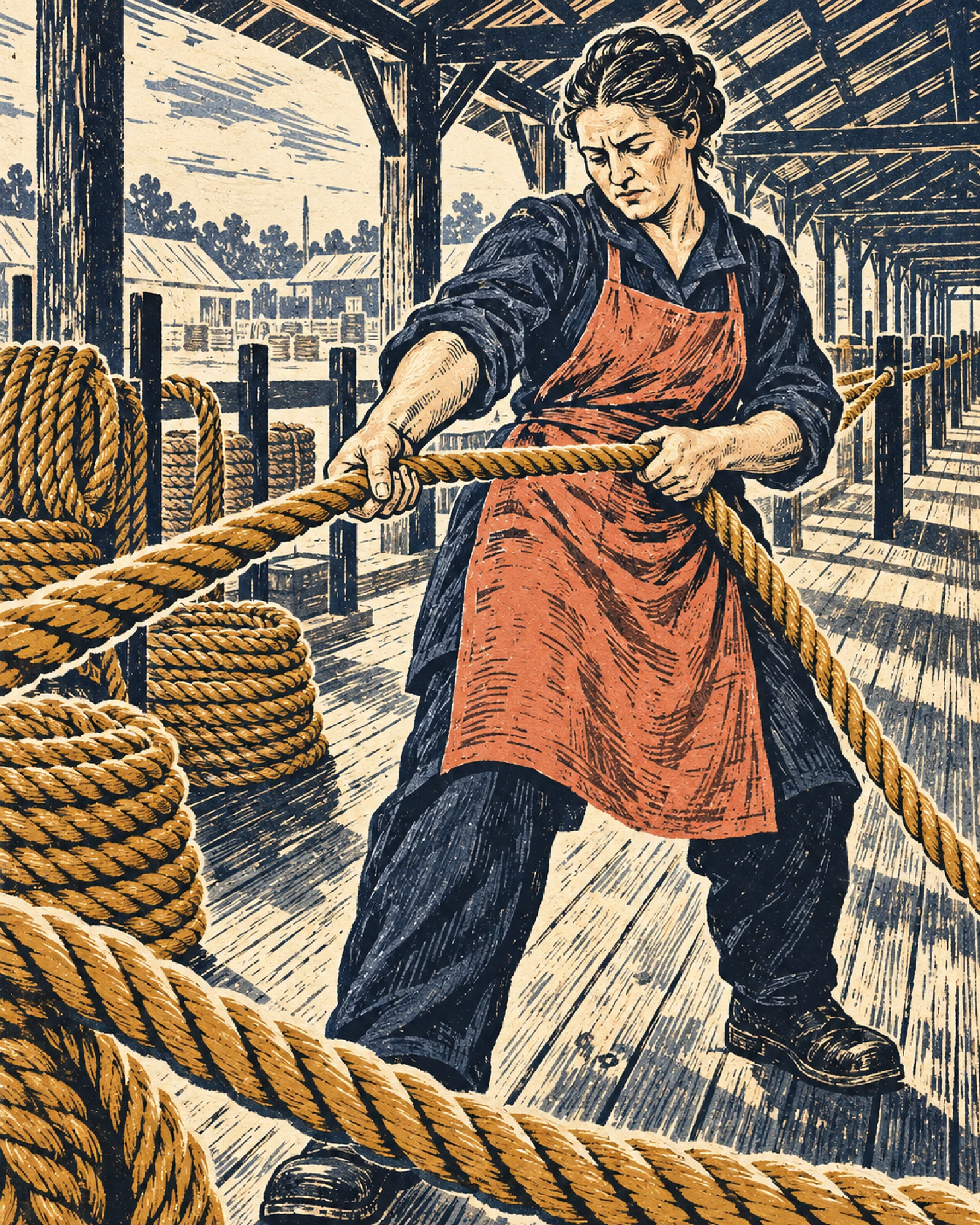
Rope Maker Drawing a Length
An original brand illustration for a rope workshop. A maker draws rope through a layered ropewalk, with sweeping loops and rhythmic linocut cuts extending the movement of her hands.
Remix this referenceRope Maker Drawing a Length
- Form language
- Reduce forms to bold interlocking masses with selective internal cuts; let smaller details vary within the same robust abstraction.
- Contour
- Use weighty, slightly chipped silhouette edges and occasional tapered incisions instead of a uniform enclosing outline.
- Mark-making
- Carve rhythmic gouge strokes in changing lengths and clustered arcs; leave irregular pauses that reveal the cutter's hand.
- Surface rendering
- Build tone through alternating ink masses and carved reserves, retaining uneven ink bite and occasional small registration offsets.
Priority
Make the bold linocut medium unmistakable through carved rhythmic marks and substantial printed ink.
What to avoid & what to check
Exact prompt for this example
MODULE OWNERSHIP
subject: Subject count, type, stable proportions and landmarks, resting face geometry, hair shape, physical materials, garment construction and permanent marks. No emotion, movement, color assignment or rendering recipe.
expression: Facial soft-tissue displacement and pupil direction, muscle coordination, regional intensity, asymmetry and onset/peak/release. No head/body pose, stable appearance, skin color or rendering.
gesture: Head/neck/body/limb orientation, joint movement, support, contact and pose-caused occlusion using existing anatomy. No eye/pupil movement, emotion, identity, props inventory or camera.
props: Prop count, type, construction, physical material and scale relative to the subject. Holding/contact belongs to gesture, position to composition, color to palette.
scene: Environment elements, terrain, backdrop/floor presence and structural detail. No canvas positions, camera, lighting, assigned colors or render texture.
camera: Projection, focal-length impression, camera elevation/yaw/roll, viewing distance and crop. No actor pose, world placement, lighting or canvas aspect ratio.
composition: Normalized 0-100% canvas positions, scale in frame, depth/overlap, focal hierarchy and margins. No joint pose, camera projection, rendering, subject/prop inventory or emotion.
palette: Color anchors, hue/saturation/value ranges, colors assigned to parts and approximate color coverage. No illumination direction, shading algorithm, physical material or layout.
lighting: Light-source direction/softness/intensity, ambient illumination, physical shadow direction/length and highlight position. Absence of directional illumination is allowed. No shading technique, palette or material changes.
style: Reusable form abstraction, contour weight/taper/edge quality, medium and mark scale/density/direction, surface rendering and tonal transition technique. No fixed subject proportions, anatomy, identity, expression, pose, palette, light-source direction, camera or layout.
output: Image count, aspect ratio, size, file/alpha requirements and global lettering/logo/watermark restrictions. No background scenery, crop, style, identity or pose.

SUBJECT
inventory: One original adult woman, actor A, a rope maker wearing a work jacket, waist apron, trousers and sturdy shoes.
geometry: A solid adult build with broad hands, a long oval face, a broad nose bridge and a compact swept-back hair shape.
resting-face: At rest, the brows are nearly straight, the upper lids gently hooded and the mouth broad with a fuller lower lip.
appearance: Heavy woven garments have a plain collar and generous sleeves; the apron is coarse canvas. Small wear marks may vary.

PRIORITY


AVOID


CHECK


EXPRESSION — ACTOR A
brows: Draw the inner brows slightly down and together, with one brow marginally lower.
lids: Narrow the upper lids slightly and firm the lower lids without closing the eyes.
cheeks: Keep the cheeks mostly relaxed, with slight compression beside the mouth.
nose: Keep the nose unwrinkled; allow a small widening of the nostrils.
mouth: Press the lips lightly together, with a small uneven pull at the corners.
jaw: Keep the jaw closed with restrained tension rather than a hard clench.
gaze: Direct both pupils down toward the rope passing between her hands.
coordination: Let brow and lid tension lead; keep the mouth tension quieter and slightly asymmetric.
timing: Capture the peak of sustained effort, with the eyes open and the lips settled.

PRIORITY


AVOID


CHECK


GESTURE
head: Incline the head toward the working hands while keeping the neck continuous with the torso.
torso: Lean the torso back against the pull, with a slight twist and staggered feet providing support.
limbs: Extend one arm along the rope and draw the other elbow toward the waist; keep both knees softly bent.
contact: Both hands grip the same rope at separated points; fingers naturally obscure the cord within each grip.

PRIORITY


AVOID


CHECK


PROPS
inventory: One continuous working rope and several spare rope skeins; no additional handheld tools.
construction: The hemp rope is thick enough for a full-hand grip, with visible twisted strands and flexible open loops.

PRIORITY


AVOID


CHECK


SCENE
inventory: An open-sided ropewalk with timber posts, roof beams, peg rails, a worn plank floor and an opening to a working yard.
structure: Repeated structural bays establish a long workshop; simple braces and a low boundary wall keep its construction legible.

PRIORITY


AVOID


CHECK


CAMERA
projection: Use restrained perspective with a moderately wide lens impression, preserving readable hands and facial features.
viewpoint: View from chest height with a gentle oblique yaw down the workshop; keep the camera level.
crop: Show the entire maker and substantial workshop depth; allow the nearest rope loop to continue beyond the crop.

PRIORITY


AVOID


CHECK


COMPOSITION
placement: Place A near 62% across the canvas, occupying most of its height; make the separated hands the primary focus.
depth: A foreground rope sweep overlaps the maker's lower silhouette; spare skeins and structural bays form successive layers.
spacing: Keep a generous opening around the hands and face, balancing the dense lower loops with a quieter upper-left passage.

PRIORITY


AVOID


CHECK


PALETTE
colors: Use ink navy, ochre, muted coral and warm paper cream, with strong value separation and restrained saturation.
assignment: Assign navy to jacket and deep architecture, ochre to rope, coral to apron, and cream to skin and open surroundings.
balance: Navy and cream dominate; ochre threads through the image, while coral remains a compact accent.

PRIORITY


AVOID


CHECK


LIGHTING
sources: Broad, moderately strong daylight enters from the upper left, supported by gentle ambient illumination.
shadows: Broad shadows fall to the lower right, with softer edges farther from the maker and posts.
highlights: Light catches the upper-left sides of the hands, rope strands and shoulder.

PRIORITY


AVOID


CHECK


STYLE GUIDE
form-language: Reduce forms to bold interlocking masses with selective internal cuts; let smaller details vary within the same robust abstraction.
contour: Use weighty, slightly chipped silhouette edges and occasional tapered incisions instead of a uniform enclosing outline.
mark-making: Carve rhythmic gouge strokes in changing lengths and clustered arcs; leave irregular pauses that reveal the cutter's hand.
surface-rendering: Build tone through alternating ink masses and carved reserves, retaining uneven ink bite and occasional small registration offsets.

PRIORITY
Make the bold linocut medium unmistakable through carved rhythmic marks and substantial printed ink.

AVOID


CHECK


OUTPUT
format: One finished image, portrait 4:5, 1600 × 2000 pixels, opaque PNG.
restrictions: Deliver one finished image, portrait 4:5, 1600 × 2000 pixels, opaque PNG; no lettering, logos or watermarks.

PRIORITY


AVOID


CHECK


FINAL INTEGRATION
expression + gesture: Expression and gesture should read as one continuous working moment.
Model information comes from image provenance. The same prompt may produce a different result.