Text to imageCharacterStyle guide
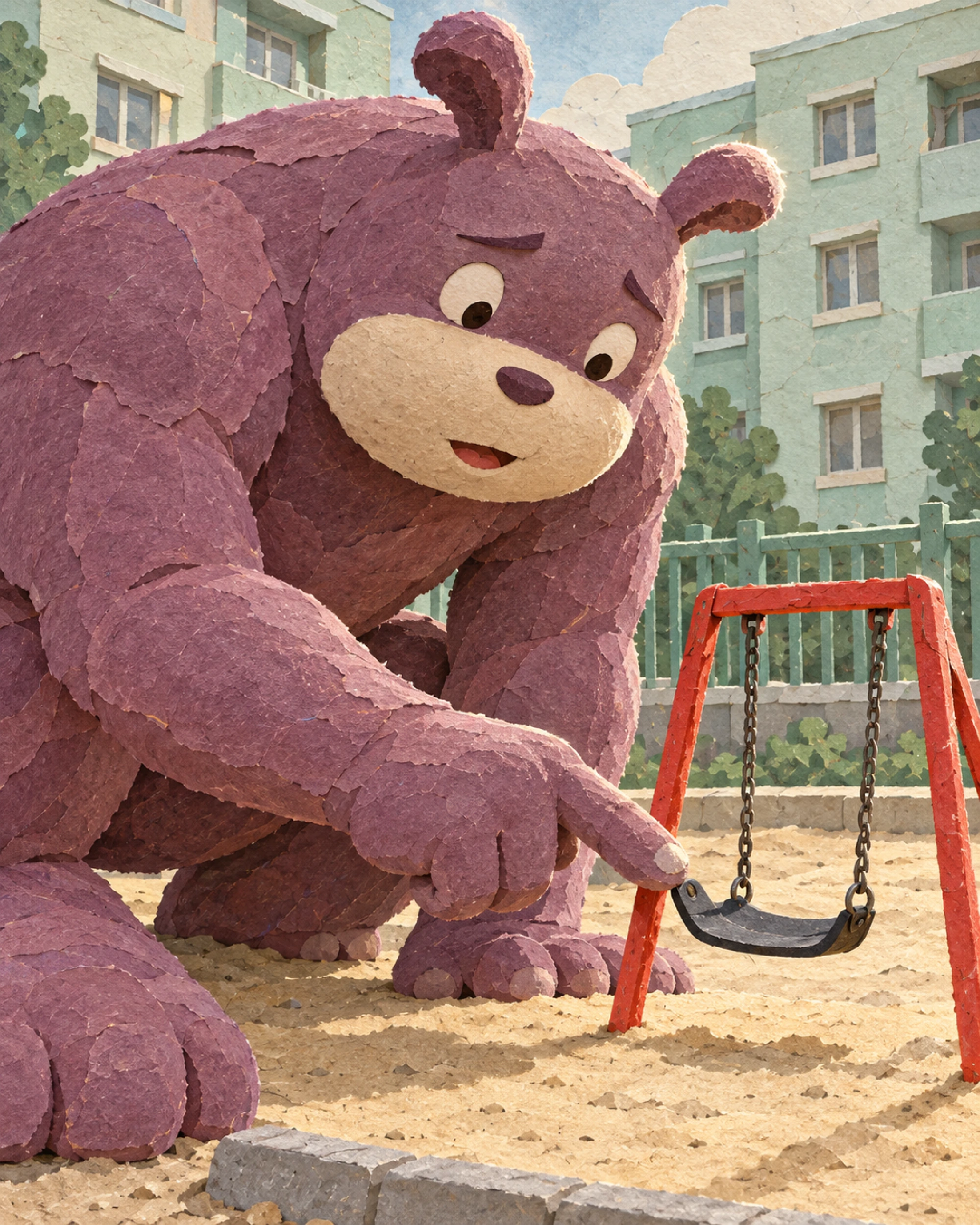
A Giant Creature Pushes a Little Swing
A giant creature lowers itself into a playground and nudges an empty swing with one finger. Layered cut paper and lifted edges make its enormous scale and careful curiosity feel playful.
Remix this referenceA Giant Creature Pushes a Little Swing
- Form language
- Build forms from generous cut silhouettes and nested inset pieces; allow slight mismatches within a coherent rounded language.
- Contour
- Use scissor-cut edges with occasional angular bites and torn interruptions; avoid uniform outline strokes.
- Mark-making
- Add sparse wax-pencil strokes and rubbed patches to selected paper pieces, varying pressure and leaving broad areas untouched.
- Surface rendering
- Retain tactile paper fibers, lifted edges and layered thickness; use separate tonal cutouts instead of smoothly modeled volume.
Priority
Layered cut-paper collage must show tangible overlaps and handmade edge variation.
What to avoid & what to check
Exact prompt for this example
MODULE OWNERSHIP
subject: Subject count, type, stable proportions and landmarks, resting face geometry, hair shape, physical materials, garment construction and permanent marks. No emotion, movement, color assignment or rendering recipe.
expression: Facial soft-tissue displacement and pupil direction, muscle coordination, regional intensity, asymmetry and onset/peak/release. No head/body pose, stable appearance, skin color or rendering.
gesture: Head/neck/body/limb orientation, joint movement, support, contact and pose-caused occlusion using existing anatomy. No eye/pupil movement, emotion, identity, props inventory or camera.
props: Prop count, type, construction, physical material and scale relative to the subject. Holding/contact belongs to gesture, position to composition, color to palette.
scene: Environment elements, terrain, backdrop/floor presence and structural detail. No canvas positions, camera, lighting, assigned colors or render texture.
camera: Projection, focal-length impression, camera elevation/yaw/roll, viewing distance and crop. No actor pose, world placement, lighting or canvas aspect ratio.
composition: Normalized 0-100% canvas positions, scale in frame, depth/overlap, focal hierarchy and margins. No joint pose, camera projection, rendering, subject/prop inventory or emotion.
palette: Color anchors, hue/saturation/value ranges, colors assigned to parts and approximate color coverage. No illumination direction, shading algorithm, physical material or layout.
lighting: Light-source direction/softness/intensity, ambient illumination, physical shadow direction/length and highlight position. Absence of directional illumination is allowed. No shading technique, palette or material changes.
style: Reusable form abstraction, contour weight/taper/edge quality, medium and mark scale/density/direction, surface rendering and tonal transition technique. No fixed subject proportions, anatomy, identity, expression, pose, palette, light-source direction, camera or layout.
output: Image count, aspect ratio, size, file/alpha requirements and global lettering/logo/watermark restrictions. No background scenery, crop, style, identity or pose.

SUBJECT
inventory: One original giant creature, actor A; no other figures.
geometry: A broad compact torso joins long arms, large rounded feet and two short tube-shaped ears.
resting-face: Small oval eyes sit above a wide rounded muzzle, a button nose and a short horizontal mouth.
appearance: Supple bare hide has shallow creases at the joints; there is no hair, clothing or permanent marking.

PRIORITY


AVOID


CHECK


EXPRESSION — ACTOR A
brows: Raise the inner brows slightly, one higher than the other.
lids: Open the upper lids attentively; keep lower lids relaxed.
cheeks: Keep the cheeks loose with only a faint upward lift.
nose: Leave the nose relaxed without wrinkling or nostril flare.
mouth: Part the lips slightly, with one corner barely raised.
jaw: Release the jaw just enough to support the small lip opening.
gaze: Direct both pupils downward toward the swing seat.
coordination: Let alert eyes lead while the lower face remains quiet.
timing: Hold the apex of curiosity briefly before the brows and lips relax.

PRIORITY


AVOID


CHECK


GESTURE
head: Lower the head toward the swing with a slight sideways inclination.
torso: Crouch low with the torso leaning forward and the hips settled near the heels.
limbs: Brace one arm on the ground; extend the other index finger while its remaining fingers curl loosely.
contact: The supporting palm bears weight as the extended fingertip nudges the back edge of the swing seat.

PRIORITY


AVOID


CHECK


PROPS
inventory: One complete playground swing, its seat small enough to fit across A's fingertip.
construction: A tubular metal frame carries a rubber sling seat on two chains.

PRIORITY


AVOID


CHECK


SCENE
inventory: A neighborhood playground with a sand bed, rounded curb, low fence and neighboring apartment walls.
structure: The curb encloses the sand; repeating windows and a modest fence establish an ordinary residential setting.

PRIORITY


AVOID


CHECK


CAMERA
projection: Use gently compressed perspective with a short-telephoto impression.
viewpoint: View from near the creature's chest height, looking slightly downward from a three-quarter angle.
crop: Show the face, supporting hand and complete swing; let the nearest foot extend beyond the frame.

PRIORITY


AVOID


CHECK


COMPOSITION
placement: A fills the left and upper field; the small swing occupies the lower right beneath the face.
depth: The near foot overlaps the sand border; the reaching hand overlaps the swing, with buildings set well behind.
spacing: Lead from the face to the fingertip and seat; preserve a clear pocket around the tiny frame.

PRIORITY


AVOID


CHECK


PALETTE
colors: Anchor the image in dusty plum, pale mint, sand cream and a sharp vermilion accent.
assignment: A is dusty plum; the swing frame is vermilion, the residential setting mint and the ground cream.
balance: The large muted body dominates color coverage; the small saturated swing punctuates the pale surroundings.

PRIORITY


AVOID


CHECK


LIGHTING
sources: A broad soft source illuminates from upper right, supported by gentle ambient fill.
shadows: The creature casts a broad soft shadow toward the lower left; close overlaps retain narrow contact shadows.
highlights: Upper-right planes receive quiet highlights, including the ear rims and extended fingertip.

PRIORITY


AVOID


CHECK


STYLE GUIDE
form-language: Build forms from generous cut silhouettes and nested inset pieces; allow slight mismatches within a coherent rounded language.
contour: Use scissor-cut edges with occasional angular bites and torn interruptions; avoid uniform outline strokes.
mark-making: Add sparse wax-pencil strokes and rubbed patches to selected paper pieces, varying pressure and leaving broad areas untouched.
surface-rendering: Retain tactile paper fibers, lifted edges and layered thickness; use separate tonal cutouts instead of smoothly modeled volume.

PRIORITY
Layered cut-paper collage must show tangible overlaps and handmade edge variation.

AVOID


CHECK


OUTPUT
format: One finished image, portrait 4:5, 2000 × 2500 pixels, opaque PNG.
restrictions: No lettering, logos or watermarks.

PRIORITY


AVOID


CHECK
Model information comes from image provenance. The same prompt may produce a different result.