Text to imageArt stylesStyle guide
Rain-Torn Banana Leaves
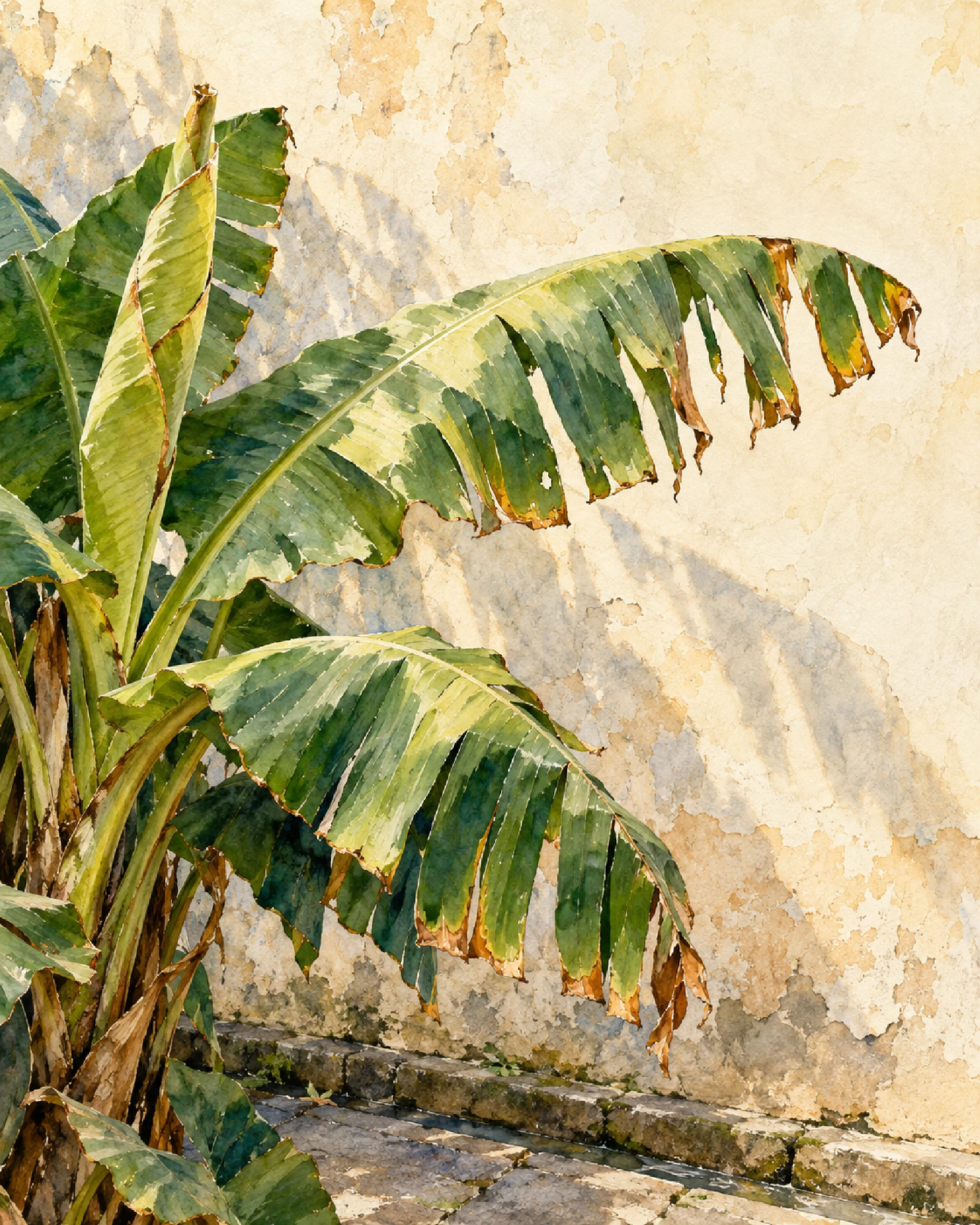
Storm-torn banana leaves cross an expansive courtyard wall, their wet forms emerging through watercolor blooms and broken edges.
Remix this referenceRain-Torn Banana Leaves
- Form language
- Reduce forms to broad tapered masses interrupted by narrow slits; let small irregularities vary within this bold vocabulary.
- Contour
- Alternate crisp brush boundaries with dissolved edges and dry skips; use occasional tapered strokes instead of continuous outlines.
- Mark-making
- Lay generous wet watercolor strokes, then interrupt them with a few directional dry-brush marks and naturally uneven pigment blooms.
- Surface rendering
- Build translucent overlapping washes with backruns, pooled rims and exposed paper; tonal changes breathe rather than resolve into smooth modeling.
Priority
Make watercolor blooms and broken edges integral to the visible forms.
What to avoid & what to check
Exact prompt for this example
MODULE OWNERSHIP
subject: Subject count, type, stable proportions and landmarks, resting face geometry, hair shape, physical materials, garment construction and permanent marks. No emotion, movement, color assignment or rendering recipe.
expression: Facial soft-tissue displacement and pupil direction, muscle coordination, regional intensity, asymmetry and onset/peak/release. No head/body pose, stable appearance, skin color or rendering.
gesture: Head/neck/body/limb orientation, joint movement, support, contact and pose-caused occlusion using existing anatomy. No eye/pupil movement, emotion, identity, props inventory or camera.
props: Prop count, type, construction, physical material and scale relative to the subject. Holding/contact belongs to gesture, position to composition, color to palette.
scene: Environment elements, terrain, backdrop/floor presence and structural detail. No canvas positions, camera, lighting, assigned colors or render texture.
camera: Projection, focal-length impression, camera elevation/yaw/roll, viewing distance and crop. No actor pose, world placement, lighting or canvas aspect ratio.
composition: Normalized 0-100% canvas positions, scale in frame, depth/overlap, focal hierarchy and margins. No joint pose, camera projection, rendering, subject/prop inventory or emotion.
palette: Color anchors, hue/saturation/value ranges, colors assigned to parts and approximate color coverage. No illumination direction, shading algorithm, physical material or layout.
lighting: Light-source direction/softness/intensity, ambient illumination, physical shadow direction/length and highlight position. Absence of directional illumination is allowed. No shading technique, palette or material changes.
style: Reusable form abstraction, contour weight/taper/edge quality, medium and mark scale/density/direction, surface rendering and tonal transition technique. No fixed subject proportions, anatomy, identity, expression, pose, palette, light-source direction, camera or layout.
output: Image count, aspect ratio, size, file/alpha requirements and global lettering/logo/watermark restrictions. No background scenery, crop, style, identity or pose.

SUBJECT
inventory: One banana plant section with two mature leaves and one furled new leaf.
geometry: Broad blades extend from stout midribs; irregular splits divide their margins into hanging strips.
resting-face: No faces are present.
appearance: Waxy leaf tissue, fibrous stalks and ragged tears; minor tears and vein details may vary naturally.

PRIORITY


AVOID


CHECK


PROPS
inventory: No separate props.
construction: No prop construction applies.

PRIORITY


AVOID


CHECK


SCENE
inventory: A courtyard plaster wall and a narrow strip of paving with a rainwater groove.
structure: The largely uninterrupted wall meets the paving at a shallow recessed footing.

PRIORITY


AVOID


CHECK


CAMERA
projection: A near-orthographic impression with little depth convergence.
viewpoint: Face the wall almost squarely from leaf height, with a slight downward view.
crop: Crop into the plant at the left and bottom; retain the mature leaf tips.

PRIORITY


AVOID


CHECK


COMPOSITION
placement: Root the visual mass near the lower-left corner; the longest leaf reaches toward 75% canvas width.
depth: Overlapping leaves lead the hierarchy; the wall recedes and the paving remains subordinate.
spacing: Leave the upper-right quadrant spacious, with irregular openings between the torn leaf strips.

PRIORITY


AVOID


CHECK


PALETTE
colors: Warm ivory, sap green, deep indigo and restrained burnt sienna.
assignment: Ivory belongs to the wall; greens to the leaves, indigo to their deepest recesses, sienna to damaged edges.
balance: A broad pale field supports concentrated greens; dark and rusty accents remain sparse.

PRIORITY


AVOID


CHECK


LIGHTING
sources: Soft post-storm daylight arrives broadly from the upper left, with generous ambient fill.
shadows: Faint leaf shadows fall down and right across the wall with diffuse boundaries.
highlights: Broad, subdued highlights follow the upper-facing leaf ridges.

PRIORITY


AVOID


CHECK


STYLE GUIDE
form-language: Reduce forms to broad tapered masses interrupted by narrow slits; let small irregularities vary within this bold vocabulary.
contour: Alternate crisp brush boundaries with dissolved edges and dry skips; use occasional tapered strokes instead of continuous outlines.
mark-making: Lay generous wet watercolor strokes, then interrupt them with a few directional dry-brush marks and naturally uneven pigment blooms.
surface-rendering: Build translucent overlapping washes with backruns, pooled rims and exposed paper; tonal changes breathe rather than resolve into smooth modeling.

PRIORITY
Make watercolor blooms and broken edges integral to the visible forms.

AVOID


CHECK


OUTPUT
format: One finished image, 4:5 aspect ratio, 1600 × 2000 pixels, opaque PNG.
restrictions: No lettering, logos or watermarks.

PRIORITY


AVOID


CHECK
Model information comes from image provenance. The same prompt may produce a different result.