Text to imageIllustrationStyle guide
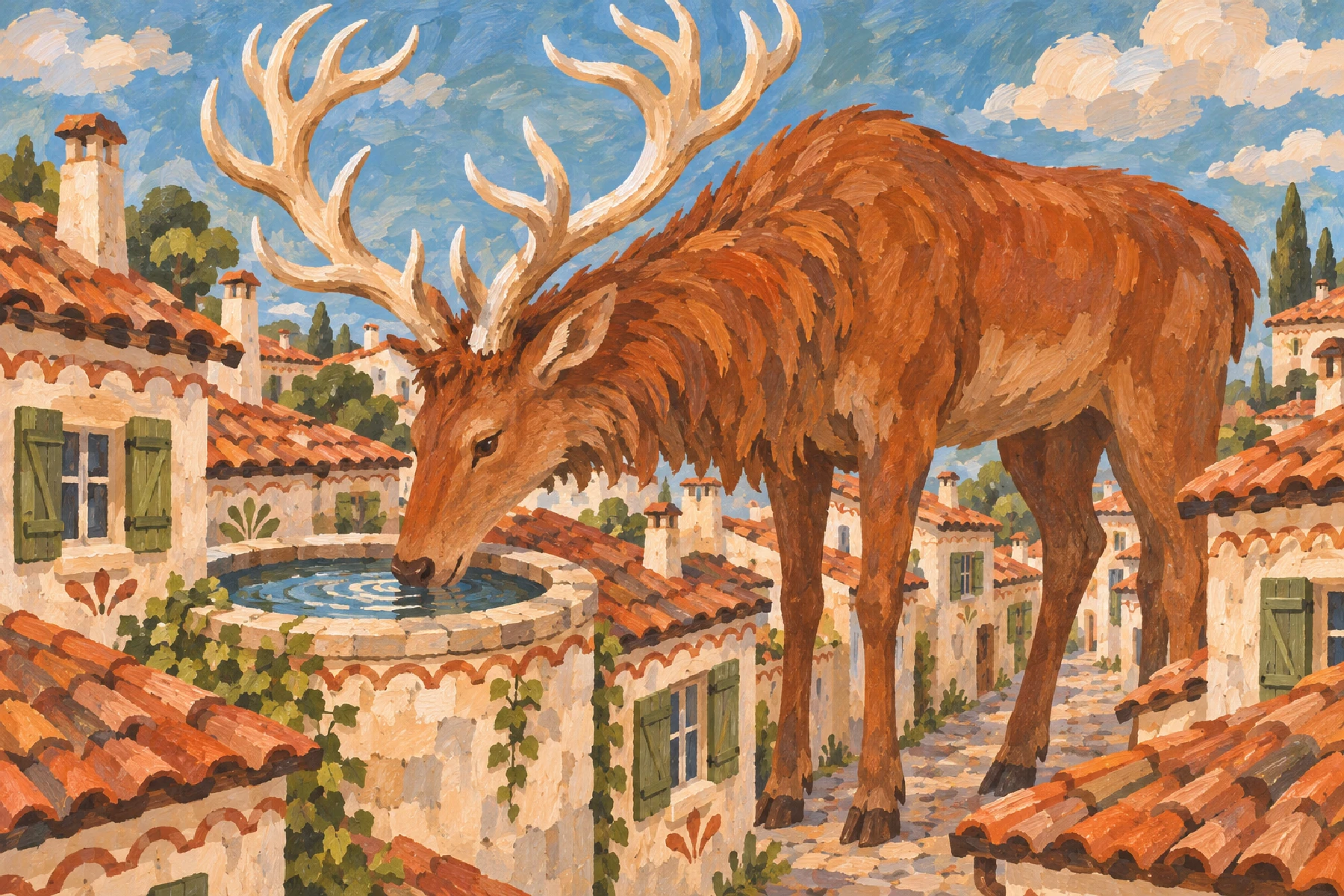
A Deer Drinking Above the Rooftops
An enormous deer standing in a residential lane drinks from a rooftop cistern. Uneven folk-painting brushwork and decorative roof patterns make its improbable neighborhood visit feel quietly familiar.
Remix this referenceA Deer Drinking Above the Rooftops
- Form language
- Simplify forms into buoyant, slightly irregular shapes; decorative scallops and repeated wedges create a handmade folk vocabulary.
- Contour
- Use uneven brush contours that thicken, taper and occasionally disappear into adjoining paint; retain small edge wobbles.
- Mark-making
- Opaque gouache leaves blunt dabs, dragged bristle streaks and loose ornamental repeats; their rhythm varies naturally.
- Surface rendering
- Build matte surfaces with imperfect overlapping patches and a few broad tonal steps; occasional thin passages reveal the paper.
Priority
Keep the lively decorative simplification of naive folk painting visible throughout.
What to avoid & what to check
Exact prompt for this example
MODULE OWNERSHIP
subject: Subject count, type, stable proportions and landmarks, resting face geometry, hair shape, physical materials, garment construction and permanent marks. No emotion, movement, color assignment or rendering recipe.
expression: Facial soft-tissue displacement and pupil direction, muscle coordination, regional intensity, asymmetry and onset/peak/release. No head/body pose, stable appearance, skin color or rendering.
gesture: Head/neck/body/limb orientation, joint movement, support, contact and pose-caused occlusion using existing anatomy. No eye/pupil movement, emotion, identity, props inventory or camera.
props: Prop count, type, construction, physical material and scale relative to the subject. Holding/contact belongs to gesture, position to composition, color to palette.
scene: Environment elements, terrain, backdrop/floor presence and structural detail. No canvas positions, camera, lighting, assigned colors or render texture.
camera: Projection, focal-length impression, camera elevation/yaw/roll, viewing distance and crop. No actor pose, world placement, lighting or canvas aspect ratio.
composition: Normalized 0-100% canvas positions, scale in frame, depth/overlap, focal hierarchy and margins. No joint pose, camera projection, rendering, subject/prop inventory or emotion.
palette: Color anchors, hue/saturation/value ranges, colors assigned to parts and approximate color coverage. No illumination direction, shading algorithm, physical material or layout.
lighting: Light-source direction/softness/intensity, ambient illumination, physical shadow direction/length and highlight position. Absence of directional illumination is allowed. No shading technique, palette or material changes.
style: Reusable form abstraction, contour weight/taper/edge quality, medium and mark scale/density/direction, surface rendering and tonal transition technique. No fixed subject proportions, anatomy, identity, expression, pose, palette, light-source direction, camera or layout.
output: Image count, aspect ratio, size, file/alpha requirements and global lettering/logo/watermark restrictions. No background scenery, crop, style, identity or pose.

SUBJECT
inventory: One adult stag, actor A; no other people or animals.
geometry: An enormous stag taller than ordinary houses, with long legs, a narrow chest, substantial neck, long muzzle and two branching antlers.
resting-face: No distinct eyebrows; almond-shaped eyes sit above a tapered muzzle, with a broad nose and naturally straight mouth line.
appearance: Short body fur becomes coarse along the neck; antlers are exposed bone, with no clothing or accessories.

PRIORITY


AVOID


CHECK


EXPRESSION — ACTOR A
brows: The brow area stays relaxed.
lids: The visible upper lid rests slightly low without squeezing.
cheeks: Cheek tissue rests without lifting or tightening.
nose: Nostrils retain their resting opening without a flare.
mouth: Lips make a small, soft opening without pulling the corners.
jaw: The jaw releases slightly, without a broad gape.
gaze: The visible pupil points down toward the water.
coordination: Relaxed lids and the small mouth opening form one restrained drinking expression.
timing: Hold the apex of a quiet drinking pause.

PRIORITY


AVOID


CHECK


GESTURE
head: A bends its neck down over the roof edge, with its muzzle lowered into the open cistern.
torso: The torso stays upright with a slight forward inclination from the shoulders.
limbs: The visible legs stand comfortably apart; the hooves bear weight on the lane.
contact: The lips meet the water, and the antlers clear the rim.

PRIORITY


AVOID


CHECK


PROPS
inventory: No separate props.
construction: No prop construction applies.

PRIORITY


AVOID


CHECK


SCENE
inventory: A narrow residential lane, closely spaced houses, tiled roofs, chimneys and one open rooftop cistern.
structure: Low houses have shuttered windows and uneven rooflines; the masonry cistern has a broad rim and visible water.

PRIORITY


AVOID


CHECK


CAMERA
projection: Use shallow perspective with a mild long-lens impression.
viewpoint: Look obliquely across the neighborhood from slightly above roof height, with no camera roll.
crop: A wide neighborhood view includes the complete antlers and torso; nearby buildings continue beyond the edges.

PRIORITY


AVOID


CHECK


COMPOSITION
placement: The stag fills the right two-thirds; the muzzle-and-cistern area left of center is the primary focus.
depth: Overlapping roofs establish depth; foreground roofs conceal parts of the legs, with the lane visible between buildings.
spacing: Leave an open sky interval around the antlers and a small clear water area beneath the muzzle.

PRIORITY


AVOID


CHECK


PALETTE
colors: Use burnt sienna, muted petrol blue, warm cream and moss green, with restrained near-black accents.
assignment: Sienna belongs to the stag and selected roofs; blue to sky and water, cream to walls, green to shutters.
balance: Warm middle values dominate; pale architecture and quieter cool areas keep the scene airy.

PRIORITY


AVOID


CHECK


LIGHTING
sources: Broad, soft daylight enters from the upper left, with generous ambient illumination.
shadows: Short, soft shadows fall toward the lower right beneath roof eaves and the cistern rim.
highlights: Gentle highlights touch the upper-left antler edges and the water beside the muzzle.

PRIORITY


AVOID


CHECK


STYLE GUIDE
form-language: Simplify forms into buoyant, slightly irregular shapes; decorative scallops and repeated wedges create a handmade folk vocabulary.
contour: Use uneven brush contours that thicken, taper and occasionally disappear into adjoining paint; retain small edge wobbles.
mark-making: Opaque gouache leaves blunt dabs, dragged bristle streaks and loose ornamental repeats; their rhythm varies naturally.
surface-rendering: Build matte surfaces with imperfect overlapping patches and a few broad tonal steps; occasional thin passages reveal the paper.

PRIORITY
Keep the lively decorative simplification of naive folk painting visible throughout.

AVOID


CHECK


OUTPUT
format: One finished image, landscape 3:2, 1800 × 1200 pixels, opaque PNG.
restrictions: No lettering, logos or watermarks.

PRIORITY


AVOID


CHECK


FINAL INTEGRATION
subject + scene + composition: Recognizable architecture makes the scale surprise legible without explanatory symbols.
expression + gesture + style: Keep the drinking action readable while allowing the painted shapes and marks to remain freely irregular.
Model information comes from image provenance. The same prompt may produce a different result.