Text to imageArt stylesStyle guide
A Mulberry Tree Through a Table Tennis Table
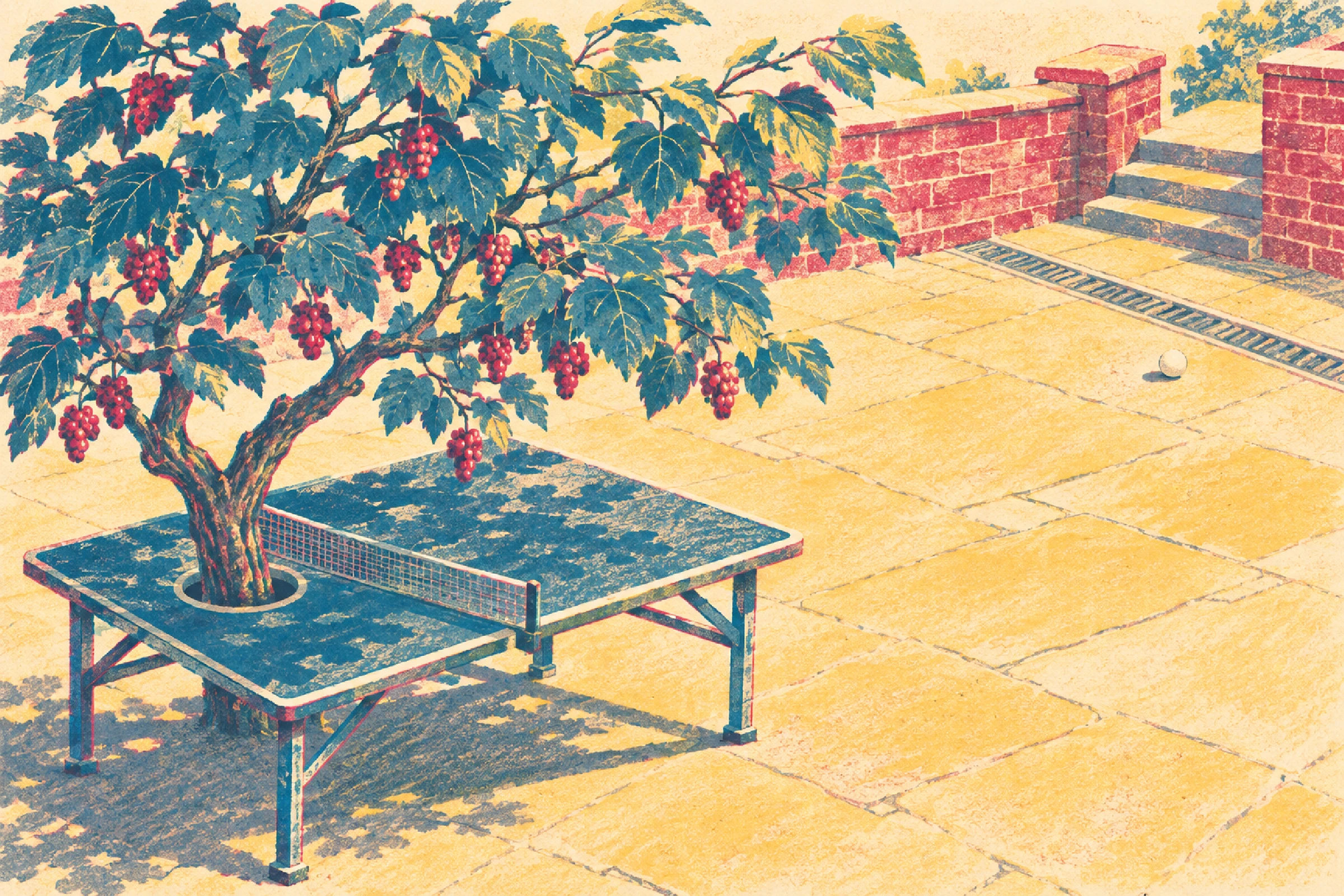
A mulberry tree grows through an opening in a table tennis table in a quiet courtyard. An off-center arrangement and spacious intervals come alive through grainy riso impressions and playful registration offsets.
Remix this referenceA Mulberry Tree Through a Table Tennis Table
- Form language
- Translate complex forms into blunt cutout masses and irregular repeated fragments, retaining lively gaps rather than mechanical repetition.
- Contour
- Let printed shape edges carry most contours; occasional broad crayon lines break, wobble and taper instead of uniformly outlining forms.
- Mark-making
- Use coarse stencil grain, rubbed crayon strokes and imperfect ink transfer, with playful offsets between selected printing passes.
- Surface rendering
- Build tones through translucent overprints and uneven ink density; reserve bare paper for the lightest tone and let grain vary naturally within each printed mass.
Priority
Make the riso process visible through porous impressions, translucent overprints and selective registration slips.
What to avoid & what to check
Exact prompt for this example
MODULE OWNERSHIP
subject: Subject count, type, stable proportions and landmarks, resting face geometry, hair shape, physical materials, garment construction and permanent marks. No emotion, movement, color assignment or rendering recipe.
expression: Facial soft-tissue displacement and pupil direction, muscle coordination, regional intensity, asymmetry and onset/peak/release. No head/body pose, stable appearance, skin color or rendering.
gesture: Head/neck/body/limb orientation, joint movement, support, contact and pose-caused occlusion using existing anatomy. No eye/pupil movement, emotion, identity, props inventory or camera.
props: Prop count, type, construction, physical material and scale relative to the subject. Holding/contact belongs to gesture, position to composition, color to palette.
scene: Environment elements, terrain, backdrop/floor presence and structural detail. No canvas positions, camera, lighting, assigned colors or render texture.
camera: Projection, focal-length impression, camera elevation/yaw/roll, viewing distance and crop. No actor pose, world placement, lighting or canvas aspect ratio.
composition: Normalized 0-100% canvas positions, scale in frame, depth/overlap, focal hierarchy and margins. No joint pose, camera projection, rendering, subject/prop inventory or emotion.
palette: Color anchors, hue/saturation/value ranges, colors assigned to parts and approximate color coverage. No illumination direction, shading algorithm, physical material or layout.
lighting: Light-source direction/softness/intensity, ambient illumination, physical shadow direction/length and highlight position. Absence of directional illumination is allowed. No shading technique, palette or material changes.
style: Reusable form abstraction, contour weight/taper/edge quality, medium and mark scale/density/direction, surface rendering and tonal transition technique. No fixed subject proportions, anatomy, identity, expression, pose, palette, light-source direction, camera or layout.
output: Image count, aspect ratio, size, file/alpha requirements and global lettering/logo/watermark restrictions. No background scenery, crop, style, identity or pose.

SUBJECT
inventory: One mature mulberry tree; no focal facial or pose actors.
geometry: A short forked trunk supports an uneven spreading crown with broad, serrated leaves and hanging clusters of fruit.
resting-face: No face or facial landmarks apply.
appearance: Furrowed bark, thin branching twigs, flexible leaves and knobbly aggregate berries; local growth may vary naturally.

PRIORITY


AVOID


CHECK


PROPS
inventory: One full-size table tennis table with its net, and one regulation-size ball.
construction: The timber tabletop has a generous circular trunk opening, metal legs and a low mesh net; the ball is hollow plastic.

PRIORITY


AVOID


CHECK


SCENE
inventory: An empty paved courtyard enclosed by a low brick wall, with a shallow drainage channel and a short entry stair.
structure: Broad paving slabs meet the wall in an irregular joint; the drainage channel interrupts the paving beside the stair.

PRIORITY


AVOID


CHECK


CAMERA
projection: Gentle parallel projection with restrained depth compression.
viewpoint: Look obliquely down into the courtyard from above wall height, without camera roll.
crop: Show the whole tabletop and crown, with the courtyard continuing beyond the image edges.

PRIORITY


AVOID


CHECK


COMPOSITION
placement: Cluster the tree and table in the lower left; let the wall and stair create a quieter answer across the upper right.
depth: The trunk passes through the tabletop opening and overlaps the net; across open paving, the ball sits beside the distant drainage channel.
spacing: Tree and table form the primary group; preserve a broad interval of empty paving before the small ball and entry stair.

PRIORITY


AVOID


CHECK


PALETTE
colors: Butter yellow, petrol blue and raspberry red sit against warm cream.
assignment: Petrol blue defines the table and foliage; yellow belongs to paving, raspberry to fruit and wall, and cream to the ball.
balance: Cream and pale yellow occupy the broadest areas; blue gathers into larger masses and red appears in smaller interruptions.

PRIORITY


AVOID


CHECK


LIGHTING
sources: Broad afternoon sunlight enters from the upper right with soft ambient illumination.
shadows: Table and foliage cast connected, moderately long shadows toward the lower left, with softened outer edges.
highlights: Upper-right leaf surfaces and the exposed table edge receive the strongest light.

PRIORITY


AVOID


CHECK


STYLE GUIDE
form-language: Translate complex forms into blunt cutout masses and irregular repeated fragments, retaining lively gaps rather than mechanical repetition.
contour: Let printed shape edges carry most contours; occasional broad crayon lines break, wobble and taper instead of uniformly outlining forms.
mark-making: Use coarse stencil grain, rubbed crayon strokes and imperfect ink transfer, with playful offsets between selected printing passes.
surface-rendering: Build tones through translucent overprints and uneven ink density; reserve bare paper for the lightest tone and let grain vary naturally within each printed mass.

PRIORITY
Make the riso process visible through porous impressions, translucent overprints and selective registration slips.

AVOID


CHECK


OUTPUT
format: One landscape image, 3:2 aspect ratio, 2400 × 1600 pixels, opaque PNG.
restrictions: Deliver one landscape image at 3:2, 2400 × 1600 pixels, as an opaque PNG; no lettering, logos or watermarks.

PRIORITY


AVOID


CHECK


FINAL INTEGRATION
palette + style: Coordinate the cream anchor with the style's bare-paper reserves.
Model information comes from image provenance. The same prompt may produce a different result.