Text to imageArt stylesStyle guide
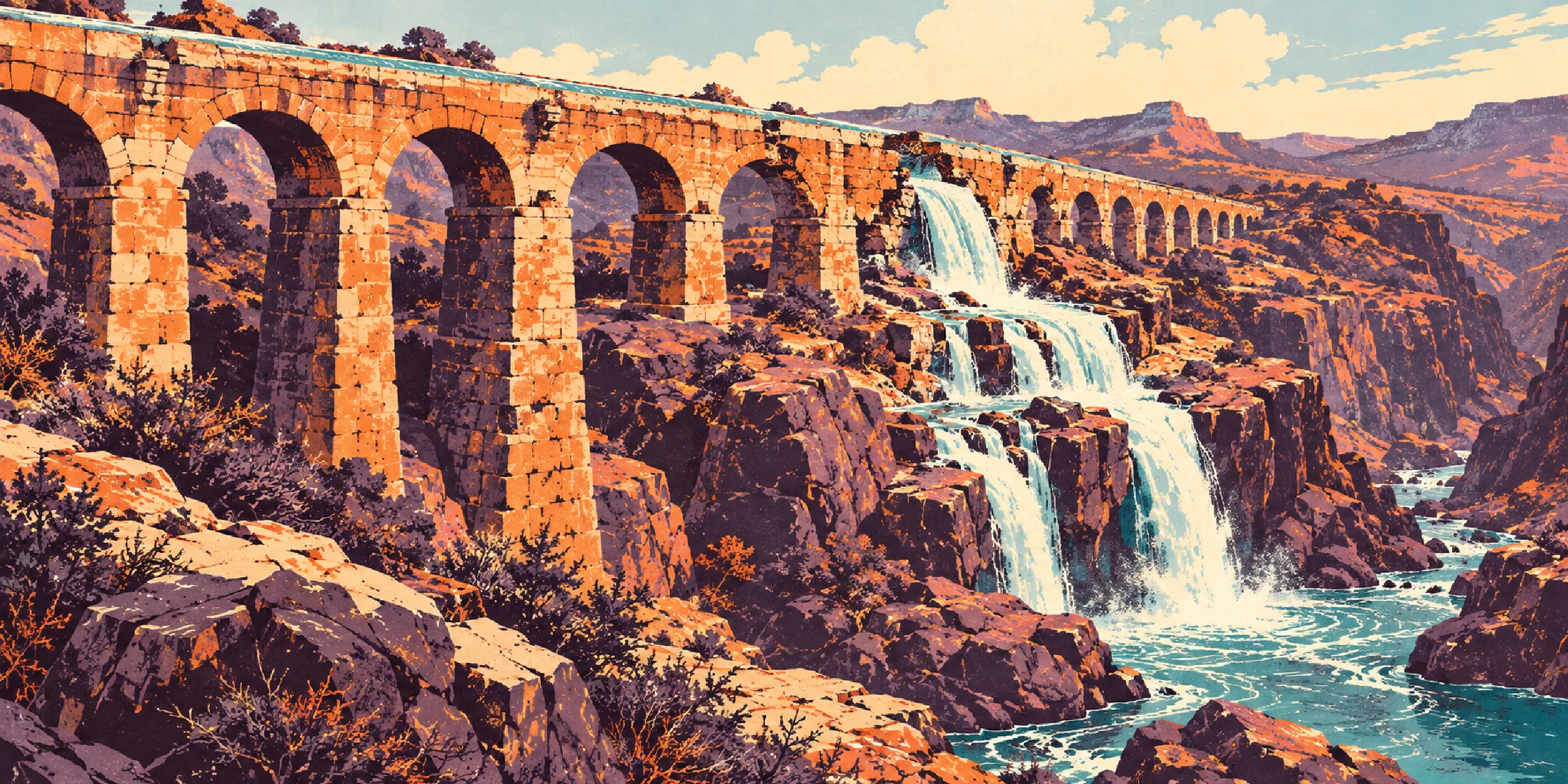
Water Falling from a Broken Aqueduct
Water pours from a breached aqueduct across a barren gorge. A panoramic screen print connects repeating arches and a branching cascade through decisive silhouettes and offset ink overlaps.
Remix this referenceWater Falling from a Broken Aqueduct
- Form language
- Reduce forms to interlocking slabs, open wedges, and branching ribbons; vary their cadence so repeated shapes never feel stamped.
- Contour
- Let adjacent ink masses define most edges; use occasional blunt contour fragments and slightly bitten stencil boundaries.
- Mark-making
- Use broad screen-pulled ink passages with sparse dragged streaks and irregular pinholes; allow marks to gather and disperse naturally.
- Surface rendering
- Build tone through opaque spot-ink layers and translucent overprints, with slight registration slips and broken-edged tonal steps.
Priority
The image must read as a graphic screen print driven by decisive shape rhythms.
What to avoid & what to check
Exact prompt for this example
MODULE OWNERSHIP
subject: Subject count, type, stable proportions and landmarks, resting face geometry, hair shape, physical materials, garment construction and permanent marks. No emotion, movement, color assignment or rendering recipe.
expression: Facial soft-tissue displacement and pupil direction, muscle coordination, regional intensity, asymmetry and onset/peak/release. No head/body pose, stable appearance, skin color or rendering.
gesture: Head/neck/body/limb orientation, joint movement, support, contact and pose-caused occlusion using existing anatomy. No eye/pupil movement, emotion, identity, props inventory or camera.
props: Prop count, type, construction, physical material and scale relative to the subject. Holding/contact belongs to gesture, position to composition, color to palette.
scene: Environment elements, terrain, backdrop/floor presence and structural detail. No canvas positions, camera, lighting, assigned colors or render texture.
camera: Projection, focal-length impression, camera elevation/yaw/roll, viewing distance and crop. No actor pose, world placement, lighting or canvas aspect ratio.
composition: Normalized 0-100% canvas positions, scale in frame, depth/overlap, focal hierarchy and margins. No joint pose, camera projection, rendering, subject/prop inventory or emotion.
palette: Color anchors, hue/saturation/value ranges, colors assigned to parts and approximate color coverage. No illumination direction, shading algorithm, physical material or layout.
lighting: Light-source direction/softness/intensity, ambient illumination, physical shadow direction/length and highlight position. Absence of directional illumination is allowed. No shading technique, palette or material changes.
style: Reusable form abstraction, contour weight/taper/edge quality, medium and mark scale/density/direction, surface rendering and tonal transition technique. No fixed subject proportions, anatomy, identity, expression, pose, palette, light-source direction, camera or layout.
output: Image count, aspect ratio, size, file/alpha requirements and global lettering/logo/watermark restrictions. No background scenery, crop, style, identity or pose.

SUBJECT
inventory: One abandoned masonry aqueduct; no people or animals.
geometry: Tall piers and unevenly spaced shallow arches support an open trough with a broad breach in its outer wall.
resting-face: No facial geometry applies.
appearance: Weathered cut-stone blocks have softened corners and occasional missing sections; individual block shapes may vary.

PRIORITY


AVOID


CHECK


PROPS
inventory: No separate props.
construction: No prop construction applies.

PRIORITY


AVOID


CHECK


SCENE
inventory: A rocky gorge, upstream stream, branching waterfall, plunge pool, sparse thorn scrub, and open sky.
structure: The stream feeds the aqueduct; water escapes its breach, splits over rock shelves, and joins the gorge river below.

PRIORITY


AVOID


CHECK


CAMERA
projection: Wide rectilinear perspective with a moderate wide-angle impression and restrained convergence.
viewpoint: Look obliquely across the gorge from slightly above the trough rim, with a level horizon.
crop: A distant environmental view includes the entire cascade; the aqueduct continues beyond one frame edge.

PRIORITY


AVOID


CHECK


COMPOSITION
placement: The arcade crosses the upper third; the breach near 65% width leads down to a pool in the lower-right quarter.
depth: A cropped foreground rock overlaps the lowest pier; receding arches connect the nearer cascade to the distant ravine.
spacing: Make the breach and cascade the focal pair, the arcade a secondary visual path, and the sky a generous open margin above.

PRIORITY


AVOID


CHECK


PALETTE
colors: Warm chalk, burnt orange, deep aubergine, and mineral turquoise form a compact, strongly separated palette.
assignment: Use orange for masonry, aubergine for rock and scrub, turquoise for water, and chalk for sky and water accents.
balance: Chalk and aubergine dominate broad areas; orange establishes the built structure and turquoise remains a narrow accent.

PRIORITY


AVOID


CHECK


LIGHTING
sources: Broad afternoon light comes from the upper left, with soft ambient fill throughout the gorge.
shadows: Piers cast long shadows toward the lower right; arch interiors retain deep shade.
highlights: Highlights catch upper-left stone edges and the exposed crests of falling water.

PRIORITY


AVOID


CHECK


STYLE GUIDE
form-language: Reduce forms to interlocking slabs, open wedges, and branching ribbons; vary their cadence so repeated shapes never feel stamped.
contour: Let adjacent ink masses define most edges; use occasional blunt contour fragments and slightly bitten stencil boundaries.
mark-making: Use broad screen-pulled ink passages with sparse dragged streaks and irregular pinholes; allow marks to gather and disperse naturally.
surface-rendering: Build tone through opaque spot-ink layers and translucent overprints, with slight registration slips and broken-edged tonal steps.

PRIORITY
The image must read as a graphic screen print driven by decisive shape rhythms.

AVOID


CHECK


OUTPUT
format: One finished panoramic image, 2:1 aspect ratio, 2400 × 1200 pixels, opaque PNG.
restrictions: No lettering, logos, signatures, or watermarks.

PRIORITY


AVOID


CHECK


FINAL INTEGRATION
scene + composition + style: Coordinate environmental continuity, visual hierarchy, and abstraction so the journey remains readable at thumbnail size.
Model information comes from image provenance. The same prompt may produce a different result.