Text to imageComicsStyle guide
Snail on the Trombone
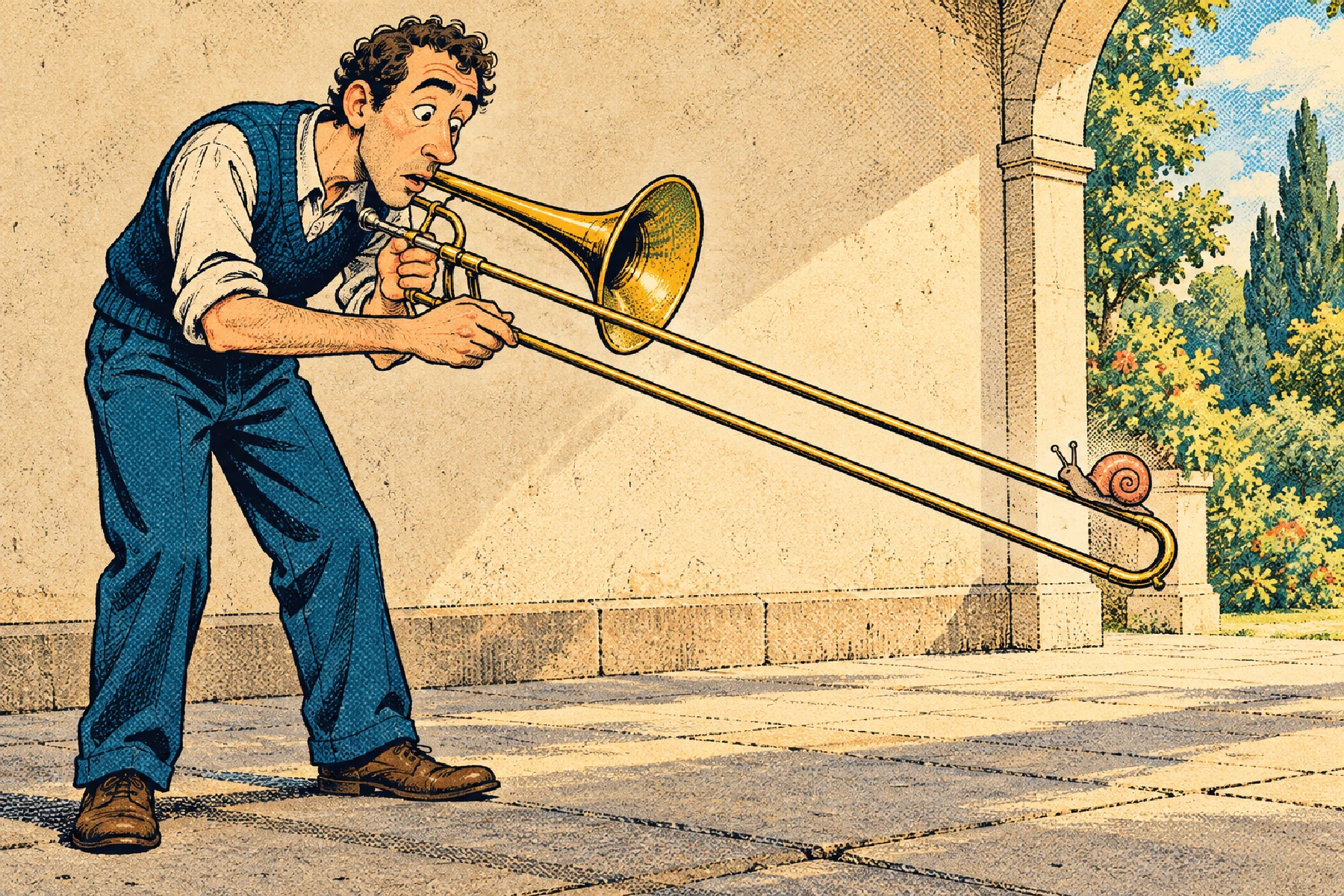
A retro comic illustration with muscular ink contours and coarse halftones. A musician bends toward a snail on the trombone slide, creating a small comic standoff across the long instrument and generous open space.
Remix this referenceSnail on the Trombone
- Form language
- Reduce forms to buoyant masses and crisp silhouette breaks, using selective angular accents; minor details may vary within this language.
- Contour
- Use thick brush-ink contours with tapered turns, occasional dry skips and finer interior lines that never close every shape.
- Mark-making
- Lay coarse round-dot screens in broad patches, interrupted by sparse flicked hatching; slight plate drift gives printed edges a lively fringe.
- Surface rendering
- Build tone through stepped screen densities and blunt ink pools; let uneven ink bite and exposed paper interrupt the fills naturally.
Priority
Rendering medium: retro halftone comic illustration in brush ink and process-color print.
What to avoid & what to check
Exact prompt for this example
MODULE OWNERSHIP
subject: Subject count, type, stable proportions and landmarks, resting face geometry, hair shape, physical materials, garment construction and permanent marks. No emotion, movement, color assignment or rendering recipe.
expression: Facial soft-tissue displacement and pupil direction, muscle coordination, regional intensity, asymmetry and onset/peak/release. No head/body pose, stable appearance, skin color or rendering.
gesture: Head/neck/body/limb orientation, joint movement, support, contact and pose-caused occlusion using existing anatomy. No eye/pupil movement, emotion, identity, props inventory or camera.
props: Prop count, type, construction, physical material and scale relative to the subject. Holding/contact belongs to gesture, position to composition, color to palette.
scene: Environment elements, terrain, backdrop/floor presence and structural detail. No canvas positions, camera, lighting, assigned colors or render texture.
camera: Projection, focal-length impression, camera elevation/yaw/roll, viewing distance and crop. No actor pose, world placement, lighting or canvas aspect ratio.
composition: Normalized 0-100% canvas positions, scale in frame, depth/overlap, focal hierarchy and margins. No joint pose, camera projection, rendering, subject/prop inventory or emotion.
palette: Color anchors, hue/saturation/value ranges, colors assigned to parts and approximate color coverage. No illumination direction, shading algorithm, physical material or layout.
lighting: Light-source direction/softness/intensity, ambient illumination, physical shadow direction/length and highlight position. Absence of directional illumination is allowed. No shading technique, palette or material changes.
style: Reusable form abstraction, contour weight/taper/edge quality, medium and mark scale/density/direction, surface rendering and tonal transition technique. No fixed subject proportions, anatomy, identity, expression, pose, palette, light-source direction, camera or layout.
output: Image count, aspect ratio, size, file/alpha requirements and global lettering/logo/watermark restrictions. No background scenery, crop, style, identity or pose.

SUBJECT
inventory: A is one adult human trombonist; one ordinary garden snail is the only other living subject.
geometry: A has a lanky build, long nose and broad hands; the snail has a rounded spiral shell, low foot and paired upper tentacles.
resting-face: A has deep-set eyes, straight brows, a long upper lip and a narrow chin.
appearance: A has close-cropped curls, a knitted sleeveless vest over a rolled-sleeve shirt, loose trousers and leather shoes.

PRIORITY


AVOID


CHECK


EXPRESSION — ACTOR A
brows: One brow rises while the other draws slightly inward.
lids: Upper lids lift unevenly; lower lids stay gently engaged.
cheeks: Cheeks relax from blowing, with a faint residual fullness.
nose: Nostrils remain relaxed without wrinkling.
mouth: Lips part into a small, uneven opening.
jaw: The jaw releases slightly without a broad drop.
gaze: Both pupils direct their attention toward the snail.
coordination: Uneven brows and a tentative mouth suggest inspection rather than alarm.
timing: Catch the first curious pause, before recognition becomes a smile.

PRIORITY


AVOID


CHECK


GESTURE
head: A cranes the neck forward with a slight sideways head tilt.
torso: A bends forward from the waist, keeping the shoulders loose.
limbs: Feet remain planted apart; one arm supports the instrument while the other extends its slide.
contact: The left hand grips the brace and the right holds the slide grip; the snail's foot rests on the outer bend. A's lips remain clear of the mouthpiece.

PRIORITY


AVOID


CHECK


PROPS
inventory: One full-size slide trombone, with the snail small enough to sit comfortably on its tubing.
construction: The brass instrument has a flared bell, mouthpiece, braced parallel tubes and a continuous U-shaped slide.

PRIORITY


AVOID


CHECK


SCENE
inventory: An open-air rehearsal pavilion with a paved floor, a plaster rear wall and an open arch onto a garden.
structure: A shallow wall base and a few paving joints establish the shelter; garden foliage remains loosely described.

PRIORITY


AVOID


CHECK


CAMERA
projection: Mild perspective with a normal-lens impression and little foreshortening along the slide.
viewpoint: View from standing chest height, slightly oblique to A's side, with a level horizon.
crop: A full-figure view includes the entire instrument and a modest stretch of surrounding floor.

PRIORITY


AVOID


CHECK


COMPOSITION
placement: A occupies the left third; the instrument spans the middle toward the snail at the slide's far end in the right third.
depth: Face and snail form the focal pair; the instrument links them while the architecture recedes behind.
spacing: Leave generous open wall above the slide, clear space around the snail and breathing room below the shoes.

PRIORITY


AVOID
No panel borders.

CHECK


PALETTE
colors: Use warm newsprint cream, near-black, muted petrol blue, mustard yellow and a small coral accent.
assignment: Petrol blue defines the vest and trousers, mustard the trombone, coral the shell; skin uses pale warm peach.
balance: Cream dominates the surroundings; dark clothing anchors the figure and the shell supplies the sharpest saturation.

PRIORITY


AVOID


CHECK


LIGHTING
sources: Broad daylight enters from the upper right with soft ambient fill throughout the pavilion.
shadows: Soft cast shadows fall leftward beneath the shoes and instrument.
highlights: Broad highlights catch the upper-right edges of the bell and shell.

PRIORITY


AVOID


CHECK


STYLE GUIDE
form-language: Reduce forms to buoyant masses and crisp silhouette breaks, using selective angular accents; minor details may vary within this language.
contour: Use thick brush-ink contours with tapered turns, occasional dry skips and finer interior lines that never close every shape.
mark-making: Lay coarse round-dot screens in broad patches, interrupted by sparse flicked hatching; slight plate drift gives printed edges a lively fringe.
surface-rendering: Build tone through stepped screen densities and blunt ink pools; let uneven ink bite and exposed paper interrupt the fills naturally.

PRIORITY
Rendering medium: retro halftone comic illustration in brush ink and process-color print.

AVOID


CHECK


OUTPUT
format: One finished image, landscape 3:2, 1800 × 1200 pixels, opaque PNG.
restrictions: No lettering, speech balloons, logos or watermarks.

PRIORITY


AVOID


CHECK


FINAL INTEGRATION
expression + gesture + composition: Let facial attention, bodily hesitation and the interval between the focal subjects carry the silent joke together.
style + palette + lighting: Translate the assigned colors and broad illumination through the print vocabulary while preserving readable forms.
Model information comes from image provenance. The same prompt may produce a different result.