Text to imagePortraitStyle guide
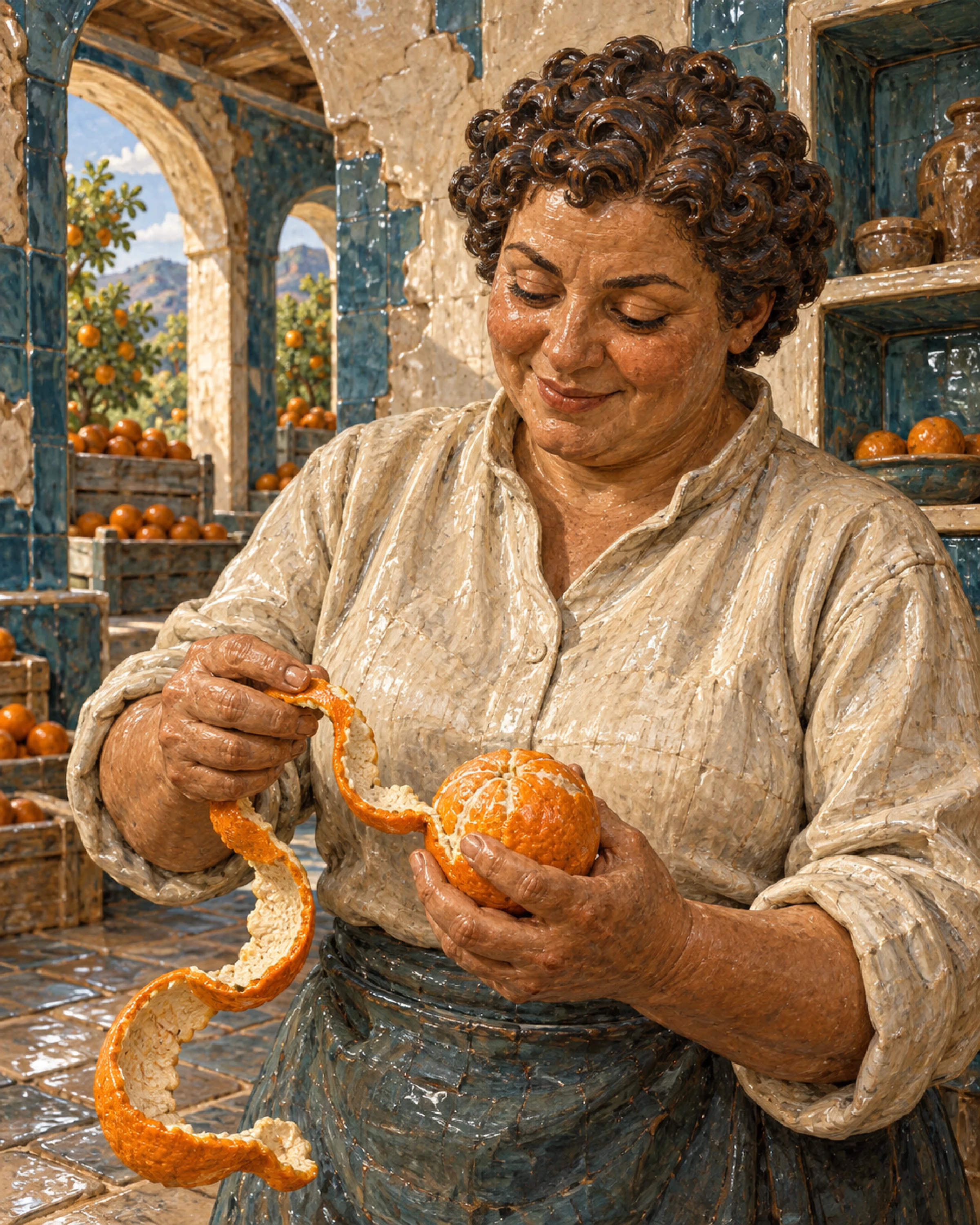
Woman Peeling an Orange
A portrait of a woman drawing a long peel from an orange among the arches and shelves of a citrus packing house. Rounded ceramic relief and pooled glaze give her face and the curling peel a tactile vitality.
Remix this referenceWoman Peeling an Orange
- Form language
- Build a ceramic relief illustration from rounded modeled masses and shallow stacked planes, with small handmade irregularities.
- Contour
- Use soft rolled edges and occasional narrow incised separations; contours emerge from relief rather than continuous drawn outlines.
- Mark-making
- Keep broad smoothing strokes and selective fingertip or tool impressions; vary their pressure and allow quieter passages between them.
- Surface rendering
- Model translucent glaze pooling in hollows and thinning over ridges, with rounded gloss breaks and softly mottled tonal transitions.
Priority
Make modeled glaze and tangible relief the defining visual treatment.
What to avoid & what to check
Exact prompt for this example
MODULE OWNERSHIP
subject: Subject count, type, stable proportions and landmarks, resting face geometry, hair shape, physical materials, garment construction and permanent marks. No emotion, movement, color assignment or rendering recipe.
expression: Facial soft-tissue displacement and pupil direction, muscle coordination, regional intensity, asymmetry and onset/peak/release. No head/body pose, stable appearance, skin color or rendering.
gesture: Head/neck/body/limb orientation, joint movement, support, contact and pose-caused occlusion using existing anatomy. No eye/pupil movement, emotion, identity, props inventory or camera.
props: Prop count, type, construction, physical material and scale relative to the subject. Holding/contact belongs to gesture, position to composition, color to palette.
scene: Environment elements, terrain, backdrop/floor presence and structural detail. No canvas positions, camera, lighting, assigned colors or render texture.
camera: Projection, focal-length impression, camera elevation/yaw/roll, viewing distance and crop. No actor pose, world placement, lighting or canvas aspect ratio.
composition: Normalized 0-100% canvas positions, scale in frame, depth/overlap, focal hierarchy and margins. No joint pose, camera projection, rendering, subject/prop inventory or emotion.
palette: Color anchors, hue/saturation/value ranges, colors assigned to parts and approximate color coverage. No illumination direction, shading algorithm, physical material or layout.
lighting: Light-source direction/softness/intensity, ambient illumination, physical shadow direction/length and highlight position. Absence of directional illumination is allowed. No shading technique, palette or material changes.
style: Reusable form abstraction, contour weight/taper/edge quality, medium and mark scale/density/direction, surface rendering and tonal transition technique. No fixed subject proportions, anatomy, identity, expression, pose, palette, light-source direction, camera or layout.
output: Image count, aspect ratio, size, file/alpha requirements and global lettering/logo/watermark restrictions. No background scenery, crop, style, identity or pose.

SUBJECT
inventory: One middle-aged woman, actor A, with a sturdy build and an unadorned woven work shirt.
geometry: A broad forehead, full lower cheeks, a rounded chin and a substantial nose give her a recognizable, grounded likeness.
resting-face: Naturally low brow arches, almond-shaped eye openings and a broad mouth with a defined upper-lip bow.
appearance: Short tight curls form an uneven cap; her shirt has a soft stand collar and permanently folded sleeve cuffs.

PRIORITY


AVOID


CHECK


EXPRESSION — ACTOR A
brows: Inner brows rise slightly, with one brow responding a little sooner.
lids: Upper lids remain relaxed while the lower lids lift gently.
cheeks: Cheek pads begin to rise, a little more strongly on the smiling side.
nose: Nostrils open subtly without wrinkling the bridge.
mouth: Closed lips form a small uneven smile, one corner curling upward first.
jaw: The jaw stays loose, with no visible clenching or mouth opening.
gaze: Both pupils turn downward toward the freshly exposed orange flesh.
coordination: The mouth leads the delight; cheek and lower-lid lifts follow without an exaggerated grin.
timing: Capture the onset, just as the first pleased smile becomes readable.

PRIORITY


AVOID


CHECK


GESTURE
head: Her neck inclines forward and her chin dips slightly toward her working hands.
torso: Her torso turns gently to one side, with one shoulder advancing as the opposite elbow draws outward.
limbs: One hand cradles the orange while the other pulls the loosened peel outward in a broad, unhurried sweep.
contact: Supporting fingers curve under the fruit; the pulling thumb and forefinger pinch only the free end of the peel.

PRIORITY


AVOID


CHECK


PROPS
inventory: One palm-sized orange with a long, still-attached strip of peel; no separate tools.
construction: The rind has a porous outer skin and soft pith inside; the exposed fruit retains its rounded segmented mass.

PRIORITY


AVOID


CHECK


SCENE
inventory: An old citrus packing house with built-in stepped shelves, tiled wall recesses and an open arch facing orchard branches.
structure: Thick masonry openings connect successive work bays; irregular tile repairs interrupt the otherwise continuous walls.

PRIORITY


AVOID


CHECK


CAMERA
projection: Use a natural perspective with the restrained depth compression of a short portrait lens.
viewpoint: View from face height at a gentle three-quarter angle, with a level horizon.
crop: Frame from above the hair to the waist, retaining both hands and the full hanging peel.

PRIORITY


AVOID


CHECK


COMPOSITION
placement: Set the face in the upper-right third, the fruit below center and the sweeping peel across the lower-left.
depth: The face leads, the hands provide the second read, and overlapping shelves and arches carry the eye into successive depths.
spacing: Let the figure occupy most of the height while preserving a generous opening beside her head and air around the peel.

PRIORITY


AVOID


CHECK


PALETTE
colors: Anchor the image in burnt orange, deep petrol teal, warm umber and chalk cream, with restrained saturation outside the fruit.
assignment: Give the fruit burnt orange, skin warm umber, the shirt chalk cream and the architectural recesses petrol teal.
balance: Let teal and umber carry the broad fields; cream opens them up, while orange remains a concentrated accent.

PRIORITY


AVOID


CHECK


LIGHTING
sources: Broad, soft daylight enters from the upper left, supported by gentle ambient illumination.
shadows: Short shadows fall toward the lower right, with deeper shelter beneath the hands and inside the wall recesses.
highlights: Soft highlights gather along the upper-left cheek, finger ridges and the raised edges of the curling peel.

PRIORITY


AVOID


CHECK


STYLE GUIDE
form-language: Build a ceramic relief illustration from rounded modeled masses and shallow stacked planes, with small handmade irregularities.
contour: Use soft rolled edges and occasional narrow incised separations; contours emerge from relief rather than continuous drawn outlines.
mark-making: Keep broad smoothing strokes and selective fingertip or tool impressions; vary their pressure and allow quieter passages between them.
surface-rendering: Model translucent glaze pooling in hollows and thinning over ridges, with rounded gloss breaks and softly mottled tonal transitions.

PRIORITY
Make modeled glaze and tangible relief the defining visual treatment.

AVOID


CHECK


OUTPUT
format: One finished image, portrait 4:5 aspect ratio, 2400 × 3000 pixels, opaque PNG.
restrictions: No lettering, logos or watermarks.

PRIORITY


AVOID


CHECK


FINAL INTEGRATION
expression + gesture + composition: Let the facial response and hand action form one readable moment while preserving the portrait's focal hierarchy.
style + lighting: Use the illumination to reveal modeled depth and glaze variation without making every surface equally glossy.
Model information comes from image provenance. The same prompt may produce a different result.