Text to imageArt stylesStyle guide
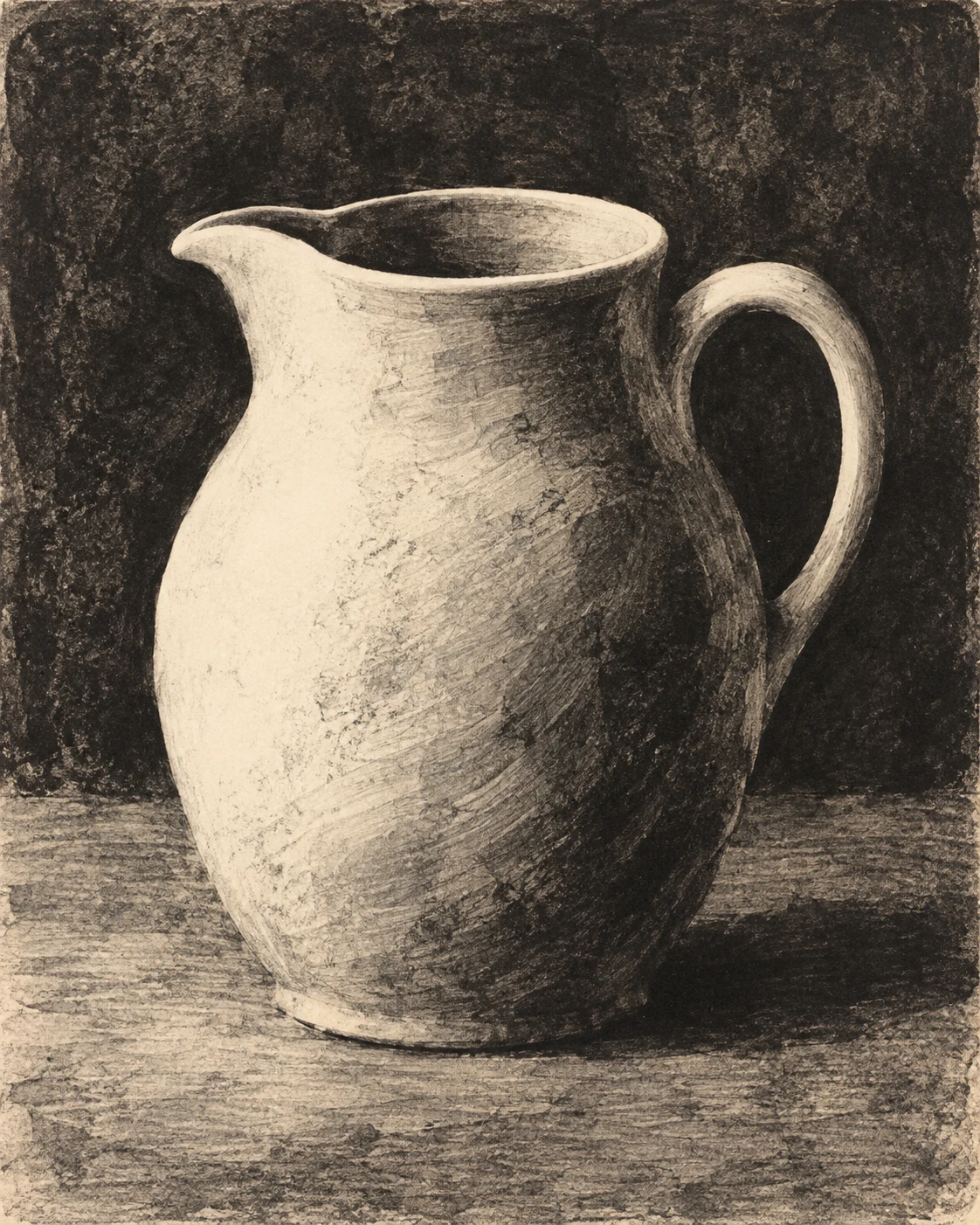
One White Pitcher · Wiped-Ink Monotype
Reveal a white pitcher by wiping broad light areas from a black ink film, using soft wipe marks to describe its volume.
One White Pitcher · Wiped-Ink Monotype
- Shape & line
- Build the pitcher from broad areas wiped out of a dark ink field. Let the rounded body emerge through a continuous pale silhouette, retain a dark crescent inside the mouth, and wipe around the handle while leaving its opening dark; use ink boundaries instead of drawn outlines.
- Color & light
- Use black ink and the warm ivory of the exposed paper. Establish light from image-upper-left by wiping the image-left shoulder and belly almost clean, leaving a gray veil across the middle and dense ink on the image-right flank; extend a low dark cast shadow toward image-right from the base.
- Texture & material
- Make the surface read as a single ink transfer: leave broad curved cloth streaks in the gray body tones, soft feathered transitions where ink was partially removed, and occasional broken ink deposits revealing paper grain. Keep the brightest wiped areas quiet so the ceramic still feels smooth.
- Composition
- Let the pitcher occupy roughly the middle two-thirds of the image height. Wipe a subdued horizontal tabletop area beneath it, keep the surrounding background darker than the body, and preserve clear dark gaps around the pouring lip and inside the handle so the pale form remains readable.
Priority
Prioritize broad wiped highlights and residual ink tones that visibly build the pitcher’s volume.
What to avoid & what to check
Avoid etched crosshatching, glossy digital gradients, and thick painted relief.
Check that the bright image-left body, dark image-right flank, and open handle read clearly through wiped ink alone.
Exact prompt for this example
SUBJECT
One plain white ceramic water pitcher with a rounded body, a short pouring lip pointing toward image-left, and one loop handle on image-right; the background remains visible through the handle opening.

COMPOSITION
Show the entire pitcher in a slightly elevated three-quarter view, centered on a simple tabletop with generous surrounding space. Keep the pouring lip, open mouth, and handle opening clearly readable.

STYLE GUIDE
1. Shape & line
Build the pitcher from broad areas wiped out of a dark ink field. Let the rounded body emerge through a continuous pale silhouette, retain a dark crescent inside the mouth, and wipe around the handle while leaving its opening dark; use ink boundaries instead of drawn outlines.

2. Color & light
Use black ink and the warm ivory of the exposed paper. Establish light from image-upper-left by wiping the image-left shoulder and belly almost clean, leaving a gray veil across the middle and dense ink on the image-right flank; extend a low dark cast shadow toward image-right from the base.

3. Texture & material
Make the surface read as a single ink transfer: leave broad curved cloth streaks in the gray body tones, soft feathered transitions where ink was partially removed, and occasional broken ink deposits revealing paper grain. Keep the brightest wiped areas quiet so the ceramic still feels smooth.

4. Composition
Let the pitcher occupy roughly the middle two-thirds of the image height. Wipe a subdued horizontal tabletop area beneath it, keep the surrounding background darker than the body, and preserve clear dark gaps around the pouring lip and inside the handle so the pale form remains readable.

PRIORITY
Preserve the requested identity, count, action, composition and output settings. Apply the style rules within those constraints; a style reference must not replace the subject or layout. Within the style: Prioritize broad wiped highlights and residual ink tones that visibly build the pitcher’s volume.

AVOID
Avoid etched crosshatching, glossy digital gradients, and thick painted relief.

OUTPUT
One image in a 4:5 portrait aspect ratio, presented as a finished monotype print on warm ivory paper, with no text, signature, labels, or border.

SELF-CHECK
Check that the bright image-left body, dark image-right flank, and open handle read clearly through wiped ink alone.
Model information comes from image provenance. The same prompt may produce a different result.