Text to imageLandscapeStyle guide
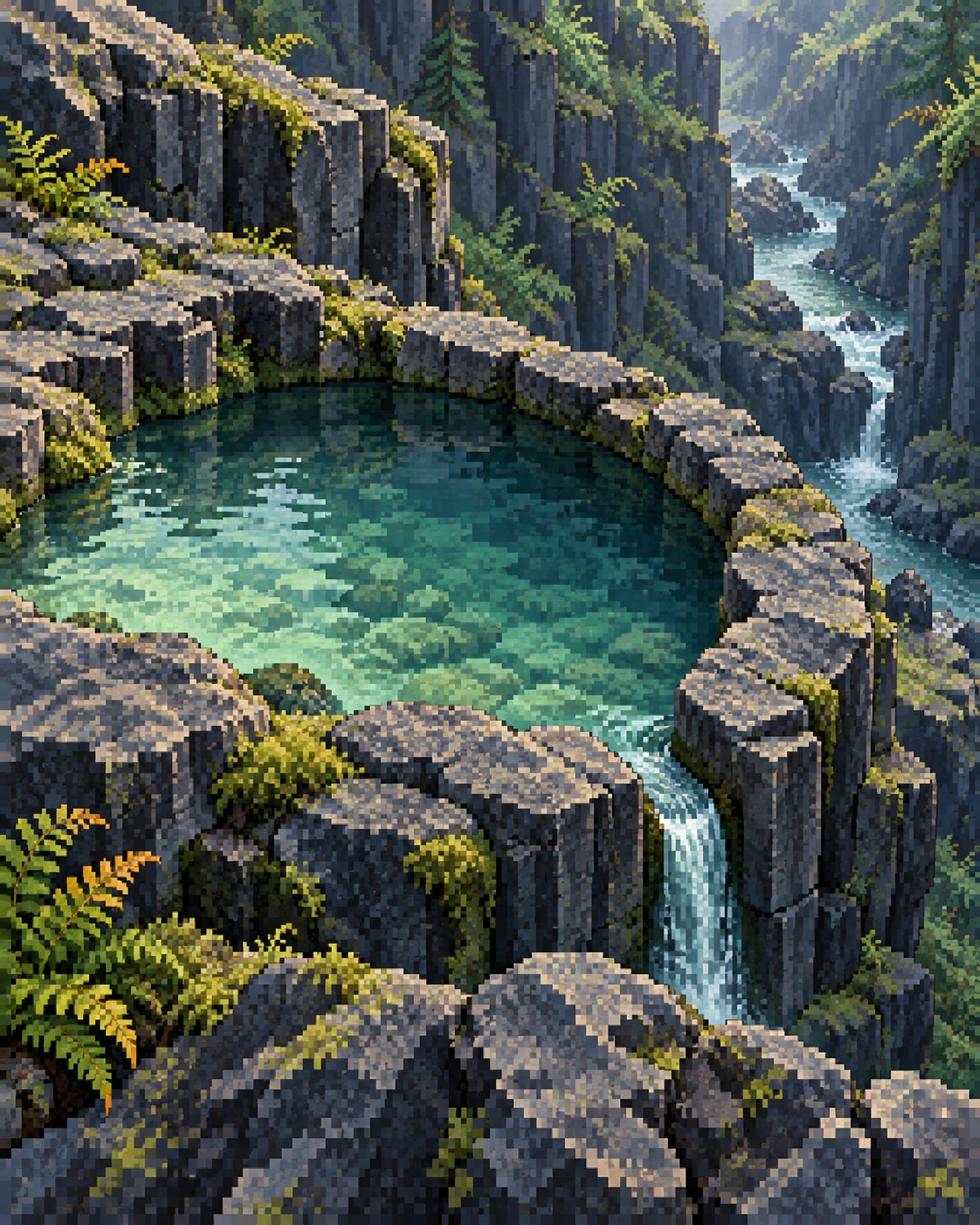
Rock Pool at the Gorge Lip
An intimate landscape of a rock pool above a narrow gorge, with basalt and water interlocking through woven pixel clusters and a distant ravine opening supplying depth.
Remix this referenceRock Pool at the Gorge Lip
- Form language
- Build broad forms from interlocking rectangular pixel clusters, with short bands crossing like woven strands rather than isolated tiles.
- Contour
- Keep deliberate low-resolution stair steps; use clustered edge breaks and occasional projecting cells instead of smooth outlines.
- Mark-making
- Alternate compact crosswise bands with longer runs; vary their length naturally while preserving a shared coarse pixel cadence.
- Surface rendering
- Shift tone through neighboring cluster exchanges and broken woven patches; allow irregular density without blurring the pixel edges.
Priority
Make the woven organization visible at first glance.
What to avoid & what to check
Avoid smooth painting covered by a pixel filter.
Interlocking bands build both edges and interior tone.
Exact prompt for this example
MODULE OWNERSHIP
subject: Subject count, type, stable proportions and landmarks, resting face geometry, hair shape, physical materials, garment construction and permanent marks. No emotion, movement, color assignment or rendering recipe.
expression: Facial soft-tissue displacement and pupil direction, muscle coordination, regional intensity, asymmetry and onset/peak/release. No head/body pose, stable appearance, skin color or rendering.
gesture: Head/neck/body/limb orientation, joint movement, support, contact and pose-caused occlusion using existing anatomy. No eye/pupil movement, emotion, identity, props inventory or camera.
props: Prop count, type, construction, physical material and scale relative to the subject. Holding/contact belongs to gesture, position to composition, color to palette.
scene: Environment elements, terrain, backdrop/floor presence and structural detail. No canvas positions, camera, lighting, assigned colors or render texture.
camera: Projection, focal-length impression, camera elevation/yaw/roll, viewing distance and crop. No actor pose, world placement, lighting or canvas aspect ratio.
composition: Normalized 0-100% canvas positions, scale in frame, depth/overlap, focal hierarchy and margins. No joint pose, camera projection, rendering, subject/prop inventory or emotion.
palette: Color anchors, hue/saturation/value ranges, colors assigned to parts and approximate color coverage. No illumination direction, shading algorithm, physical material or layout.
lighting: Light-source direction/softness/intensity, ambient illumination, physical shadow direction/length and highlight position. Absence of directional illumination is allowed. No shading technique, palette or material changes.
style: Reusable form abstraction, contour weight/taper/edge quality, medium and mark scale/density/direction, surface rendering and tonal transition technique. No fixed subject proportions, anatomy, identity, expression, pose, palette, light-source direction, camera or layout.
output: Image count, aspect ratio, size, file/alpha requirements and global lettering/logo/watermark restrictions. No background scenery, crop, style, identity or pose.

SUBJECT
inventory: One focal basalt shelf enclosing a shallow rock pool; no people or animals.
geometry: A horseshoe rim opens into a narrow spillway; blunt column ends distinguish the surrounding stone.
resting-face: No facial geometry applies.
appearance: Solid basalt, shallow water and small moss mats; natural chips and moss boundaries may vary.

PRIORITY
Make the pool's enclosing stone lip unmistakable.

AVOID
Avoid a generic circular pond.

CHECK
The spillway remains a recognizable landmark.

PROPS
inventory: No separate props.
construction: No prop construction applies.

PRIORITY


AVOID


CHECK


SCENE
inventory: A narrow gorge with fractured walls, sparse ferns and a glimpse of its lower watercourse.
structure: Uneven ledges step down into a cleft; the spillway connects the shelf to the gorge below.

PRIORITY
Give the close detail a convincing larger landscape.

AVOID
Avoid buildings or a manicured garden setting.

CHECK
The surrounding cleft explains the landscape's depth.

CAMERA
projection: Natural perspective with a mild short-telephoto impression.
viewpoint: Look obliquely down from just above the shelf, close enough to inspect its lip and water.
crop: Crop the nearest rock mass at the lower frame edges, retaining the pool opening and a narrow view beyond.

PRIORITY
Make the landscape feel encountered at close range.

AVOID
Avoid an aerial map view.

CHECK
Both the rim thickness and the water surface are visible.

COMPOSITION
placement: Anchor the pool near 40% width and 60% height; let the gorge opening occupy the upper-right area.
depth: A large foreground rim overlaps the pool, then receding ledges lead toward the small distant watercourse.
spacing: Give the pool a broad readable interior; gather surrounding rock along the lower margins.

PRIORITY
Let the quiet pool lead before the distant gorge.

AVOID
Avoid equally weighted bands of terrain.

CHECK
The broad pool remains the focal area while the smaller distant watercourse stays legible.

PALETTE
colors: Anchor the image in deep indigo, muted jade, pale celadon and a small amber accent.
assignment: Use indigo for basalt, jade and celadon for water, subdued green for moss, and amber for fern tips.
balance: Dark stone dominates; lighter water forms the main relief, with warm accents kept scarce.

PRIORITY
Make the water a luminous color interval.

AVOID
Avoid rainbow pixel accents.

CHECK
The cool anchors remain coherent across the image.

LIGHTING
sources: Soft daylight enters from the upper left, with gentle ambient fill inside the gorge.
shadows: Shallow ledge shadows extend rightward; deeper recesses remain subdued without becoming empty.
highlights: Broad highlights touch the upper-left rim and a few exposed stretches of water.

PRIORITY
Reveal the shelf's shallow relief.

AVOID
Avoid a theatrical spotlight.

CHECK
The rim separates visibly from its recesses.

STYLE GUIDE
form-language: Build broad forms from interlocking rectangular pixel clusters, with short bands crossing like woven strands rather than isolated tiles.
contour: Keep deliberate low-resolution stair steps; use clustered edge breaks and occasional projecting cells instead of smooth outlines.
mark-making: Alternate compact crosswise bands with longer runs; vary their length naturally while preserving a shared coarse pixel cadence.
surface-rendering: Shift tone through neighboring cluster exchanges and broken woven patches; allow irregular density without blurring the pixel edges.

PRIORITY
Make the woven organization visible at first glance.

AVOID
Avoid smooth painting covered by a pixel filter.

CHECK
Interlocking bands build both edges and interior tone.

OUTPUT
format: One portrait image, 4:5 aspect ratio, 1600 × 2000 pixels, opaque PNG.
restrictions: No lettering, logos, signatures or watermarks.

PRIORITY
Deliver one complete image at the specified export size.

AVOID
Avoid process panels or explanatory labels.

CHECK
The export contains one uninterrupted image.

FINAL INTEGRATION
subject + scene + camera + composition: Keep the focal formation readable while the surrounding environment establishes depth.
palette + lighting + style: Let color and illumination remain distinguishable through the chosen mark language.
Model information comes from image provenance. The same prompt may produce a different result.