Text to imageProductStyle guide
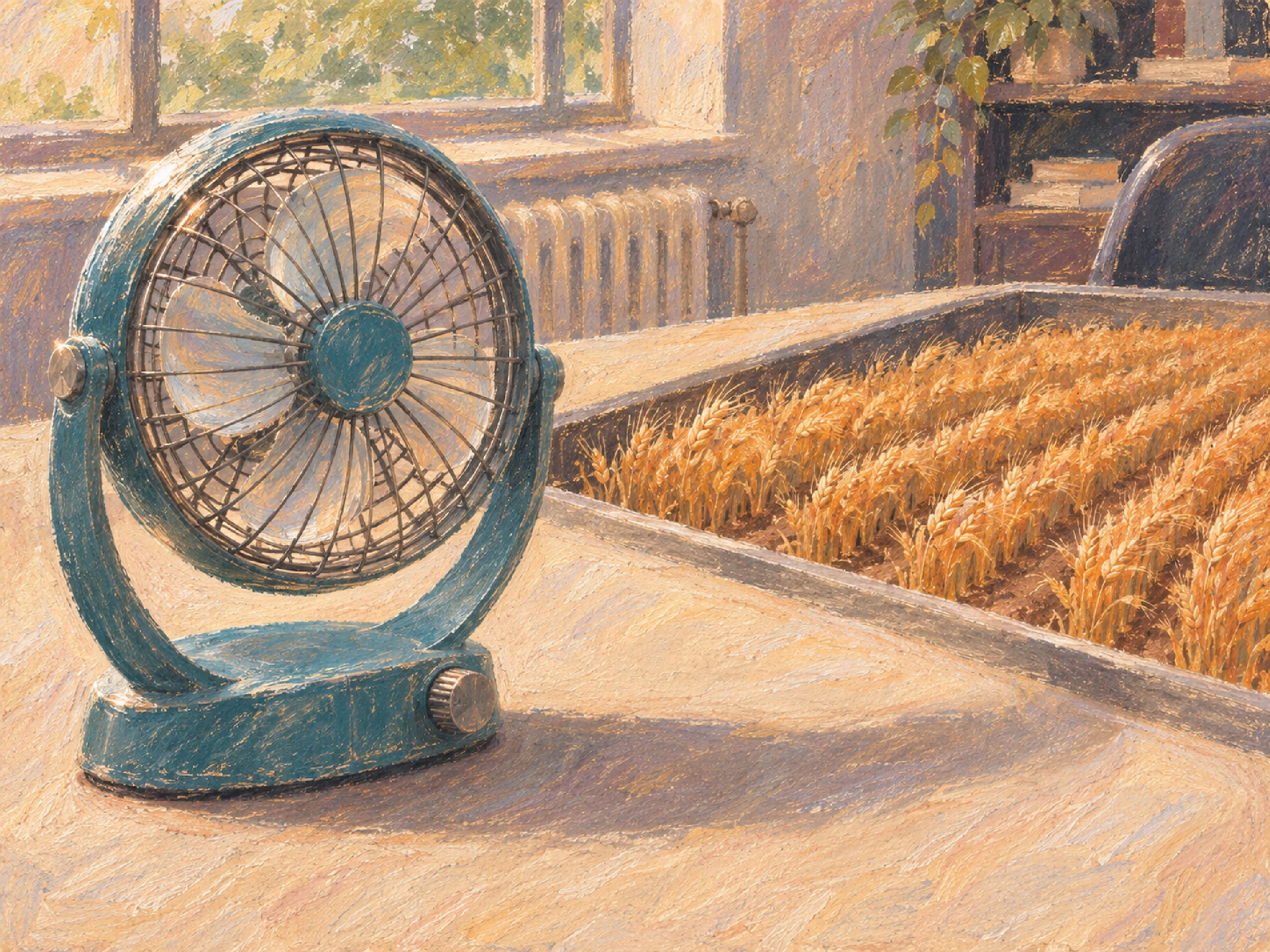
A Fan Above a Desk of Wheat
A desk's document well becomes a miniature wheat field beneath an arched fan, illustrated with dreamlike rubbed and scratched oil pastel.
Remix this referenceA Fan Above a Desk of Wheat
- Form language
- Reduce forms to softly swollen masses and broad planes, allowing small irregularities within a coherent handmade language.
- Contour
- Use broken waxy edges that alternately sharpen and dissolve; occasional scratched lines recover essential boundaries.
- Mark-making
- Drag blunt oil-pastel strokes over rubbed passages, then scratch through selected layers with loose, uneven rhythms.
- Surface rendering
- Build dreamlike tonal transitions through rubbed pigment veils, retaining wax crumbs and exposed underlayers in selected passages.
Priority
Make rubbed and scratched oil pastel visibly define the finished image.
What to avoid & what to check
Exact prompt for this example
MODULE OWNERSHIP
subject: Subject count, type, stable proportions and landmarks, resting face geometry, hair shape, physical materials, garment construction and permanent marks. No emotion, movement, color assignment or rendering recipe.
expression: Facial soft-tissue displacement and pupil direction, muscle coordination, regional intensity, asymmetry and onset/peak/release. No head/body pose, stable appearance, skin color or rendering.
gesture: Head/neck/body/limb orientation, joint movement, support, contact and pose-caused occlusion using existing anatomy. No eye/pupil movement, emotion, identity, props inventory or camera.
props: Prop count, type, construction, physical material and scale relative to the subject. Holding/contact belongs to gesture, position to composition, color to palette.
scene: Environment elements, terrain, backdrop/floor presence and structural detail. No canvas positions, camera, lighting, assigned colors or render texture.
camera: Projection, focal-length impression, camera elevation/yaw/roll, viewing distance and crop. No actor pose, world placement, lighting or canvas aspect ratio.
composition: Normalized 0-100% canvas positions, scale in frame, depth/overlap, focal hierarchy and margins. No joint pose, camera projection, rendering, subject/prop inventory or emotion.
palette: Color anchors, hue/saturation/value ranges, colors assigned to parts and approximate color coverage. No illumination direction, shading algorithm, physical material or layout.
lighting: Light-source direction/softness/intensity, ambient illumination, physical shadow direction/length and highlight position. Absence of directional illumination is allowed. No shading technique, palette or material changes.
style: Reusable form abstraction, contour weight/taper/edge quality, medium and mark scale/density/direction, surface rendering and tonal transition technique. No fixed subject proportions, anatomy, identity, expression, pose, palette, light-source direction, camera or layout.
output: Image count, aspect ratio, size, file/alpha requirements and global lettering/logo/watermark restrictions. No background scenery, crop, style, identity or pose.

SUBJECT
inventory: One original desktop electric fan.
geometry: A circular head nests inside an open horseshoe arch above a shallow oval foot, with a side dial.
resting-face: No face or facial landmarks.
appearance: Powder-coated aluminum housing, a wire grille and translucent molded blades; small fittings may vary.

PRIORITY


AVOID


CHECK


PROPS
inventory: No separate props.
construction: No prop construction applies.

PRIORITY


AVOID


CHECK


SCENE
inventory: An office desktop with a recessed document well, a window, a radiator and a miniature wheat field.
structure: Wheat grows in tiny furrows bounded by the document well; its raised lip makes the change of scale unmistakable.

PRIORITY


AVOID


CHECK


CAMERA
projection: Moderate perspective with a natural standard-lens impression.
viewpoint: Look obliquely across the desktop from slightly above the fan head.
crop: Include the complete fan, the document well and a partial view of the office beyond.

PRIORITY


AVOID


CHECK


COMPOSITION
placement: The fan anchors the left third; the wheat field extends diagonally toward the upper right.
depth: Read the fan first, then the tiny furrows; the distant window remains subordinate.
spacing: Leave a generous strip of bare desktop between the fan foot and the field.

PRIORITY


AVOID


CHECK


PALETTE
colors: Petrol blue, ripe apricot, chalk cream and muted charcoal.
assignment: Petrol blue defines the fan, apricot the wheat, cream the desk, and charcoal the grille and recesses.
balance: Cream dominates, blue provides a concentrated counterweight, and softly varied apricot supplies warmth.

PRIORITY


AVOID


CHECK


LIGHTING
sources: Broad, soft window light enters from the upper left with gentle ambient fill.
shadows: A soft fan shadow stretches rightward across the desktop and reaches the field edge.
highlights: Restrained highlights follow the upper-left arch and the nearest grille wires.

PRIORITY


AVOID


CHECK


STYLE GUIDE
form-language: Reduce forms to softly swollen masses and broad planes, allowing small irregularities within a coherent handmade language.
contour: Use broken waxy edges that alternately sharpen and dissolve; occasional scratched lines recover essential boundaries.
mark-making: Drag blunt oil-pastel strokes over rubbed passages, then scratch through selected layers with loose, uneven rhythms.
surface-rendering: Build dreamlike tonal transitions through rubbed pigment veils, retaining wax crumbs and exposed underlayers in selected passages.

PRIORITY
Make rubbed and scratched oil pastel visibly define the finished image.

AVOID


CHECK


OUTPUT
format: One finished image, landscape 4:3, 2400 × 1800 pixels, opaque PNG.
restrictions: No lettering, logos or watermarks.

PRIORITY


AVOID


CHECK


FINAL INTEGRATION
subject + scene + composition: Product clarity and environmental discovery should cooperate so the scale surprise rewards a second look.
Model information comes from image provenance. The same prompt may produce a different result.