Text to imagePortraitStyle guide
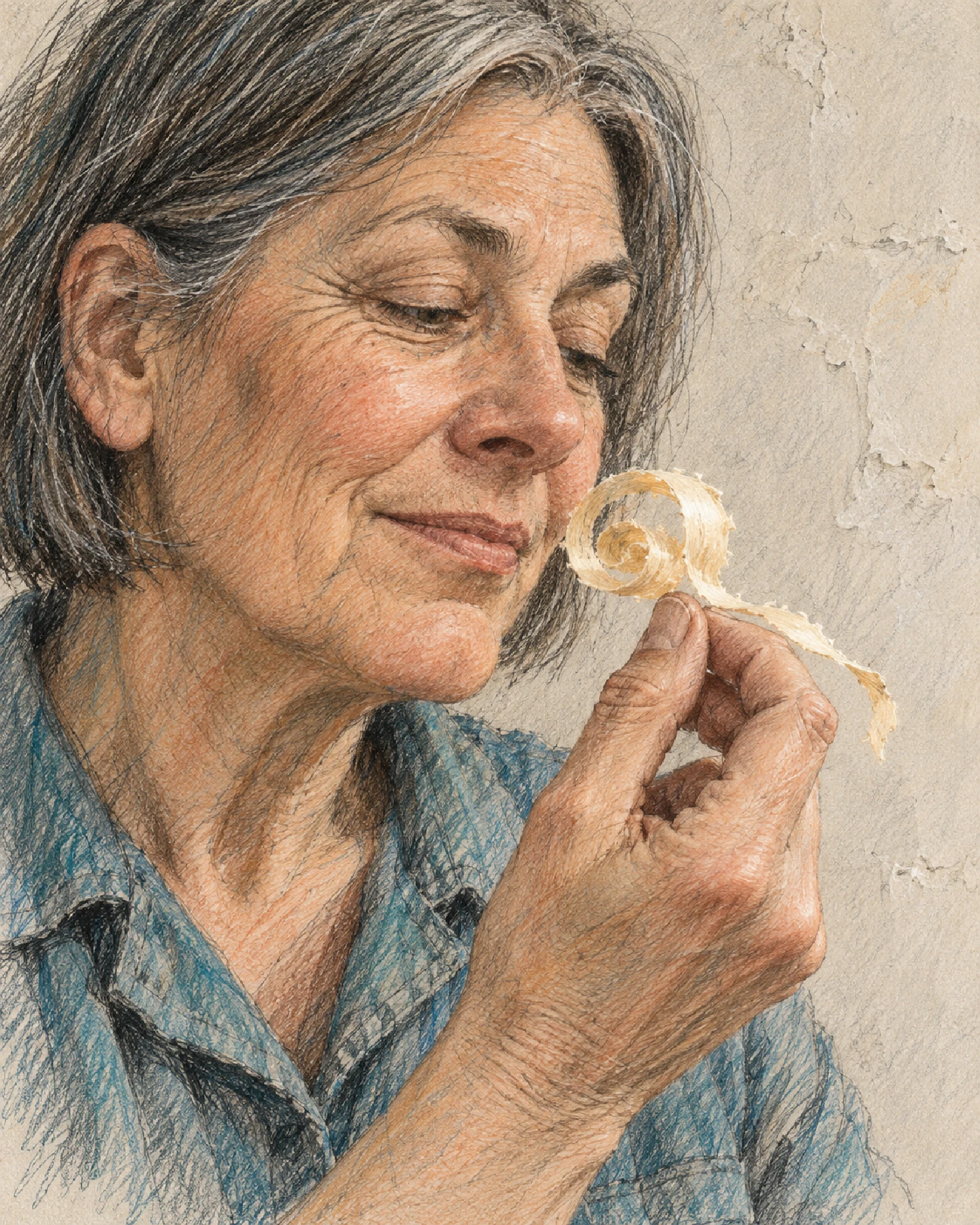
A Maker Smelling a Wood Shaving
An older instrument maker raises a curled wood shaving toward her nose as its scent registers. Rough graphite and loosely layered colored pencil capture an intimate pause.
Remix this referenceA Maker Smelling a Wood Shaving
- Form language
- Use searching observational simplification, retaining telling irregularities while leaving minor details unresolved.
- Contour
- Build broken contours from repeated pencil passes, varying pressure and leaving tentative lines visible.
- Mark-making
- Combine loose graphite hatching with oblique colored-pencil strokes that skip across the paper tooth.
- Surface rendering
- Leave paper between translucent pencil layers; occasionally rub graphite without fully smoothing its grain.
Priority
Maintain the visibly rough graphite and colored-pencil character of a sketchbook drawing.
What to avoid & what to check
Exact prompt for this example
MODULE OWNERSHIP
subject: Subject count, type, stable proportions and landmarks, resting face geometry, hair shape, physical materials, garment construction and permanent marks. No emotion, movement, color assignment or rendering recipe.
expression: Facial soft-tissue displacement and pupil direction, muscle coordination, regional intensity, asymmetry and onset/peak/release. No head/body pose, stable appearance, skin color or rendering.
gesture: Head/neck/body/limb orientation, joint movement, support, contact and pose-caused occlusion using existing anatomy. No eye/pupil movement, emotion, identity, props inventory or camera.
props: Prop count, type, construction, physical material and scale relative to the subject. Holding/contact belongs to gesture, position to composition, color to palette.
scene: Environment elements, terrain, backdrop/floor presence and structural detail. No canvas positions, camera, lighting, assigned colors or render texture.
camera: Projection, focal-length impression, camera elevation/yaw/roll, viewing distance and crop. No actor pose, world placement, lighting or canvas aspect ratio.
composition: Normalized 0-100% canvas positions, scale in frame, depth/overlap, focal hierarchy and margins. No joint pose, camera projection, rendering, subject/prop inventory or emotion.
palette: Color anchors, hue/saturation/value ranges, colors assigned to parts and approximate color coverage. No illumination direction, shading algorithm, physical material or layout.
lighting: Light-source direction/softness/intensity, ambient illumination, physical shadow direction/length and highlight position. Absence of directional illumination is allowed. No shading technique, palette or material changes.
style: Reusable form abstraction, contour weight/taper/edge quality, medium and mark scale/density/direction, surface rendering and tonal transition technique. No fixed subject proportions, anatomy, identity, expression, pose, palette, light-source direction, camera or layout.
output: Image count, aspect ratio, size, file/alpha requirements and global lettering/logo/watermark restrictions. No background scenery, crop, style, identity or pose.

SUBJECT
inventory: One older adult woman, an instrument maker, designated actor A.
geometry: A long rectangular face with a broad nasal bridge, substantial chin and slightly uneven ear rims.
resting-face: Heavy upper lids, a narrow upper lip and permanent fine creases beside the eyes and mouth.
appearance: A blunt bob with one ear exposed, a coarse cotton work shirt and short unpolished fingernails.

PRIORITY


AVOID


CHECK


EXPRESSION — ACTOR A
brows: Brows ease apart, with a slight lift at the outer ends.
lids: Upper lids descend gently without squeezing shut.
cheeks: A small cheek lift is stronger on the near side.
nose: Nostrils widen subtly with the beginning of an inhalation.
mouth: Closed lips soften into a faint, uneven smile.
jaw: The jaw releases tension while the teeth remain together.
gaze: Pupils settle downward toward the open curl.
coordination: The eyelid release and small smile agree without becoming a broad grin.
timing: Catch the onset of pleasure as the scent is first recognized.

PRIORITY


AVOID


CHECK


GESTURE
head: A inclines her head slightly toward the raised shaving, keeping the neck relaxed.
torso: Her upper torso inclines forward with one shoulder slightly advanced.
limbs: The forearm brings the hand toward the nose while the elbow stays low.
contact: Thumb and forefinger lightly pinch the shaving's tail; the open curl stays clear of the face.

PRIORITY


AVOID


CHECK


PROPS
inventory: One fresh wood shaving with an open curl roughly the width of two fingertips.
construction: A paper-thin continuous ribbon of wood with a tapered torn tail and a naturally irregular edge.

PRIORITY


AVOID


CHECK


SCENE
inventory: An unadorned plaster workshop wall; no furnishings are visible.
structure: The wall is continuous, with a few shallow repairs and no visible floor.

PRIORITY


AVOID


CHECK


CAMERA
projection: Natural perspective with mild portrait-lens compression.
viewpoint: View her at eye level from a close three-quarter angle, without camera roll.
crop: Crop through the crown and lower chest while retaining the entire visible hand and wood curl.

PRIORITY


AVOID


CHECK


COMPOSITION
placement: The face fills the left and upper portions; the hand enters from below and the curl occupies open space to the right.
depth: The hand overlaps the shirt but leaves the mouth visible; a narrow interval separates the curl from the nose.
spacing: Emphasize the nose-to-curl interval first, then the near eye; the cropped head outweighs the quiet wall.

PRIORITY


AVOID


CHECK


PALETTE
colors: Graphite gray, warm paper cream, restrained terracotta and faded turquoise.
assignment: Terracotta accents the skin, turquoise belongs to the shirt, cream to wood and wall, and gray to hair and linework.
balance: Keep most areas close to the paper's value, reserving deepest gray for a few facial and hand accents.

PRIORITY


AVOID


CHECK


LIGHTING
sources: A broad soft window source comes from the upper right, with gentle ambient fill.
shadows: Short soft shadows fall leftward beneath the nose, lower lip and curled ribbon.
highlights: The upper cheek, nose ridge and upper rim of the shaving receive the clearest light.

PRIORITY


AVOID


CHECK


STYLE GUIDE
form-language: Use searching observational simplification, retaining telling irregularities while leaving minor details unresolved.
contour: Build broken contours from repeated pencil passes, varying pressure and leaving tentative lines visible.
mark-making: Combine loose graphite hatching with oblique colored-pencil strokes that skip across the paper tooth.
surface-rendering: Leave paper between translucent pencil layers; occasionally rub graphite without fully smoothing its grain.

PRIORITY
Maintain the visibly rough graphite and colored-pencil character of a sketchbook drawing.

AVOID


CHECK


OUTPUT
format: One opaque PNG image, portrait 4:5, 1440 × 1800 pixels.
restrictions: No lettering, logos or watermarks.

PRIORITY


AVOID


CHECK


FINAL INTEGRATION
expression + gesture + composition: The restrained acting and close arrangement work together to make a small sensory discovery readable.
style + lighting: Let the drawing communicate the soft illumination while preserving its searching marks.
Model information comes from image provenance. The same prompt may produce a different result.