Text to imageCharacterStyle guide
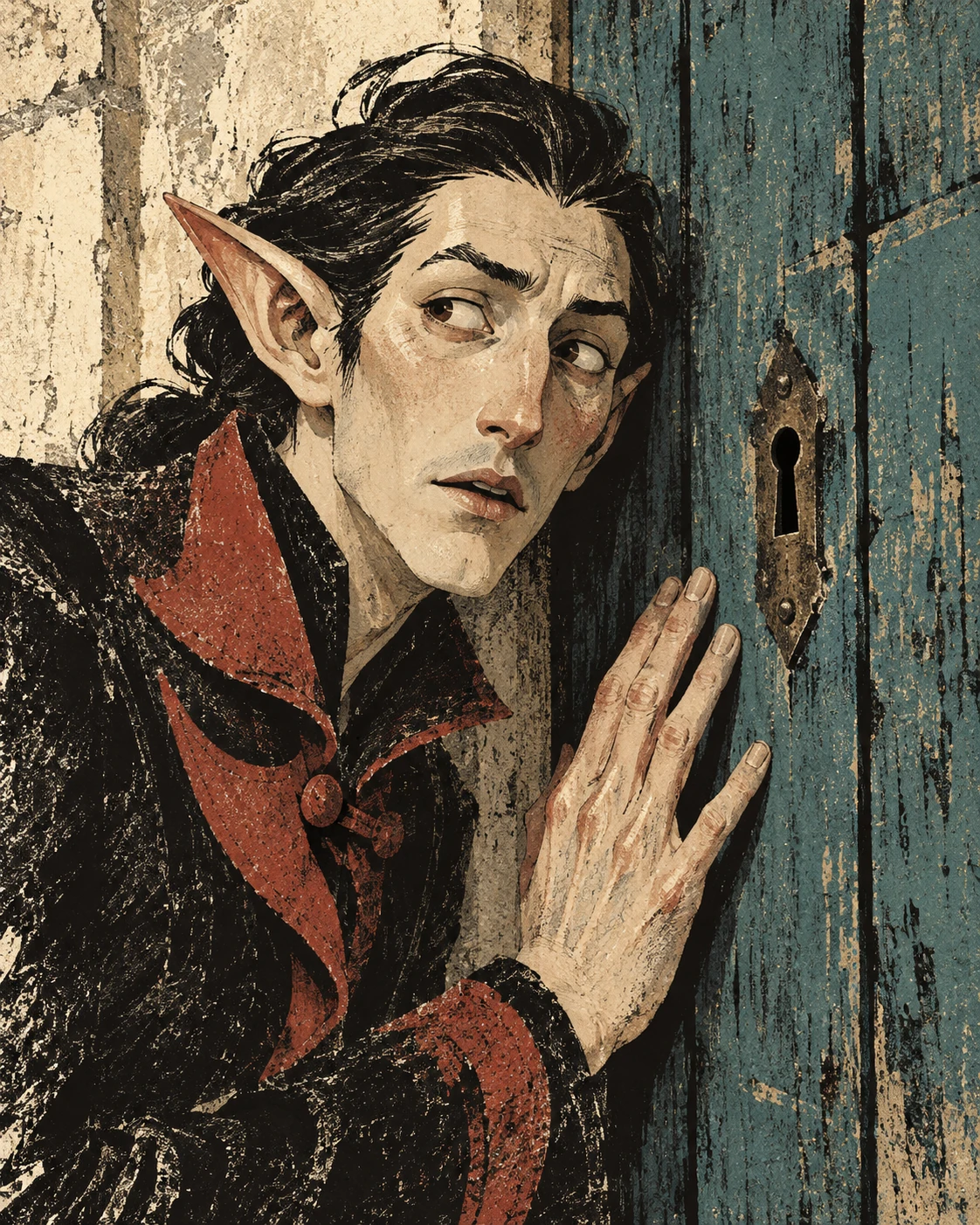
Long-Eared Door Listener
A long-eared gatekeeper with crescent lapels braces a hand against a door and listens beyond its keyhole. Ragged ink lines and displaced print layers turn quiet curiosity into a striking poster scene.
Remix this referenceLong-Eared Door Listener
- Form language
- Compress forms into interlocking wedges and rounded cut shapes; let small irregularities vary within a bold poster vocabulary.
- Contour
- Brush-ink contours swell, fray and occasionally disappear into printed masses; retain a few blunt cut edges.
- Mark-making
- Combine dragged ink streaks with coarse stencil impressions and sparse scraped interruptions; marks vary with the hand.
- Surface rendering
- Build tone through porous print deposits, overlapping ink layers and selective misregistration; leave small paper breaks alive.
Priority
Make the experimental ink-and-print process visibly present in edges and overlapping deposits.
What to avoid & what to check
Exact prompt for this example
MODULE OWNERSHIP
subject: Subject count, type, stable proportions and landmarks, resting face geometry, hair shape, physical materials, garment construction and permanent marks. No emotion, movement, color assignment or rendering recipe.
expression: Facial soft-tissue displacement and pupil direction, muscle coordination, regional intensity, asymmetry and onset/peak/release. No head/body pose, stable appearance, skin color or rendering.
gesture: Head/neck/body/limb orientation, joint movement, support, contact and pose-caused occlusion using existing anatomy. No eye/pupil movement, emotion, identity, props inventory or camera.
props: Prop count, type, construction, physical material and scale relative to the subject. Holding/contact belongs to gesture, position to composition, color to palette.
scene: Environment elements, terrain, backdrop/floor presence and structural detail. No canvas positions, camera, lighting, assigned colors or render texture.
camera: Projection, focal-length impression, camera elevation/yaw/roll, viewing distance and crop. No actor pose, world placement, lighting or canvas aspect ratio.
composition: Normalized 0-100% canvas positions, scale in frame, depth/overlap, focal hierarchy and margins. No joint pose, camera projection, rendering, subject/prop inventory or emotion.
palette: Color anchors, hue/saturation/value ranges, colors assigned to parts and approximate color coverage. No illumination direction, shading algorithm, physical material or layout.
lighting: Light-source direction/softness/intensity, ambient illumination, physical shadow direction/length and highlight position. Absence of directional illumination is allowed. No shading technique, palette or material changes.
style: Reusable form abstraction, contour weight/taper/edge quality, medium and mark scale/density/direction, surface rendering and tonal transition technique. No fixed subject proportions, anatomy, identity, expression, pose, palette, light-source direction, camera or layout.
output: Image count, aspect ratio, size, file/alpha requirements and global lettering/logo/watermark restrictions. No background scenery, crop, style, identity or pose.

SUBJECT
inventory: A is one original adult humanoid gatekeeper; no other figures appear.
geometry: Long leaf-shaped ears flank a narrow oval face; a compact torso supports broad, recognizable hands.
resting-face: The resting face has a long nose bridge, shallow-set eyes, a short upper lip and a softly pointed chin.
appearance: Swept-back hair forms one loose crest; a felt coat has layered crescent lapels and cloth-covered fastenings.

PRIORITY


AVOID


CHECK


EXPRESSION — ACTOR A
brows: The door-side brow lifts slightly; the other remains nearly level.
lids: Upper lids open modestly while lower lids retain gentle tension.
cheeks: Cheeks remain low, with a slight gathering beside the nose.
nose: Nostrils stay relaxed without flaring or wrinkling.
mouth: Lips part narrowly, with one corner held a little higher.
jaw: The jaw releases just enough to leave a small lip opening.
gaze: Pupils turn toward the visible keyhole without an extreme sideways shift.
coordination: A small brow lift leads; the mouth responds more quietly.
timing: Capture curiosity beginning, before the face fully opens in surprise.

PRIORITY


AVOID


CHECK


GESTURE
head: A turns the head toward the door and brings the near ear close to its surface, keeping the face visible.
torso: The upper torso inclines toward the door, with the near shoulder slightly advanced.
limbs: The visible arm bends comfortably; its hand opens against the door with fingers loosely spread.
contact: The palm and fingertips brace against the door; the ear remains just clear of it.

PRIORITY


AVOID


CHECK


PROPS
inventory: No separate props.
construction: No prop construction applies.

PRIORITY


AVOID


CHECK


SCENE
inventory: A tall wooden door and a narrow adjoining plaster wall form the entire setting; no floor is visible.
structure: The door has broad vertical boards and an inset keyhole plate; the adjoining wall has a worn bevel.

PRIORITY


AVOID


CHECK


CAMERA
projection: Use a perspective view with a normal-lens impression and little near-to-far exaggeration.
viewpoint: View from face height with a slight oblique yaw toward the door and no camera roll.
crop: An intimate upper-body crop includes the complete face, one ear, lapels and hand; lower torso exits frame.

PRIORITY


AVOID


CHECK


COMPOSITION
placement: The face sits near 40% canvas width; the door occupies the right third, with the hand between them.
depth: The face leads the focal hierarchy, followed by the hand and keyhole; the wall remains a subordinate rear plane.
spacing: Let the coat extend beyond the left and lower margins; preserve an open interval between the face and keyhole.

PRIORITY


AVOID


CHECK


PALETTE
colors: Use soot black, warm ivory, muted vermilion and a restrained dusty teal, with strong dark-to-light separation.
assignment: Ivory belongs to skin and wall, black to hair and coat, vermilion to lapels, and dusty teal to the door.
balance: Ivory and black occupy most of the image; dusty teal forms a substantial secondary field, and vermilion remains a compact accent.

PRIORITY


AVOID


CHECK


LIGHTING
sources: Broad soft light enters from the upper left, with modest ambient fill.
shadows: The nose and hand cast short, soft-edged shadows downward and to the right.
highlights: Light gathers on the upper cheek, ear rim and raised finger joints without sharp glare.

PRIORITY


AVOID


CHECK


STYLE GUIDE
form-language: Compress forms into interlocking wedges and rounded cut shapes; let small irregularities vary within a bold poster vocabulary.
contour: Brush-ink contours swell, fray and occasionally disappear into printed masses; retain a few blunt cut edges.
mark-making: Combine dragged ink streaks with coarse stencil impressions and sparse scraped interruptions; marks vary with the hand.
surface-rendering: Build tone through porous print deposits, overlapping ink layers and selective misregistration; leave small paper breaks alive.

PRIORITY
Make the experimental ink-and-print process visibly present in edges and overlapping deposits.

AVOID


CHECK


OUTPUT
format: Produce one finished image.
restrictions: One image, 4:5 aspect ratio, 2400 × 3000 pixels, opaque PNG; no lettering, logos or watermarks.

PRIORITY


AVOID


CHECK


FINAL INTEGRATION
expression + gesture: Let the facial response and listening posture describe the same newly noticed sound.
lighting + style: Translate the visible illumination through the print vocabulary while keeping its broad direction legible.
Model information comes from image provenance. The same prompt may produce a different result.