Text to imageLandscapeStyle guide
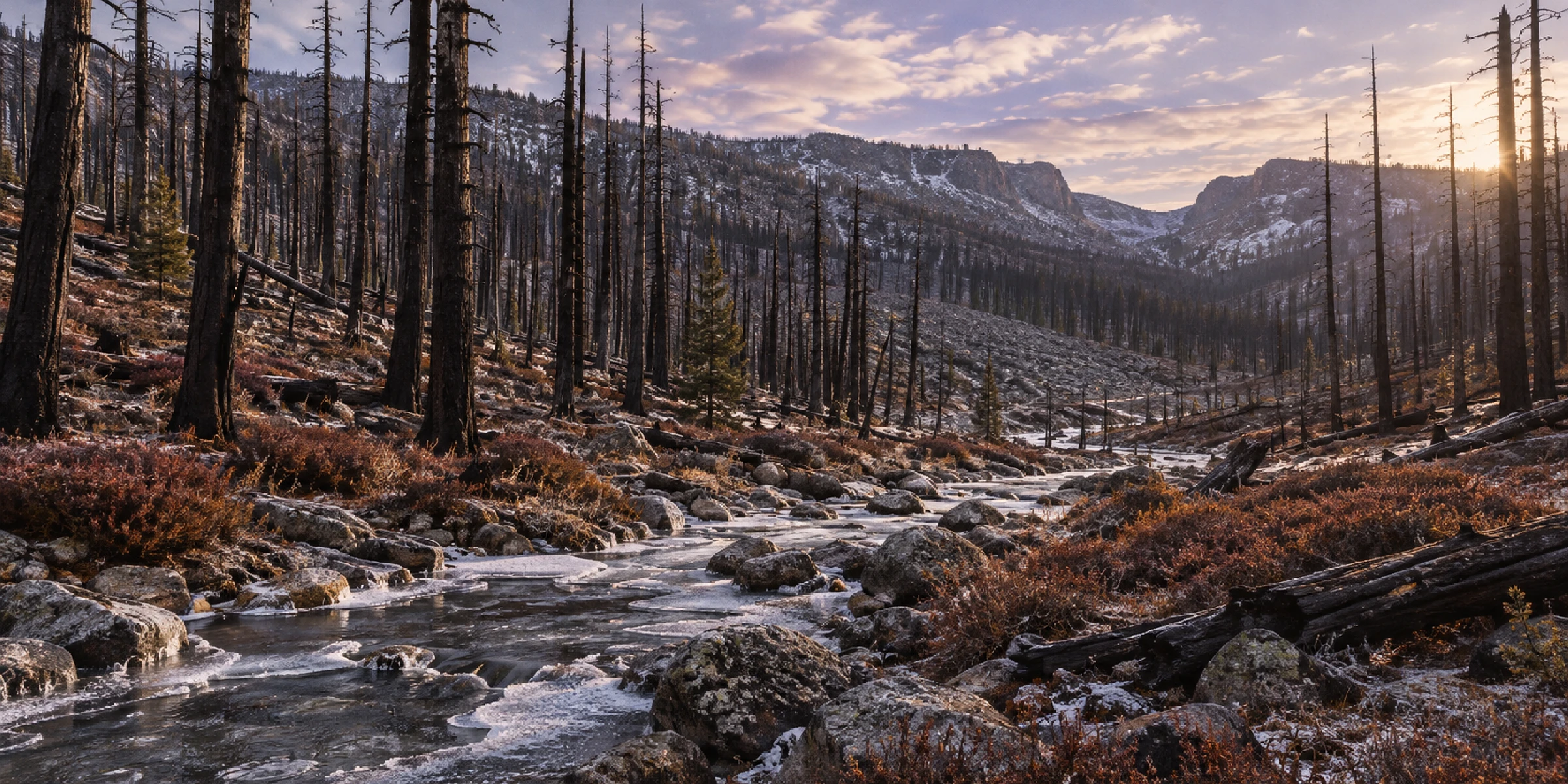
Frost Creek Through Burned Pines
A silver ribbon of frost threads through a burned pine basin toward a distant ridge notch. Soft analog grain and expressive depth give the scarred woodland the stillness of early morning.
Remix this referenceFrost Creek Through Burned Pines
- Form language
- Retain photographic irregularity while simplifying distant detail into broad connected masses; natural local variation is welcome.
- Contour
- Use unoutlined photographic edges: crisp broken detail nearby, softer boundaries at distance, and occasional edges lost in shadow.
- Mark-making
- Introduce fine, irregular film grain with modest density variation; preserve organic detail without digital sharpening halos.
- Surface rendering
- Use chromogenic-print tonal depth, gently lifted blacks and rounded highlight transitions, with subtle emulsion softness in small detail.
Priority
Analog photographic depth and film response define the finished treatment.
What to avoid & what to check
Exact prompt for this example
MODULE OWNERSHIP
subject: Subject count, type, stable proportions and landmarks, resting face geometry, hair shape, physical materials, garment construction and permanent marks. No emotion, movement, color assignment or rendering recipe.
expression: Facial soft-tissue displacement and pupil direction, muscle coordination, regional intensity, asymmetry and onset/peak/release. No head/body pose, stable appearance, skin color or rendering.
gesture: Head/neck/body/limb orientation, joint movement, support, contact and pose-caused occlusion using existing anatomy. No eye/pupil movement, emotion, identity, props inventory or camera.
props: Prop count, type, construction, physical material and scale relative to the subject. Holding/contact belongs to gesture, position to composition, color to palette.
scene: Environment elements, terrain, backdrop/floor presence and structural detail. No canvas positions, camera, lighting, assigned colors or render texture.
camera: Projection, focal-length impression, camera elevation/yaw/roll, viewing distance and crop. No actor pose, world placement, lighting or canvas aspect ratio.
composition: Normalized 0-100% canvas positions, scale in frame, depth/overlap, focal hierarchy and margins. No joint pose, camera projection, rendering, subject/prop inventory or emotion.
palette: Color anchors, hue/saturation/value ranges, colors assigned to parts and approximate color coverage. No illumination direction, shading algorithm, physical material or layout.
lighting: Light-source direction/softness/intensity, ambient illumination, physical shadow direction/length and highlight position. Absence of directional illumination is allowed. No shading technique, palette or material changes.
style: Reusable form abstraction, contour weight/taper/edge quality, medium and mark scale/density/direction, surface rendering and tonal transition technique. No fixed subject proportions, anatomy, identity, expression, pose, palette, light-source direction, camera or layout.
output: Image count, aspect ratio, size, file/alpha requirements and global lettering/logo/watermark restrictions. No background scenery, crop, style, identity or pose.

SUBJECT
inventory: One continuous landscape, without people or animals.
geometry: No discrete character geometry applies; environmental construction belongs to scene.
resting-face: No faces are present.
appearance: Bare timber, exposed stone and ice provide the landscape's physical substance.

PRIORITY


AVOID


CHECK


PROPS
inventory: No separate props.
construction: No prop construction applies.

PRIORITY


AVOID


CHECK


SCENE
inventory: A burned pine basin in upland terrain contains a frost-lined creek, heather patches, a stony fan and a distant ridge beneath open sky with thin cloud.
structure: The creek has thin surface ice, winds between standing trunks, crosses the stony fan and disappears through a notch in the ridge.

PRIORITY


AVOID


CHECK


CAMERA
projection: Use rectilinear perspective with a moderate wide-angle lens impression and natural distance expansion.
viewpoint: View from low standing height, looking gently down the basin with level roll.
crop: Include the nearby creek bank through the distant sky; let a few outer trunks continue beyond the side edges.

PRIORITY


AVOID


CHECK


COMPOSITION
placement: The frost ribbon enters at lower left and leads toward a notch right of center; keep the ridge in the upper third.
depth: Large nearby trunks overlap the creek in places; smaller woodland layers recede toward the ridge.
spacing: Make the creek the primary visual journey, with irregular trunk gaps and generous sky above the destination.

PRIORITY


AVOID


CHECK


PALETTE
colors: Anchor the image in charcoal, pewter silver, subdued russet and pale lavender, with restrained saturation.
assignment: Assign charcoal to trunks, pewter to frost and ice, russet to heather, and pale lavender to sky and distant ridge.
balance: Dark woodland and pale sky form the broad color fields; silver provides a narrow accent and russet a quiet counterpoint.

PRIORITY


AVOID


CHECK


LIGHTING
sources: Diffuse sunlight from a low sun enters from upper right, supported by broad, gentle sky illumination.
shadows: Trunks cast long, softened shadows toward lower left; ambient light keeps the basin's recesses legible.
highlights: Small highlights gather on right-facing ice edges and exposed upper stone surfaces.

PRIORITY


AVOID


CHECK


STYLE GUIDE
form-language: Retain photographic irregularity while simplifying distant detail into broad connected masses; natural local variation is welcome.
contour: Use unoutlined photographic edges: crisp broken detail nearby, softer boundaries at distance, and occasional edges lost in shadow.
mark-making: Introduce fine, irregular film grain with modest density variation; preserve organic detail without digital sharpening halos.
surface-rendering: Use chromogenic-print tonal depth, gently lifted blacks and rounded highlight transitions, with subtle emulsion softness in small detail.

PRIORITY
Analog photographic depth and film response define the finished treatment.

AVOID


CHECK


OUTPUT
format: One finished image, 2:1 aspect ratio, 2400 × 1200 pixels, opaque JPEG.
restrictions: No lettering, logos or watermarks.

PRIORITY


AVOID


CHECK


FINAL INTEGRATION
scene + camera + composition: Environmental continuity and overlapping depth make the panorama readable as a journey through one place.
palette + lighting + style: Color restraint, visible light and analog tonal response cooperate to sustain quiet depth without losing surface detail.
Model information comes from image provenance. The same prompt may produce a different result.