Text to imageIllustrationStyle guide
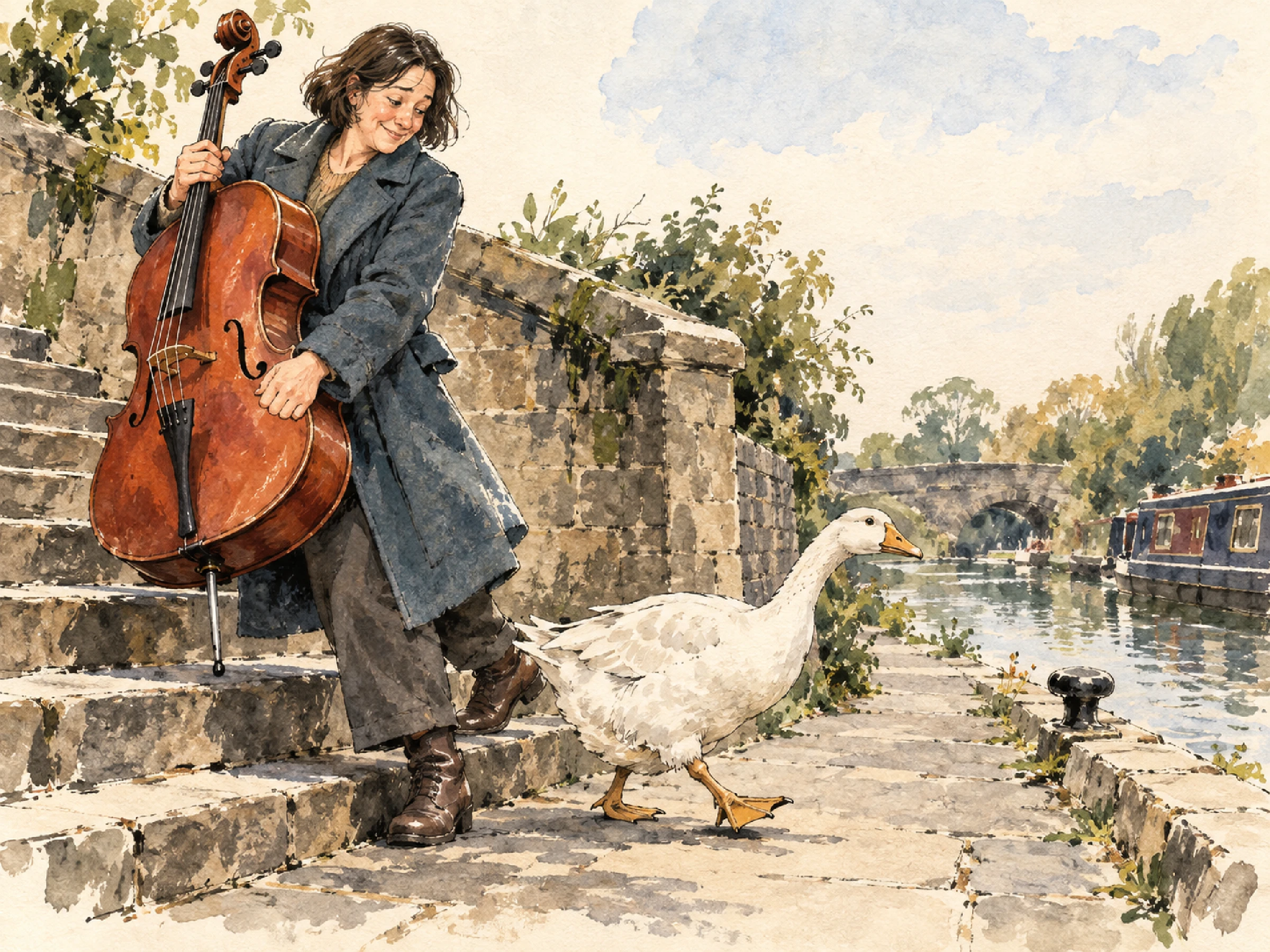
Cellist Letting a Goose Pass
A musician lifts her cello to let a goose pass on canal steps. Overlapping silhouettes, spreading ink washes, and generous untouched paper give the small interruption a lively rhythm.
Remix this referenceCellist Letting a Goose Pass
- Form language
- Reduce forms to buoyant, uneven masses with selective descriptive notches; let minor details vary within this economical vocabulary.
- Contour
- Use pressure-swollen brush contours that taper abruptly or break away; let adjacent washes complete some boundaries.
- Mark-making
- Alternate quick hooked ink strokes with broad wash sweeps; retain natural bristle skips and occasional pooled stroke endings.
- Surface rendering
- Build tone through translucent overlapping washes, wet blooms, and exposed paper; use crisp dry marks for a few descriptive accents.
Priority
Make editorial ink wash visible through assertive brushwork and untouched paper.
What to avoid & what to check
Exact prompt for this example
MODULE OWNERSHIP
subject: Subject count, type, stable proportions and landmarks, resting face geometry, hair shape, physical materials, garment construction and permanent marks. No emotion, movement, color assignment or rendering recipe.
expression: Facial soft-tissue displacement and pupil direction, muscle coordination, regional intensity, asymmetry and onset/peak/release. No head/body pose, stable appearance, skin color or rendering.
gesture: Head/neck/body/limb orientation, joint movement, support, contact and pose-caused occlusion using existing anatomy. No eye/pupil movement, emotion, identity, props inventory or camera.
props: Prop count, type, construction, physical material and scale relative to the subject. Holding/contact belongs to gesture, position to composition, color to palette.
scene: Environment elements, terrain, backdrop/floor presence and structural detail. No canvas positions, camera, lighting, assigned colors or render texture.
camera: Projection, focal-length impression, camera elevation/yaw/roll, viewing distance and crop. No actor pose, world placement, lighting or canvas aspect ratio.
composition: Normalized 0-100% canvas positions, scale in frame, depth/overlap, focal hierarchy and margins. No joint pose, camera projection, rendering, subject/prop inventory or emotion.
palette: Color anchors, hue/saturation/value ranges, colors assigned to parts and approximate color coverage. No illumination direction, shading algorithm, physical material or layout.
lighting: Light-source direction/softness/intensity, ambient illumination, physical shadow direction/length and highlight position. Absence of directional illumination is allowed. No shading technique, palette or material changes.
style: Reusable form abstraction, contour weight/taper/edge quality, medium and mark scale/density/direction, surface rendering and tonal transition technique. No fixed subject proportions, anatomy, identity, expression, pose, palette, light-source direction, camera or layout.
output: Image count, aspect ratio, size, file/alpha requirements and global lettering/logo/watermark restrictions. No background scenery, crop, style, identity or pose.

SUBJECT
inventory: A is one adult woman cellist; B is one domestic goose. No other figures.
geometry: A has a sturdy build and broad hands. B has a heavy oval body, long neck, wedge-shaped bill, and webbed feet.
resting-face: A has a broad face, rounded chin, wide nose, and almond-shaped eyes. B has small lateral eyes and a rigid bill.
appearance: A has an ear-length swept bob, a broad-lapelled wool coat, loose trousers, and leather ankle boots; B has dense feathers.

PRIORITY


AVOID


CHECK


EXPRESSION — ACTOR A
brows: One brow lifts slightly; the other stays relaxed.
lids: Upper lids remain open; lower lids tighten very gently.
cheeks: A small cheek lift begins beside the higher mouth corner.
nose: Nostrils and nose bridge remain relaxed.
mouth: Closed lips curve into a small, uneven smile.
jaw: Jaw stays loose without dropping open.
gaze: Pupils turn downward toward the passing goose.
coordination: The mouth leads the amusement; the upper face responds more quietly.
timing: Catch the first instant of the smile, before it broadens into laughter.

PRIORITY


AVOID


CHECK


EXPRESSION — ACTOR B
brows: The feathered brow area stays unraised and uncontracted.
lids: Visible eyelids stay naturally open without narrowing.
cheeks: The feathered cheek area remains at rest without lifting or bunching.
nose: The tissue around the nares remains still, without flaring.
mouth: The bill stays gently closed along its natural meeting line.
jaw: The lower bill remains at rest, without dropping or clamping.
gaze: Visible pupils aim ahead along the towpath rather than toward A.
coordination: Open lids and the closed bill form a quiet, neutral facial state.
timing: Hold the settled neutral state, with no facial reaction beginning or releasing.

PRIORITY


AVOID


CHECK


GESTURE
head: A dips her chin toward B; B extends its neck forward with its head held level.
torso: A leans back and turns slightly away from the passage; B carries its body forward in a stride.
limbs: A braces on separate steps and bends both elbows to lift the cello; B advances one foot while the other supports it.
contact: A grips the cello neck and cups its lower bout, keeping the endpin clear; B passes without touching either.

PRIORITY


AVOID


CHECK


PROPS
inventory: One full-sized cello, with a body roughly spanning A's hip-to-chest length and a neck extending beyond her shoulder.
construction: A hollow wooden body with curved bouts, bridge, paired sound holes, strings, scroll, and a slender metal endpin.

PRIORITY


AVOID


CHECK


SCENE
inventory: An outdoor canal landing with broad stone steps, a low parapet, a narrow towpath, and a glimpse of water.
structure: The steps meet the towpath at a cramped turn; worn stone joints provide sparse structural detail.

PRIORITY


AVOID


CHECK


CAMERA
projection: Natural perspective with a normal-lens impression and restrained depth compression.
viewpoint: Observe from slightly above the landing in a three-quarter view, with a level horizon.
crop: A medium-wide view includes both complete figures and the cello; nearby architecture extends beyond the edges.

PRIORITY


AVOID


CHECK


COMPOSITION
placement: A occupies the left third and B sits just right of the middle; the cello connects their silhouettes diagonally.
depth: The cello overlaps A's coat; B overlaps her boots below its neck. Hands and goose lead, followed by the instrument.
spacing: Gather the encounter low and left; leave a broad, irregular upper-right opening and clear gaps around B's head.

PRIORITY


AVOID


CHECK


PALETTE
colors: Warm paper ivory, charcoal, muted petrol blue, rusty vermilion, and a small ochre accent.
assignment: Petrol blue belongs to the coat, vermilion to the cello, ochre to bill and feet; goose and open areas retain ivory.
balance: Ivory dominates; charcoal supplies the deepest values, while the two muted color masses carry limited saturation.

PRIORITY


AVOID


CHECK


LIGHTING
sources: Broad, soft daylight arrives from upper left with ample ambient fill.
shadows: Short, soft shadows fall lower right; contact shadows deepen beneath boots and B's supporting foot.
highlights: Broad highlights occupy upper-left-facing surfaces, with a modest glint on the cello shoulder.

PRIORITY


AVOID


CHECK


STYLE GUIDE
form-language: Reduce forms to buoyant, uneven masses with selective descriptive notches; let minor details vary within this economical vocabulary.
contour: Use pressure-swollen brush contours that taper abruptly or break away; let adjacent washes complete some boundaries.
mark-making: Alternate quick hooked ink strokes with broad wash sweeps; retain natural bristle skips and occasional pooled stroke endings.
surface-rendering: Build tone through translucent overlapping washes, wet blooms, and exposed paper; use crisp dry marks for a few descriptive accents.

PRIORITY
Make editorial ink wash visible through assertive brushwork and untouched paper.

AVOID


CHECK


OUTPUT
format: One finished illustration, landscape 4:3, 2400 × 1800 pixels, opaque PNG.
restrictions: No lettering, logos, signatures, or watermarks.

PRIORITY


AVOID


CHECK


FINAL INTEGRATION
gesture + composition: Let the accommodation read through the overlap while preserving the encounter's essential gaps.
style + lighting: Translate the illumination into selective wash relationships while retaining spontaneous edges.
Model information comes from image provenance. The same prompt may produce a different result.