Text to imageLandscapeStyle guide
Tidal Creek · S-Curve Leading Line
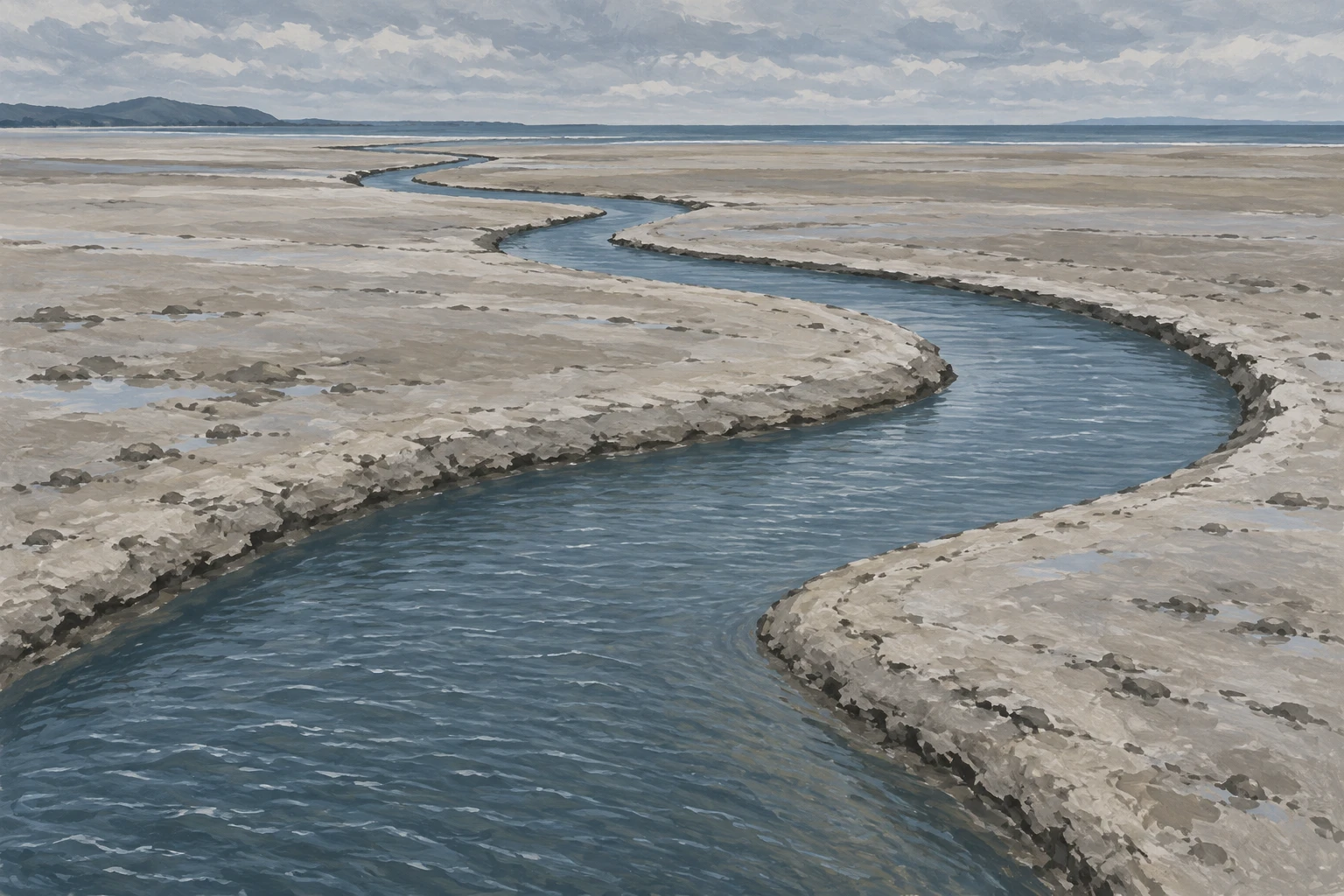
One creek crossing a pale tidal flat demonstrates how connected bends lead the eye from the foreground toward the distant horizon.
Tidal Creek · S-Curve Leading Line
- Shape & line
- Draw two continuous, gently irregular bank contours around the creek; make the foreground channel broad and let its width taper toward the horizon, preserving rounded bends rather than angular zigzags.
- Color & light
- Paint the mud banks in pale warm gray and the creek in muted blue-gray, keeping the water visibly darker along its entire route; use soft overcast light so cast shadows do not interrupt this contrast.
- Texture & material
- Use matte, opaque gouache strokes for the mud and smoother connected paint for the water. Add a few shallow ripple strokes across the foreground creek and sparse broken marks on the banks, leaving the distant flat mostly smooth.
- Composition
- Build the eye path from the lower-left entrance through the broad image-right bend to the smaller upper-left bend. Leave generous uninterrupted mud inside and outside each curve, and separate the distant creek from the horizon with a narrow visible strip of flat.
Priority
Make the continuous S-shaped water route the clearest organizing feature.
What to avoid & what to check
Avoid disconnected pools, equally wide distant bends, and busy bank textures that obscure the route.
Check that the eye can follow one unbroken creek from the lower-left foreground through both bends into the distance.
Exact prompt for this example
SUBJECT
One winding tidal creek cuts through a broad, exposed tidal flat toward a distant sea horizon. Its connected bends form one continuous S-shaped route, with pale mud banks enclosing darker water.

COMPOSITION
Use an elevated, oblique view in a horizontal frame. The creek enters at the lower-left edge, bends toward the image-right middle ground, then returns toward the upper-left distance. Place the horizon in the upper quarter and keep both banks readable through the main bends.

STYLE GUIDE
1. Shape & line
Draw two continuous, gently irregular bank contours around the creek; make the foreground channel broad and let its width taper toward the horizon, preserving rounded bends rather than angular zigzags.

2. Color & light
Paint the mud banks in pale warm gray and the creek in muted blue-gray, keeping the water visibly darker along its entire route; use soft overcast light so cast shadows do not interrupt this contrast.

3. Texture & material
Use matte, opaque gouache strokes for the mud and smoother connected paint for the water. Add a few shallow ripple strokes across the foreground creek and sparse broken marks on the banks, leaving the distant flat mostly smooth.

4. Composition
Build the eye path from the lower-left entrance through the broad image-right bend to the smaller upper-left bend. Leave generous uninterrupted mud inside and outside each curve, and separate the distant creek from the horizon with a narrow visible strip of flat.

PRIORITY
Preserve the requested identity, count, action, composition and output settings. Apply the style rules within those constraints; a style reference must not replace the subject or layout. Within the style: Make the continuous S-shaped water route the clearest organizing feature.

AVOID
Avoid disconnected pools, equally wide distant bends, and busy bank textures that obscure the route.

OUTPUT
Create one landscape image in a 3:2 aspect ratio, rendered as a naturalistic opaque gouache painting, with no text, labels, borders, or watermark.

SELF-CHECK
Check that the eye can follow one unbroken creek from the lower-left foreground through both bends into the distance.
Model information comes from image provenance. The same prompt may produce a different result.