Text to imageCharacterStyle guide
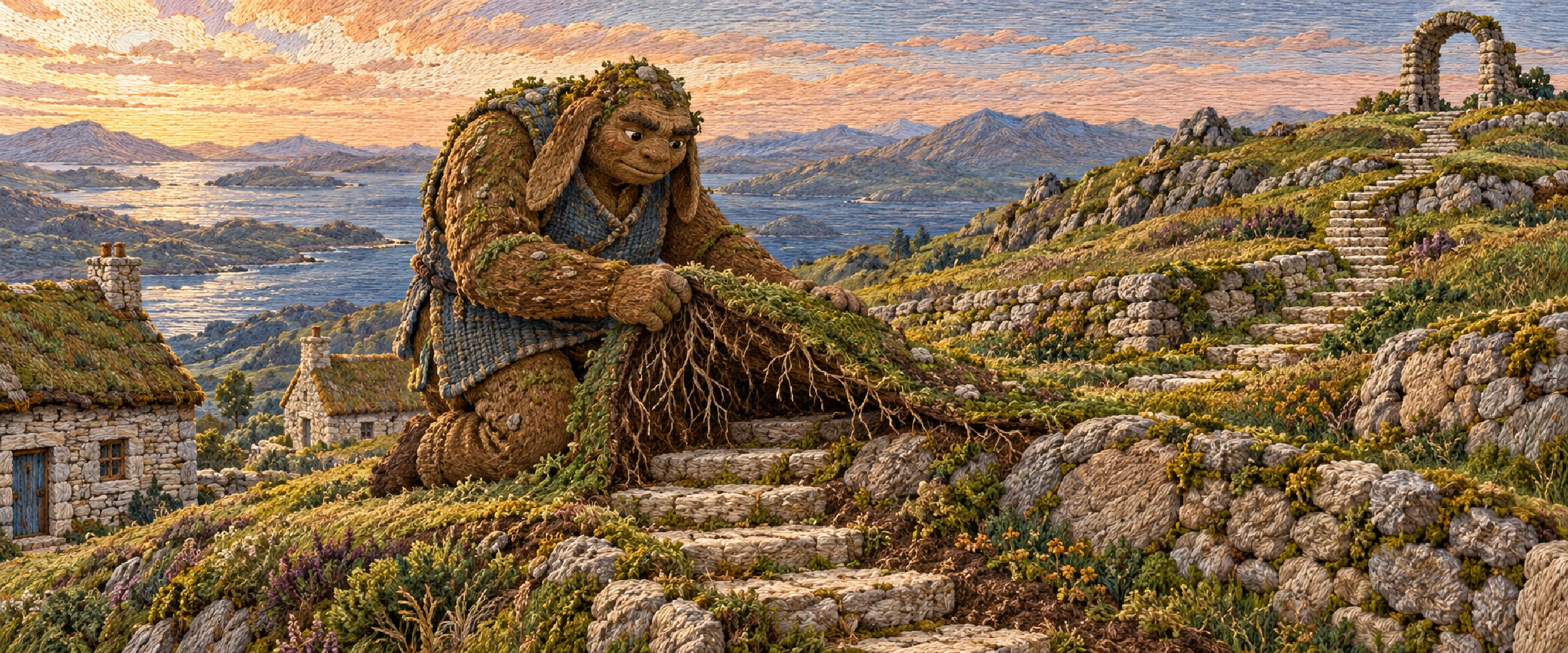
Giant Uncovering the Hillside Steps
A peat giant with drooping ears and long forearms peels back turf to uncover an old stairway. Raised embroidery carries the route from hillside cottages to an arch on the ridge.
Remix this referenceGiant Uncovering the Hillside Steps
- Form language
- Translate forms into softly interlocking textile shapes, with simplified planes and naturally uneven handmade boundaries.
- Contour
- Use intermittent couched cords and stitched edges of changing thickness; allow adjacent stitched fields to meet without an outline.
- Mark-making
- Build flowing stitch directions with loose long-and-short embroidery; scatter a few knots and allow thread lengths to vary naturally.
- Surface rendering
- Layer raised yarn over visible woven backing; blend tones through interleaved threads while preserving gaps and tactile ridges.
Priority
The defining medium is embroidered textile illustration with visible thread relief.
What to avoid & what to check
Exact prompt for this example
MODULE OWNERSHIP
subject: Subject count, type, stable proportions and landmarks, resting face geometry, hair shape, physical materials, garment construction and permanent marks. No emotion, movement, color assignment or rendering recipe.
expression: Facial soft-tissue displacement and pupil direction, muscle coordination, regional intensity, asymmetry and onset/peak/release. No head/body pose, stable appearance, skin color or rendering.
gesture: Head/neck/body/limb orientation, joint movement, support, contact and pose-caused occlusion using existing anatomy. No eye/pupil movement, emotion, identity, props inventory or camera.
props: Prop count, type, construction, physical material and scale relative to the subject. Holding/contact belongs to gesture, position to composition, color to palette.
scene: Environment elements, terrain, backdrop/floor presence and structural detail. No canvas positions, camera, lighting, assigned colors or render texture.
camera: Projection, focal-length impression, camera elevation/yaw/roll, viewing distance and crop. No actor pose, world placement, lighting or canvas aspect ratio.
composition: Normalized 0-100% canvas positions, scale in frame, depth/overlap, focal hierarchy and margins. No joint pose, camera projection, rendering, subject/prop inventory or emotion.
palette: Color anchors, hue/saturation/value ranges, colors assigned to parts and approximate color coverage. No illumination direction, shading algorithm, physical material or layout.
lighting: Light-source direction/softness/intensity, ambient illumination, physical shadow direction/length and highlight position. Absence of directional illumination is allowed. No shading technique, palette or material changes.
style: Reusable form abstraction, contour weight/taper/edge quality, medium and mark scale/density/direction, surface rendering and tonal transition technique. No fixed subject proportions, anatomy, identity, expression, pose, palette, light-source direction, camera or layout.
output: Image count, aspect ratio, size, file/alpha requirements and global lettering/logo/watermark restrictions. No background scenery, crop, style, identity or pose.

SUBJECT
inventory: One original humanoid peat giant, actor A; no other characters.
geometry: A compact trunk, long forearms, sturdy short legs and long drooping ears create a distinctive working silhouette.
resting-face: A flattened oval face has wide-set eyes, thick brows, a broad blunt nose and a wide, naturally level mouth.
appearance: Supple peat forms the body, with embedded stones and moss at the crown; a sleeveless hemp coat has overlapping front panels.

PRIORITY


AVOID


CHECK


EXPRESSION — ACTOR A
brows: Draw the brows slightly inward, keeping their outer ends loose.
lids: Narrow the lids mildly without squeezing them shut.
cheeks: Keep the cheeks mostly relaxed, with slight tension beside the mouth.
nose: Keep the nose smooth and the nostrils unflared.
mouth: Press the lips together gently, with one corner slightly higher.
jaw: Hold the jaw steady without a visible clench.
gaze: Aim both pupils at the newly exposed edge of the steps.
coordination: Let the brow and lid tension carry concentration while the lower face stays restrained.
timing: Show the apex of sustained concentration, with no sudden facial change.

PRIORITY


AVOID


CHECK


GESTURE
head: Bend the neck forward and turn the face toward the uncovered stair edge.
torso: Kneel with the torso leaning back slightly against the resistance of the lifted turf.
limbs: Draw both elbows back as the hands raise a broad turf flap; keep the visible lower leg folded beneath the body.
contact: Both hands grip the turf edge while the knees bear weight on the hillside; the lifted flap partly hides the fingers.

PRIORITY


AVOID


CHECK


PROPS
inventory: No separate props.
construction: No prop construction applies.

PRIORITY


AVOID


CHECK


SCENE
inventory: A terraced hillside with old stone steps, a loose turf layer, two stone cottages and a freestanding ridge arch.
structure: The stair route connects the cottages to the ridge through retaining walls; exposed roots bind the lifted turf into a flexible mat.

PRIORITY


AVOID


CHECK


CAMERA
projection: Use gently compressed perspective with enough recession to distinguish the successive hillside terraces.
viewpoint: Look across the slope from a slightly elevated, oblique viewpoint with a level roll.
crop: Use a distant environmental full-body view, retaining the complete giant and the route's two endpoints.

PRIORITY


AVOID


CHECK


COMPOSITION
placement: Place the giant left of center as the main focus; the stair route carries attention toward the distant right-hand arch.
depth: Foreground cottages introduce the route; the giant overlaps the middle terraces, followed by smaller ascending stair sections.
spacing: Give the giant substantial frame height while leaving a broad stretch of landscape to the right and open space above the ridge.

PRIORITY


AVOID


CHECK


PALETTE
colors: Use peat umber, moss green, faded apricot and chalk cream, with a small deep-blue accent.
assignment: Umber belongs to the giant and earth, green to vegetation, apricot to the sky, cream to stonework, blue to the coat.
balance: Let subdued earth and vegetation hues occupy most of the image; reserve the darkest blue for the coat.

PRIORITY


AVOID


CHECK


LIGHTING
sources: Soft daylight comes from the upper left, with broad ambient fill across the hillside.
shadows: Gentle cast shadows fall to the right; small stitches cast close shadows that reveal their physical relief.
highlights: Thread ridges catch small highlights on their upper-left edges, with broader illumination over exposed upper surfaces.

PRIORITY


AVOID


CHECK


STYLE GUIDE
form-language: Translate forms into softly interlocking textile shapes, with simplified planes and naturally uneven handmade boundaries.
contour: Use intermittent couched cords and stitched edges of changing thickness; allow adjacent stitched fields to meet without an outline.
mark-making: Build flowing stitch directions with loose long-and-short embroidery; scatter a few knots and allow thread lengths to vary naturally.
surface-rendering: Layer raised yarn over visible woven backing; blend tones through interleaved threads while preserving gaps and tactile ridges.

PRIORITY
The defining medium is embroidered textile illustration with visible thread relief.

AVOID


CHECK


OUTPUT
format: One finished image, 12:5 aspect ratio, 2400 × 1000 pixels, opaque PNG; no lettering, logos or watermarks.
restrictions: One finished image, 12:5 aspect ratio, 2400 × 1000 pixels, opaque PNG; no lettering, logos or watermarks.

PRIORITY


AVOID


CHECK


FINAL INTEGRATION
gesture + scene: The character's effort and the terrain's response should read as one continuous action.
composition + style + lighting: The route remains legible through the textile surface, while illumination makes the embroidery's relief tangible.
Model information comes from image provenance. The same prompt may produce a different result.