Text to imageAnimationStyle guide
Meltwater in the Summer Icehouse
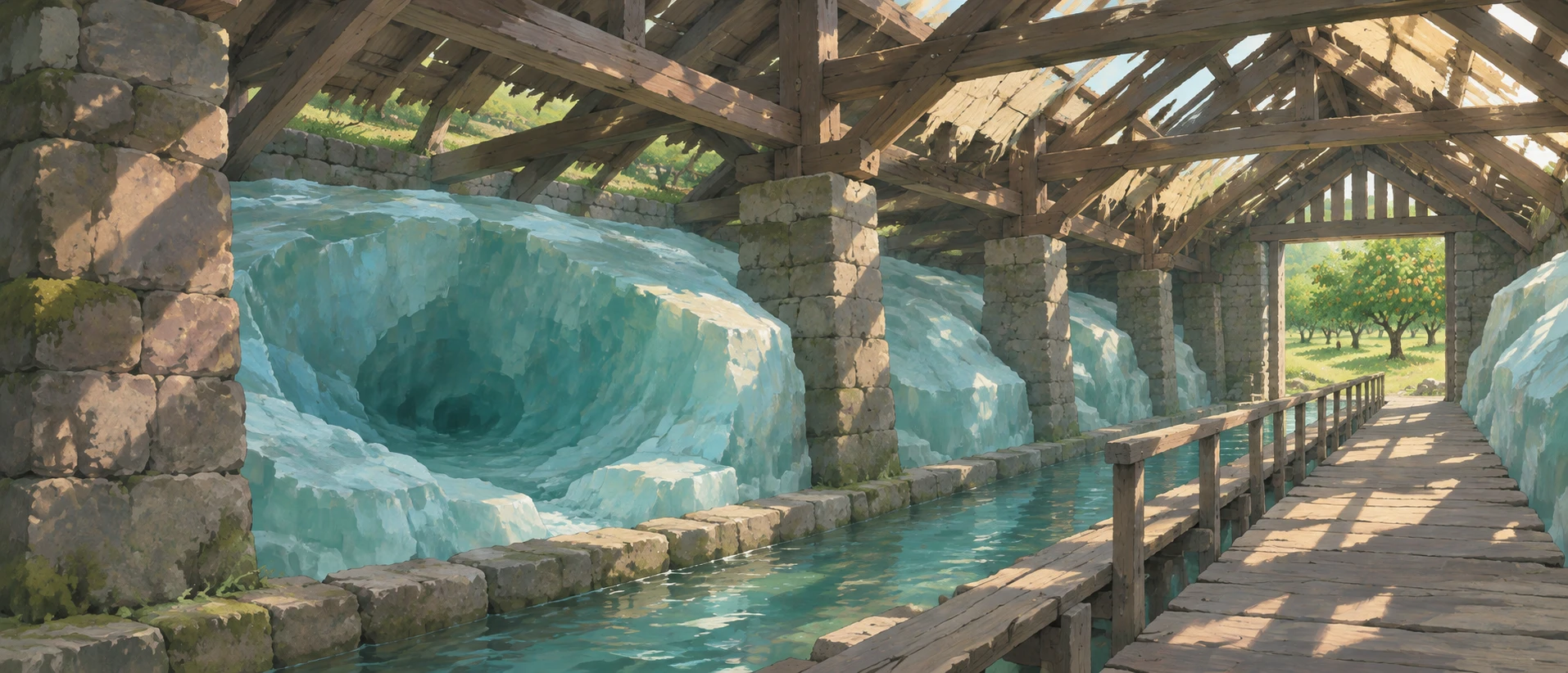
Summer daylight enters a roof-damaged icehouse. A meltwater channel and inspection walk wind between hollowed ice masses toward an open doorway and an orchard beyond.
Remix this referenceMeltwater in the Summer Icehouse
- Form language
- Establish broad interlocking painted planes before smaller surface variations; simplify detail while allowing coherent irregularity.
- Contour
- Define forms with alternating hard and soft painted boundaries; use brief tapered accents instead of continuous heavy outlines.
- Mark-making
- Overlap brush traces along each plane, varying their breadth naturally; sparse dry-brush breaks interrupt broader passages.
- Surface rendering
- Retain shallow paper-and-pigment grain beneath uneven opaque paint; blend tonal transitions while leaving selected brush edges visible.
Priority
Rendering medium: 2D hand-painted animated-film background illustration; formal rendering reference: Studio Ghibli · 2020s · The Boy and the Heron (2023), background art
What to avoid & what to check
Exact prompt for this example
MODULE OWNERSHIP
subject: Subject count, type, stable proportions and landmarks, resting face geometry, hair shape, physical materials, garment construction and permanent marks. No emotion, movement, color assignment or rendering recipe.
expression: Facial soft-tissue displacement and pupil direction, muscle coordination, regional intensity, asymmetry and onset/peak/release. No head/body pose, stable appearance, skin color or rendering.
gesture: Head/neck/body/limb orientation, joint movement, support, contact and pose-caused occlusion using existing anatomy. No eye/pupil movement, emotion, identity, props inventory or camera.
props: Prop count, type, construction, physical material and scale relative to the subject. Holding/contact belongs to gesture, position to composition, color to palette.
scene: Environment elements, terrain, backdrop/floor presence and structural detail. No canvas positions, camera, lighting, assigned colors or render texture.
camera: Projection, focal-length impression, camera elevation/yaw/roll, viewing distance and crop. No actor pose, world placement, lighting or canvas aspect ratio.
composition: Normalized 0-100% canvas positions, scale in frame, depth/overlap, focal hierarchy and margins. No joint pose, camera projection, rendering, subject/prop inventory or emotion.
palette: Color anchors, hue/saturation/value ranges, colors assigned to parts and approximate color coverage. No illumination direction, shading algorithm, physical material or layout.
lighting: Light-source direction/softness/intensity, ambient illumination, physical shadow direction/length and highlight position. Absence of directional illumination is allowed. No shading technique, palette or material changes.
style: Reusable form abstraction, contour weight/taper/edge quality, medium and mark scale/density/direction, surface rendering and tonal transition technique. No fixed subject proportions, anatomy, identity, expression, pose, palette, light-source direction, camera or layout.
output: Image count, aspect ratio, size, file/alpha requirements and global lettering/logo/watermark restrictions. No background scenery, crop, style, identity or pose.

SUBJECT
inventory: Environment only; no people, animals, or personified forms.
geometry: No character proportions or anatomical landmarks apply.
resting-face: No faces are present.
appearance: No character hair, clothing, or permanent marks apply.

PRIORITY


AVOID


CHECK


PROPS
inventory: No separate props.
construction: No prop construction applies.

PRIORITY


AVOID


CHECK


SCENE
inventory: A hillside icehouse contains stored lake ice, a runoff channel, and a timber inspection walk; an orchard grows outside.
structure: Stone piers support exposed rafters beneath a broken roof. Recessed ice bays have deep melt hollows; the channel and walk lead through an open gable doorway.

PRIORITY


AVOID


CHECK


CAMERA
projection: Rectilinear perspective with a gentle wide-angle impression and restrained edge stretching.
viewpoint: Eye-level view from the entrance end, looking obliquely along the hall with a level horizon.
crop: A broad establishing view includes the overhead rafters, channel floor, and distant doorway.

PRIORITY


AVOID


CHECK


COMPOSITION
placement: A scooped ice hollow dominates left of center; the channel enters at lower left and guides attention toward the doorway in the right third.
depth: Near piers overlap the ice bays; the inspection walk links these layers to the small orchard beyond the doorway.
spacing: Keep generous open intervals along the channel, with compressed ice masses on either side and breathing room around the distant opening.

PRIORITY


AVOID


CHECK


PALETTE
colors: Use glacier turquoise, dusty umber, pale straw, and orchard green, with small apricot accents.
assignment: Assign turquoise to ice and water, umber to masonry and timber, straw to roof remnants, and green with apricot fruit to the orchard.
balance: Turquoise and muted earth hues occupy most of the image; the orchard provides a smaller, more saturated counterpoint.

PRIORITY


AVOID


CHECK


LIGHTING
sources: Broad sunlight enters through roof gaps from upper right, supported by gentle diffuse sky illumination.
shadows: Rafter and pier shadows extend toward lower left with softened edges; ice hollows retain deeper shade.
highlights: Highlights gather on upper-right-facing ice ridges, with occasional narrow glints along the water.

PRIORITY


AVOID


CHECK


STYLE GUIDE
form-language: Establish broad interlocking painted planes before smaller surface variations; simplify detail while allowing coherent irregularity.
contour: Define forms with alternating hard and soft painted boundaries; use brief tapered accents instead of continuous heavy outlines.
mark-making: Overlap brush traces along each plane, varying their breadth naturally; sparse dry-brush breaks interrupt broader passages.
surface-rendering: Retain shallow paper-and-pigment grain beneath uneven opaque paint; blend tonal transitions while leaving selected brush edges visible.

PRIORITY
Rendering medium: 2D hand-painted animated-film background illustration; formal rendering reference: Studio Ghibli · 2020s · The Boy and the Heron (2023), background art

AVOID


CHECK


OUTPUT
format: One finished image, 21:9 aspect ratio, 3360 × 1440 pixels, opaque PNG.
restrictions: No lettering, logos, signatures, or watermarks.

PRIORITY


AVOID


CHECK


FINAL INTEGRATION
scene + composition + camera: Let the building's connected passages sustain the visual journey and remain legible across the establishing view.
palette + lighting + style: Preserve the distinction between assigned hues and physical illumination while the painted surfaces unify both.
Art direction
스튜디오 지브리 / Studio Ghibli · 2020s · 그대들은 어떻게 살 것인가(2023)의 배경 미술 / The Boy and the Heron (2023), background art ↗- Establish broad form planes before describing smaller surface variations with painted patches
- Use hard and soft painted boundaries rather than strong continuous outlines
- Overlapping brush traces following the plane direction with sparse dry-brush marks
- Shallow paper-and-pigment texture, uneven painted planes and blended tonal transitions
Model information comes from image provenance. The same prompt may produce a different result.