Text to imageCafe & brandStyle guide
Paper Lantern Raised in the Courtyard
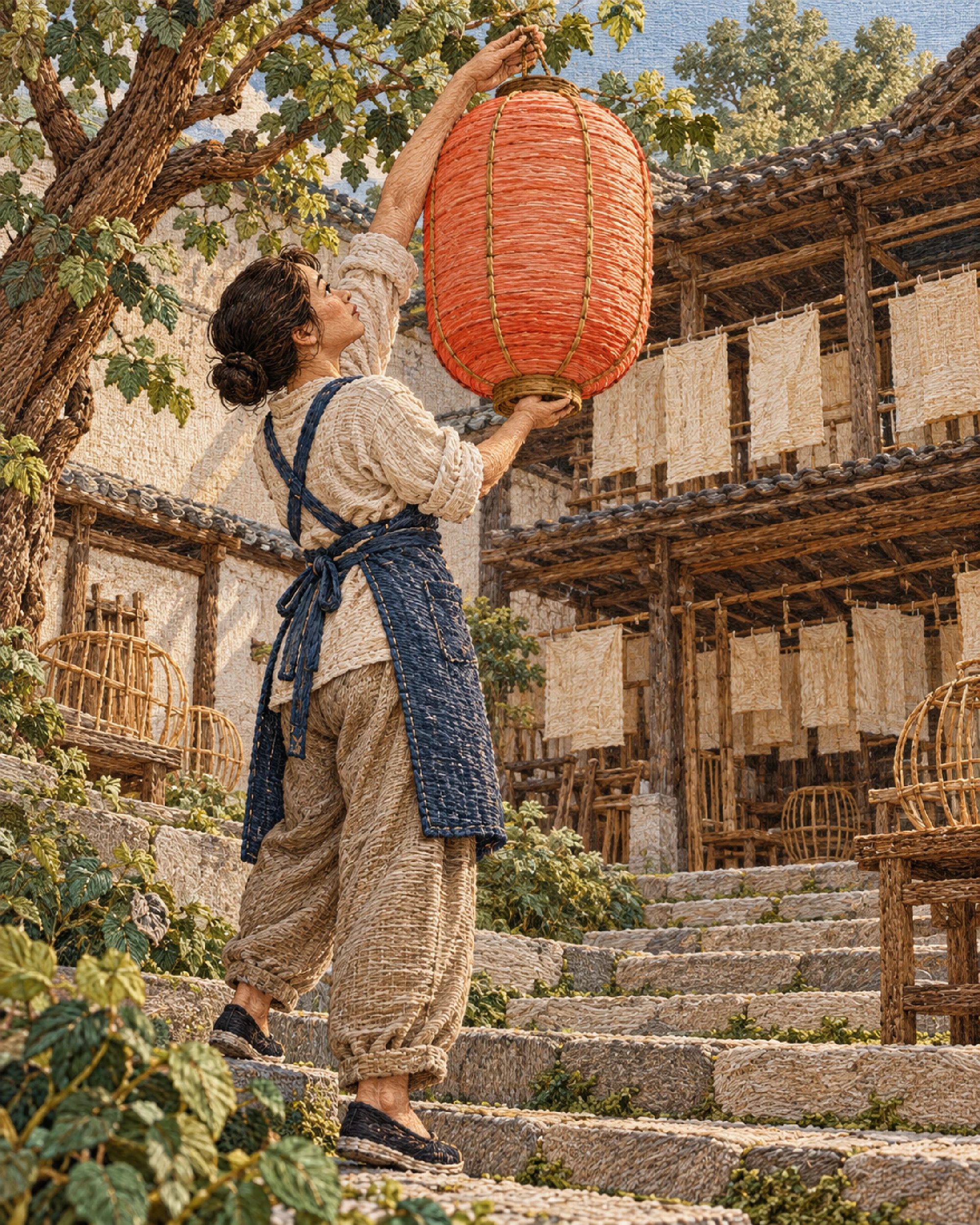
A craft brand illustration of a maker raising a paper lantern in a stepped workshop courtyard, built from raised embroidery.
Remix this referencePaper Lantern Raised in the Courtyard
- Form language
- Translate forms into broad appliqué-like masses with selective raised details; let small shapes vary within a coherent handmade vocabulary.
- Contour
- Use couched cord for major boundaries and softer stitched edges within them; allow slight wavering and occasional broken outlines.
- Mark-making
- Alternate long directional satin stitches with loose seed stitches; vary stitch length naturally and leave quiet passages of woven ground.
- Surface rendering
- Build tangible thread relief through overlapping stitch beds; blend tones by interleaving strands so transitions remain visibly fibrous.
Priority
The finished illustration must visibly read as raised embroidery on a woven textile ground.
What to avoid & what to check
Exact prompt for this example
MODULE OWNERSHIP
subject: Subject count, type, stable proportions and landmarks, resting face geometry, hair shape, physical materials, garment construction and permanent marks. No emotion, movement, color assignment or rendering recipe.
expression: Facial soft-tissue displacement and pupil direction, muscle coordination, regional intensity, asymmetry and onset/peak/release. No head/body pose, stable appearance, skin color or rendering.
gesture: Head/neck/body/limb orientation, joint movement, support, contact and pose-caused occlusion using existing anatomy. No eye/pupil movement, emotion, identity, props inventory or camera.
props: Prop count, type, construction, physical material and scale relative to the subject. Holding/contact belongs to gesture, position to composition, color to palette.
scene: Environment elements, terrain, backdrop/floor presence and structural detail. No canvas positions, camera, lighting, assigned colors or render texture.
camera: Projection, focal-length impression, camera elevation/yaw/roll, viewing distance and crop. No actor pose, world placement, lighting or canvas aspect ratio.
composition: Normalized 0-100% canvas positions, scale in frame, depth/overlap, focal hierarchy and margins. No joint pose, camera projection, rendering, subject/prop inventory or emotion.
palette: Color anchors, hue/saturation/value ranges, colors assigned to parts and approximate color coverage. No illumination direction, shading algorithm, physical material or layout.
lighting: Light-source direction/softness/intensity, ambient illumination, physical shadow direction/length and highlight position. Absence of directional illumination is allowed. No shading technique, palette or material changes.
style: Reusable form abstraction, contour weight/taper/edge quality, medium and mark scale/density/direction, surface rendering and tonal transition technique. No fixed subject proportions, anatomy, identity, expression, pose, palette, light-source direction, camera or layout.
output: Image count, aspect ratio, size, file/alpha requirements and global lettering/logo/watermark restrictions. No background scenery, crop, style, identity or pose.

SUBJECT
inventory: One adult woman, lantern maker A; no other people or animals.
geometry: Broad shoulders, a compact torso and a substantial apron silhouette give A a sturdy build.
resting-face: A has a broad nose, rounded chin, straight resting brows and a softly defined lip line.
appearance: A has a low hair coil, a collarless cotton shirt, a cross-back linen apron and loose sewn trousers.

PRIORITY


AVOID


CHECK


EXPRESSION — ACTOR A
brows: The visible brow lifts slightly without pulling inward.
lids: The visible upper lid lifts slightly; the lower lid stays relaxed.
cheeks: The visible cheek stays loose, without a smile-driven lift.
nose: The visible nostril and nose crease remain relaxed.
mouth: The lips meet softly, with the visible corner level.
jaw: The jaw remains unclenched, with no visible downward drop.
gaze: The visible pupil points upward toward the lantern's paper surface.
coordination: Keep the slight brow and lid lift coordinated with the quiet mouth; hidden features remain unprescribed.
timing: Hold a quiet apex of curiosity, with no transitional facial motion.

PRIORITY


AVOID


CHECK


GESTURE
head: A tips her head slightly back and turns left, exposing the near-side face.
torso: Her torso stretches upward with a slight sideways lean, continuing the lifting action through her back.
limbs: One arm extends overhead, the other bends before her chest; offset feet support the standing pose.
contact: The upper hand grips the lantern loop, the lower palm supports its base, and both feet bear on the landing.

PRIORITY


AVOID


CHECK


PROPS
inventory: One large paper lantern, approximately the length of A's torso, with a single carrying loop.
construction: Thin mulberry paper encloses rounded bamboo ribs, with a small wooden base and a narrow cord loop.

PRIORITY


AVOID


CHECK


SCENE
inventory: An open lantern-workshop courtyard with stepped landings, drying galleries, plaster walls and a mature mulberry tree.
structure: Stone steps connect the landings. Timber galleries hold hanging paper sheets and include a broad opening; exposed roots cross paving joints.

PRIORITY


AVOID


CHECK


CAMERA
projection: Use natural perspective with a normal-lens impression and gentle depth compression.
viewpoint: View from A's rear-left quarter at waist height, with a modest upward pitch and no roll.
crop: Show A's complete figure and the whole lantern; let courtyard architecture continue beyond the edges.

PRIORITY


AVOID


CHECK


COMPOSITION
placement: Place A in the lower left third and the lantern above the middle; position the gallery opening on the right for balance.
depth: Foreground foliage overlaps the lowest steps; A and the lantern precede staggered galleries and the distant tree crown.
spacing: Make the lantern the first focal point and A's hands the second; leave breathing room around the lantern's outline.

PRIORITY


AVOID


CHECK


PALETTE
colors: Use persimmon coral, deep indigo, muted mulberry green and warm flax, with restrained natural skin tones.
assignment: Assign coral to the lantern, indigo to the apron, green to vegetation, and flax tones to paper sheets and plaster.
balance: Flax tones occupy the broadest area; the lantern carries the strongest saturation and indigo supplies a dark anchor.

PRIORITY


AVOID


CHECK


LIGHTING
sources: Broad daylight enters from the upper left with soft courtyard fill; the lantern itself is unlit.
shadows: Soft shadows fall toward the lower right; small contact shadows sit beneath raised surface ridges.
highlights: Gentle highlights touch upper-left surface ridges and the lantern's exposed rim.

PRIORITY


AVOID


CHECK


STYLE GUIDE
form-language: Translate forms into broad appliqué-like masses with selective raised details; let small shapes vary within a coherent handmade vocabulary.
contour: Use couched cord for major boundaries and softer stitched edges within them; allow slight wavering and occasional broken outlines.
mark-making: Alternate long directional satin stitches with loose seed stitches; vary stitch length naturally and leave quiet passages of woven ground.
surface-rendering: Build tangible thread relief through overlapping stitch beds; blend tones by interleaving strands so transitions remain visibly fibrous.

PRIORITY
The finished illustration must visibly read as raised embroidery on a woven textile ground.

AVOID


CHECK


OUTPUT
format: Deliver one finished image, portrait 4:5, 2000 × 2500 pixels, as an opaque PNG.
restrictions: No lettering, logos, signatures or watermarks.

PRIORITY


AVOID


CHECK


FINAL INTEGRATION
subject + gesture + camera + expression: The partial facial view accommodates the acting controls while retaining the expansive lifting gesture.
gesture + props + composition: The grip and support remain legible through the overlaps around the lantern.
style + lighting: Light reveals the embroidered surface while stitched transitions continue to carry the tonal modeling.
Model information comes from image provenance. The same prompt may produce a different result.