Text to imageArt stylesStyle guide
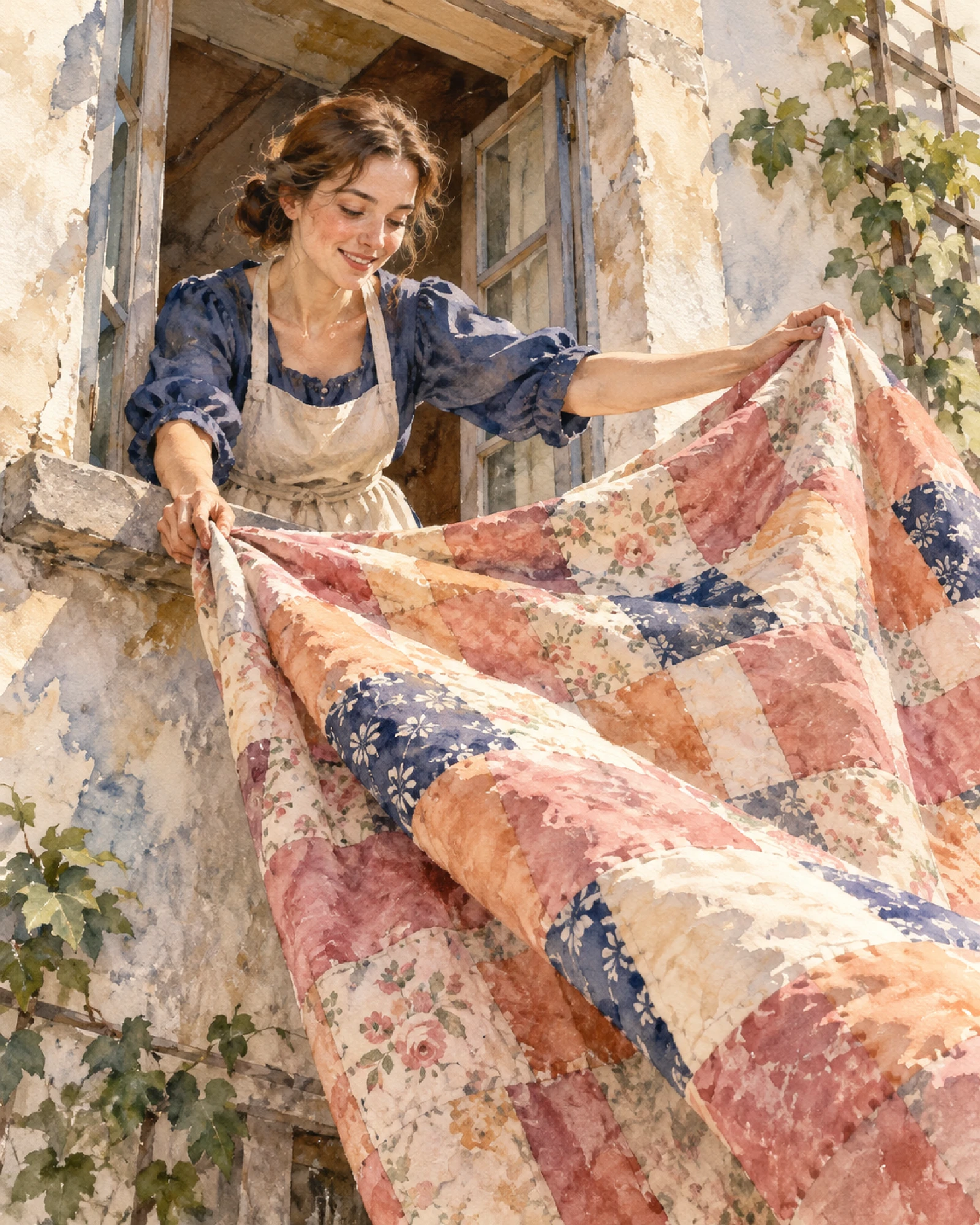
Quilt Unfurled from a Window
A woman shakes a quilt open from a window. Overlapping cloth waves and window edges meet in blooming watercolor washes and broken contours.
Remix this referenceQuilt Unfurled from a Window
- Form language
- Simplify forms into broad interlocking wash shapes; let small irregularities keep the construction lively.
- Contour
- Use broken brush-defined edges, alternating crisp fragments with lost wet edges; avoid a continuous enclosing line.
- Mark-making
- Lay generous wet strokes beside quick dry-brush skips; allow uneven blooms and occasional pooled pigment to arise naturally.
- Surface rendering
- Build volume through transparent wash overlaps, soft bleeding transitions and paper reserves rather than uniform blended modeling.
Priority
Make watercolor blooms and broken edges visibly integral to the finished image.
What to avoid & what to check
Exact prompt for this example
MODULE OWNERSHIP
subject: Subject count, type, stable proportions and landmarks, resting face geometry, hair shape, physical materials, garment construction and permanent marks. No emotion, movement, color assignment or rendering recipe.
expression: Facial soft-tissue displacement and pupil direction, muscle coordination, regional intensity, asymmetry and onset/peak/release. No head/body pose, stable appearance, skin color or rendering.
gesture: Head/neck/body/limb orientation, joint movement, support, contact and pose-caused occlusion using existing anatomy. No eye/pupil movement, emotion, identity, props inventory or camera.
props: Prop count, type, construction, physical material and scale relative to the subject. Holding/contact belongs to gesture, position to composition, color to palette.
scene: Environment elements, terrain, backdrop/floor presence and structural detail. No canvas positions, camera, lighting, assigned colors or render texture.
camera: Projection, focal-length impression, camera elevation/yaw/roll, viewing distance and crop. No actor pose, world placement, lighting or canvas aspect ratio.
composition: Normalized 0-100% canvas positions, scale in frame, depth/overlap, focal hierarchy and margins. No joint pose, camera projection, rendering, subject/prop inventory or emotion.
palette: Color anchors, hue/saturation/value ranges, colors assigned to parts and approximate color coverage. No illumination direction, shading algorithm, physical material or layout.
lighting: Light-source direction/softness/intensity, ambient illumination, physical shadow direction/length and highlight position. Absence of directional illumination is allowed. No shading technique, palette or material changes.
style: Reusable form abstraction, contour weight/taper/edge quality, medium and mark scale/density/direction, surface rendering and tonal transition technique. No fixed subject proportions, anatomy, identity, expression, pose, palette, light-source direction, camera or layout.
output: Image count, aspect ratio, size, file/alpha requirements and global lettering/logo/watermark restrictions. No background scenery, crop, style, identity or pose.

SUBJECT
inventory: One original adult woman, actor A.
geometry: An ordinary adult build with a long oval face, broad forehead and softly squared chin.
resting-face: Straight brows, almond-shaped eyes, a rounded nose tip and a broad natural mouth define the resting face.
appearance: Hair forms a loose low knot; a woven blouse has roomy sleeves, and a plain apron ties at the waist.

PRIORITY


AVOID


CHECK


EXPRESSION — ACTOR A
brows: Brows rise slightly, with one outer end a little higher.
lids: Lower lids lift gently; upper lids remain comfortably open.
cheeks: Cheeks bunch upward, slightly stronger on the higher-smiling side.
nose: Nostrils remain relaxed, with no nose wrinkling.
mouth: A small parted smile lifts one corner more than the other.
jaw: Jaw releases just enough for the parted smile.
gaze: Pupils look downward toward the quilt's nearest fold.
coordination: Cheek lift and mouth-corner lift agree; the eyes retain a soft, unstrained opening.
timing: Capture the apex of brief amusement before the smile begins to settle.

PRIORITY


AVOID


CHECK


GESTURE
head: Head inclines toward the cloth; the neck follows the forward reach without a sharp bend.
torso: The upper torso leans through the opening, with the lower body remaining inside and out of view.
limbs: Both arms extend outward at different heights as a broad outward shake opens the quilt.
contact: Hands grip two corners; the lower forearm rests briefly on the sill, and cloth partly hides that wrist.

PRIORITY


AVOID


CHECK


PROPS
inventory: One bed-sized patchwork quilt, substantially broader than the woman's arm span.
construction: Soft woven patches surround a lightly padded center with a supple bound border; patch sizes may vary.

PRIORITY


AVOID


CHECK


SCENE
inventory: An open upper-storey window above a small courtyard, with a plaster wall and a sparse vine trellis.
structure: A deep window recess and worn stone sill establish the facade; only a suggestion of courtyard paving is needed.

PRIORITY


AVOID


CHECK


CAMERA
projection: Natural perspective with a normal-lens impression and mild depth convergence.
viewpoint: Look gently upward from the courtyard with a slight side yaw and level roll.
crop: Include the window opening, face and forearms; let the quilt's lower edge continue beyond the frame.

PRIORITY


AVOID


CHECK


COMPOSITION
placement: The face sits near 30% across and 25% down; the quilt dominates the middle and lower-right, with the face leading attention.
depth: The quilt overlaps the sill and facade; its nearest fold overlaps another broad fold without concealing the face.
spacing: Leave a spacious wall interval above the cloth and a small clear opening around the face.

PRIORITY


AVOID


CHECK


PALETTE
colors: Use apricot, dusty rose, deep indigo and warm ivory, with muted supporting greens.
assignment: Apricot and rose alternate through the quilt; indigo marks the blouse, ivory the wall, and greens the vine.
balance: Pale ivory occupies the largest area; warm cloth colors carry the broad accent, with indigo kept compact.

PRIORITY


AVOID


CHECK


LIGHTING
sources: Broad, soft daylight arrives from upper left, with gentle courtyard ambient light.
shadows: Short, soft shadows fall down and right beneath the sill and within the cloth folds.
highlights: The forehead, upper forearms and left-facing fold crests receive the brightest light.

PRIORITY


AVOID


CHECK


STYLE GUIDE
form-language: Simplify forms into broad interlocking wash shapes; let small irregularities keep the construction lively.
contour: Use broken brush-defined edges, alternating crisp fragments with lost wet edges; avoid a continuous enclosing line.
mark-making: Lay generous wet strokes beside quick dry-brush skips; allow uneven blooms and occasional pooled pigment to arise naturally.
surface-rendering: Build volume through transparent wash overlaps, soft bleeding transitions and paper reserves rather than uniform blended modeling.

PRIORITY
Make watercolor blooms and broken edges visibly integral to the finished image.

AVOID


CHECK


OUTPUT
format: Produce one finished image, 4:5 portrait, 1600 × 2000 pixels.
restrictions: Deliver an opaque PNG without lettering, logos or watermarks.

PRIORITY


AVOID


CHECK


FINAL INTEGRATION
expression + gesture + composition: Keep the facial performance readable while the cloth supplies the larger movement.
style + lighting: Let the wash transitions interpret the illumination without making every boundary equally explicit.
Model information comes from image provenance. The same prompt may produce a different result.