Text to imageComicsStyle guide
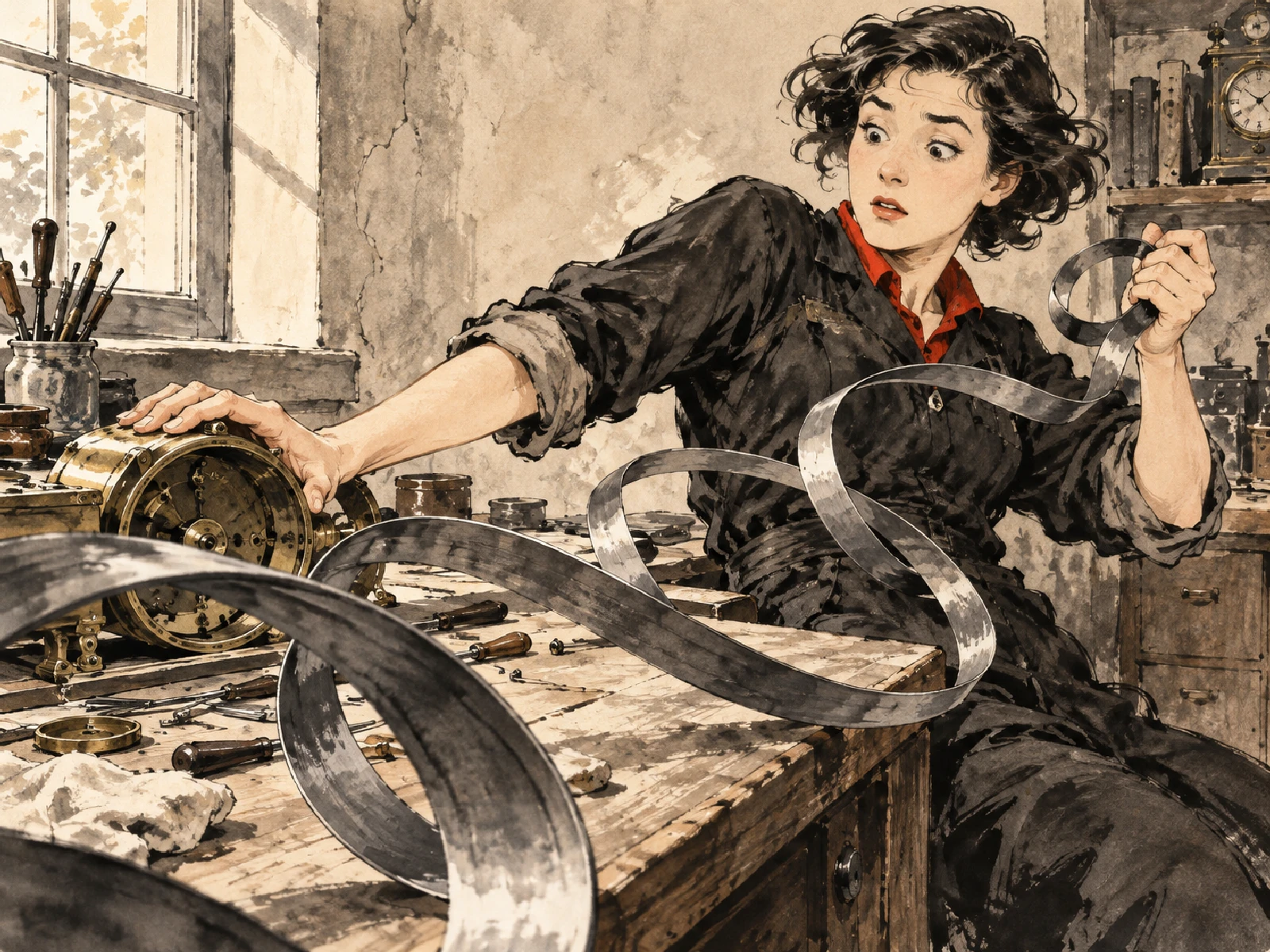
Clockmaker Gripping an Escaping Spring
A clockmaker recoils while gripping a large spring unwinding across her workbench. Whipping brush lines and spreading ink bind the metal loops and her startled face into one lively comic illustration.
Remix this referenceClockmaker Gripping an Escaping Spring
- Form language
- Reduce forms into elastic wedges and broad curved planes; let small irregularities keep the drawing spontaneous.
- Contour
- Alternate loaded brush swells with needle-fine tapered exits; break edges where a fast stroke runs dry.
- Mark-making
- Use sparse whipping accents, split-bristle drags, and brief scratchy corrections with naturally varied pressure.
- Surface rendering
- Join pooled ink masses to uneven diluted washes; preserve paper gaps and occasional tide edges instead of polished blending.
Priority
Rendering medium: expressive brush-ink manga illustration with diluted ink washes on paper.
What to avoid & what to check
Exact prompt for this example
MODULE OWNERSHIP
subject: Subject count, type, stable proportions and landmarks, resting face geometry, hair shape, physical materials, garment construction and permanent marks. No emotion, movement, color assignment or rendering recipe.
expression: Facial soft-tissue displacement and pupil direction, muscle coordination, regional intensity, asymmetry and onset/peak/release. No head/body pose, stable appearance, skin color or rendering.
gesture: Head/neck/body/limb orientation, joint movement, support, contact and pose-caused occlusion using existing anatomy. No eye/pupil movement, emotion, identity, props inventory or camera.
props: Prop count, type, construction, physical material and scale relative to the subject. Holding/contact belongs to gesture, position to composition, color to palette.
scene: Environment elements, terrain, backdrop/floor presence and structural detail. No canvas positions, camera, lighting, assigned colors or render texture.
camera: Projection, focal-length impression, camera elevation/yaw/roll, viewing distance and crop. No actor pose, world placement, lighting or canvas aspect ratio.
composition: Normalized 0-100% canvas positions, scale in frame, depth/overlap, focal hierarchy and margins. No joint pose, camera projection, rendering, subject/prop inventory or emotion.
palette: Color anchors, hue/saturation/value ranges, colors assigned to parts and approximate color coverage. No illumination direction, shading algorithm, physical material or layout.
lighting: Light-source direction/softness/intensity, ambient illumination, physical shadow direction/length and highlight position. Absence of directional illumination is allowed. No shading technique, palette or material changes.
style: Reusable form abstraction, contour weight/taper/edge quality, medium and mark scale/density/direction, surface rendering and tonal transition technique. No fixed subject proportions, anatomy, identity, expression, pose, palette, light-source direction, camera or layout.
output: Image count, aspect ratio, size, file/alpha requirements and global lettering/logo/watermark restrictions. No background scenery, crop, style, identity or pose.

SUBJECT
inventory: One adult woman, a clock repairer.
geometry: Compact adult build, broad cheekbones, a long straight nose, and a square chin.
resting-face: Almond eye openings, level brow baselines, and a thin upper lip above a fuller lower lip.
appearance: Swept-back wavy bob; woven cotton coveralls with a stand collar and rolled cuffs.

PRIORITY


AVOID


CHECK


EXPRESSION — ACTOR A
brows: Both brows lift, with the left rising slightly higher.
lids: Upper lids lift sharply; lower lids remain lightly tense.
cheeks: Cheeks stay mostly slack, without a smile lift.
nose: Nostrils widen subtly without wrinkling the bridge.
mouth: Lips part into a small uneven oval, one corner drawn sideways.
jaw: Jaw releases slightly rather than dropping fully.
gaze: Pupils track down-left toward the nearest spring loop.
coordination: The eyes react more strongly than the mouth; retain the uneven brow response.
timing: Catch surprise at onset, before the mouth opens into a shout.

PRIORITY


AVOID


CHECK


GESTURE
head: Head draws back over the neck while the chin remains directed toward the spring.
torso: Torso recoils from the bench, weight settling backward with a slight waist twist.
limbs: Left arm reaches toward the bench; right elbow folds beside the ribs with the wrist turned outward.
contact: Left palm pins the clock housing to the bench; right fingers grip the outer spring end.

PRIORITY


AVOID


CHECK


PROPS
inventory: Two props: an open table-clock housing and its broad ribbon mainspring.
construction: The head-sized brass housing has a circular cavity; the steel strip forms loose body-spanning coils.

PRIORITY


AVOID


CHECK


SCENE
inventory: A narrow repair room with a wooden workbench, deep window recess, and plaster wall.
structure: A thick bench slab rests on a solid cabinet base; the window has a simple divided sash.

PRIORITY


AVOID


CHECK


CAMERA
projection: Moderate wide-angle perspective with mild near-to-far enlargement.
viewpoint: View diagonally across the bench from slightly above its surface, with a level horizon.
crop: Three-quarter-length framing includes the head, both hands, and bench front; lower legs remain outside. Crop one foreground spring loop.

PRIORITY


AVOID


CHECK


COMPOSITION
placement: Face sits in the upper-right third; sweeping spring loops dominate the middle and lower left.
depth: A near loop overlaps the bench and sleeve; another passes behind the right forearm, leaving the face clear.
spacing: The face leads, then the right hand and spring; retain open wall around the head.

PRIORITY


AVOID


CHECK


PALETTE
colors: Soot black, warm paper ivory, cool gray, and a restrained vermilion accent.
assignment: Hair and coveralls carry black; spring carries cool gray; skin and wall retain ivory; collar carries vermilion.
balance: Ivory and black dominate, gray bridges them, and vermilion remains a small sharp interruption.

PRIORITY


AVOID


CHECK


LIGHTING
sources: Broad soft daylight enters from upper left, supported by gentle room ambience.
shadows: Short, soft shadows fall down-right across the bench; overlap contacts create deeper narrow shadows.
highlights: Broken highlights follow upper-left-facing spring edges and the upper cheek.

PRIORITY


AVOID


CHECK


STYLE GUIDE
form-language: Reduce forms into elastic wedges and broad curved planes; let small irregularities keep the drawing spontaneous.
contour: Alternate loaded brush swells with needle-fine tapered exits; break edges where a fast stroke runs dry.
mark-making: Use sparse whipping accents, split-bristle drags, and brief scratchy corrections with naturally varied pressure.
surface-rendering: Join pooled ink masses to uneven diluted washes; preserve paper gaps and occasional tide edges instead of polished blending.

PRIORITY
Rendering medium: expressive brush-ink manga illustration with diluted ink washes on paper.

AVOID


CHECK


OUTPUT
format: One finished illustration, landscape 4:3, 1600 × 1200 pixels, opaque PNG.
restrictions: No lettering, speech balloons, logos, or watermarks.

PRIORITY


AVOID


CHECK


FINAL INTEGRATION
expression + gesture + composition: Coordinate the facial reaction and recoil so overlapping action remains immediately readable.
style + lighting + palette: Let brush and wash variation interpret the established illumination and color roles without adding new effects.
Model information comes from image provenance. The same prompt may produce a different result.