Text to imagePortraitStyle guide
Woman Sounding a Metal Sheet
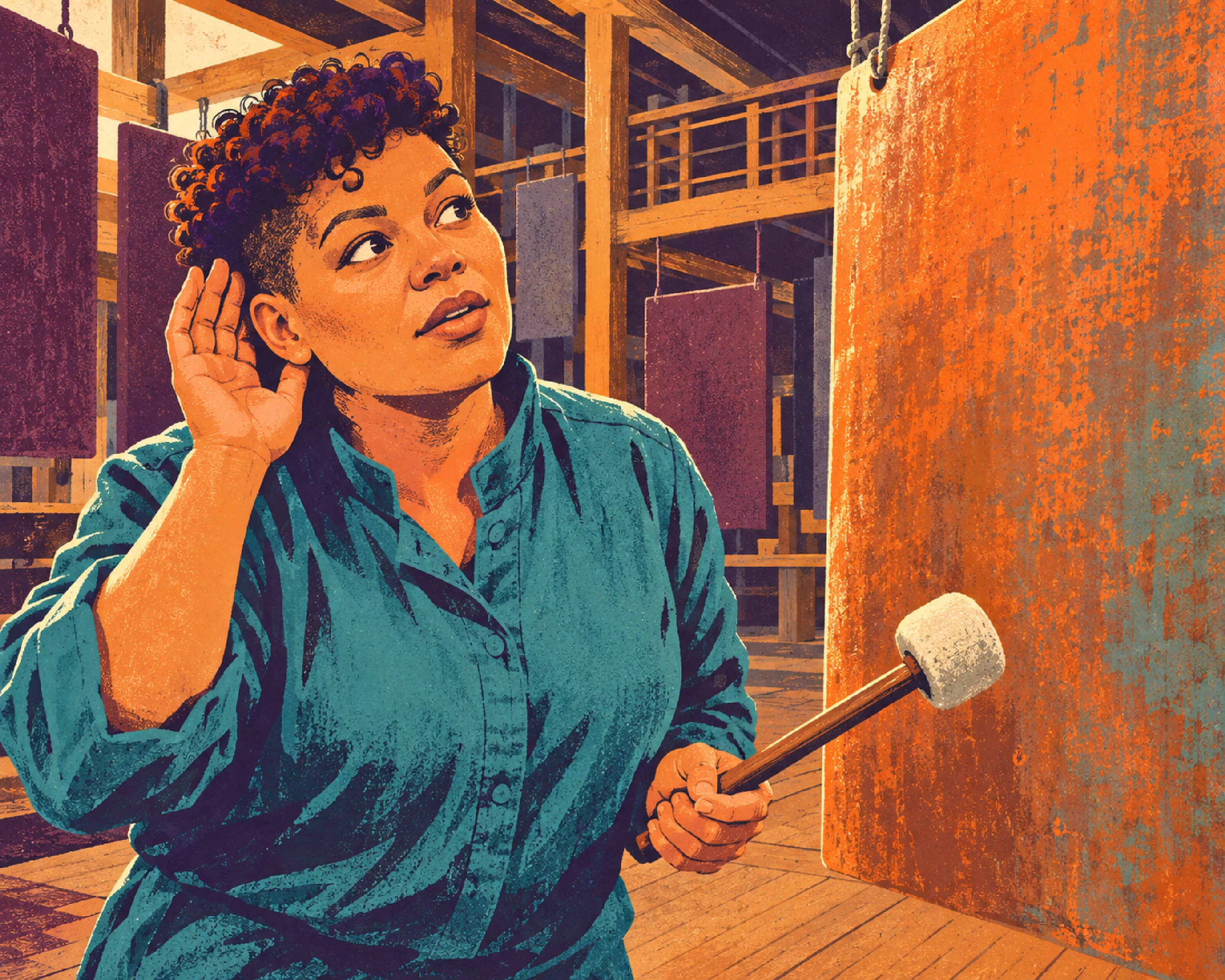
Inside a layered sound workshop, a woman listens after striking a large metal sheet. Bold screenprinted shapes and slipped ink edges build a rhythm around her hand and face.
Remix this referenceWoman Sounding a Metal Sheet
- Form language
- Reduce forms to interlocking wedges, hooked arcs and broad slabs, alternating compressed rhythms with long unbroken shapes.
- Contour
- Let ink boundaries carry most contours; reserve short, blunt contour strokes for essential internal separations.
- Mark-making
- Use broad squeegee pulls with occasional dry skips and slightly slipped overprints; irregularities should feel naturally printed.
- Surface rendering
- Build tone through stacked ink shapes and sparse broken hatching; keep transitions stepped while allowing tooth within large fields.
Priority
Make decisive screenprinted shape rhythms the defining visual treatment.
What to avoid & what to check
Exact prompt for this example
MODULE OWNERSHIP
subject: Subject count, type, stable proportions and landmarks, resting face geometry, hair shape, physical materials, garment construction and permanent marks. No emotion, movement, color assignment or rendering recipe.
expression: Facial soft-tissue displacement and pupil direction, muscle coordination, regional intensity, asymmetry and onset/peak/release. No head/body pose, stable appearance, skin color or rendering.
gesture: Head/neck/body/limb orientation, joint movement, support, contact and pose-caused occlusion using existing anatomy. No eye/pupil movement, emotion, identity, props inventory or camera.
props: Prop count, type, construction, physical material and scale relative to the subject. Holding/contact belongs to gesture, position to composition, color to palette.
scene: Environment elements, terrain, backdrop/floor presence and structural detail. No canvas positions, camera, lighting, assigned colors or render texture.
camera: Projection, focal-length impression, camera elevation/yaw/roll, viewing distance and crop. No actor pose, world placement, lighting or canvas aspect ratio.
composition: Normalized 0-100% canvas positions, scale in frame, depth/overlap, focal hierarchy and margins. No joint pose, camera projection, rendering, subject/prop inventory or emotion.
palette: Color anchors, hue/saturation/value ranges, colors assigned to parts and approximate color coverage. No illumination direction, shading algorithm, physical material or layout.
lighting: Light-source direction/softness/intensity, ambient illumination, physical shadow direction/length and highlight position. Absence of directional illumination is allowed. No shading technique, palette or material changes.
style: Reusable form abstraction, contour weight/taper/edge quality, medium and mark scale/density/direction, surface rendering and tonal transition technique. No fixed subject proportions, anatomy, identity, expression, pose, palette, light-source direction, camera or layout.
output: Image count, aspect ratio, size, file/alpha requirements and global lettering/logo/watermark restrictions. No background scenery, crop, style, identity or pose.

SUBJECT
inventory: A is one original adult human woman.
geometry: A broad face, substantial neck and compact shoulders give her a sturdy, recognizable build.
resting-face: Wide-set eyes, a broad nasal bridge, full lips and a shallow chin cleft define the resting face.
appearance: Short tight curls crown close-cut sides; a cotton work shirt has a standing collar and generous cuffed sleeves.

PRIORITY


AVOID


CHECK


EXPRESSION — ACTOR A
brows: One brow lifts slightly higher; the inner ends stay unknitted.
lids: Upper lids lift modestly while lower lids hold a light attentive tension.
cheeks: Cheeks rise just enough to soften the lower eye contours.
nose: Nostrils remain relaxed without a nasal wrinkle.
mouth: Lips part narrowly, with one corner faintly drawn outward.
jaw: The jaw releases slightly without dropping into an open gape.
gaze: Pupils turn toward the sheet's upper edge.
coordination: The uneven brows and small lip opening suggest absorbed listening rather than alarm.
timing: Hold curiosity at its apex.

PRIORITY


AVOID


CHECK


GESTURE
head: Tip the head toward the raised listening hand, keeping the neck comfortably extended.
torso: Turn the upper torso toward the sheet with a small forward inclination.
limbs: One hand cups behind an ear; the other arm extends with the mallet loosely recoiled after contact.
contact: Fingers rest behind the ear; the opposite hand grips the mallet, whose head is now clear of the sheet.

PRIORITY


AVOID


CHECK


PROPS
inventory: One suspended metal sheet taller than A and one forearm-length mallet.
construction: The thin copper sheet hangs from cord loops; the mallet has a wooden shaft and a felt-covered head.

PRIORITY


AVOID


CHECK


SCENE
inventory: An enclosed sound workshop with timber galleries, felt baffles and a plank floor.
structure: Open gallery rails and staggered baffles reveal connected bays; minor workshop details may vary.

PRIORITY


AVOID


CHECK


CAMERA
projection: Use moderate wide-angle perspective with a natural sense of nearby space.
viewpoint: Look from shoulder height, slightly across her front, with no camera roll.
crop: Frame a close waist-up portrait, retaining both hands while cutting through the sheet and surrounding architecture.

PRIORITY


AVOID


CHECK


COMPOSITION
placement: Her face sits near the left third; the sheet commands the right half.
depth: Face and listening hand lead, mallet follows, and overlapping gallery openings carry attention into the workshop.
spacing: Keep an open wedge around her face; let cropped baffles and the sheet press against the outer margins.

PRIORITY


AVOID


CHECK


PALETTE
colors: Use aubergine, burnt orange, pale apricot and muted turquoise as the principal ink anchors.
assignment: Apricot skin, turquoise shirt, orange sheet and aubergine hair and architectural darks establish distinct roles.
balance: Orange and aubergine occupy broad areas; apricot opens the image and turquoise supplies a concentrated counterpoint.

PRIORITY


AVOID


CHECK


LIGHTING
sources: Broad light enters from high left, with enough ambient fill to retain the workshop's recesses.
shadows: Soft-edged cast shadows fall down and right; the listening hand casts a short shadow beside the ear.
highlights: Light catches the upper cheek, finger ridges and the sheet's left-facing edge.

PRIORITY


AVOID


CHECK


STYLE GUIDE
form-language: Reduce forms to interlocking wedges, hooked arcs and broad slabs, alternating compressed rhythms with long unbroken shapes.
contour: Let ink boundaries carry most contours; reserve short, blunt contour strokes for essential internal separations.
mark-making: Use broad squeegee pulls with occasional dry skips and slightly slipped overprints; irregularities should feel naturally printed.
surface-rendering: Build tone through stacked ink shapes and sparse broken hatching; keep transitions stepped while allowing tooth within large fields.

PRIORITY
Make decisive screenprinted shape rhythms the defining visual treatment.

AVOID


CHECK


OUTPUT
format: One finished image, landscape 5:4, 2500 × 2000 pixels, opaque PNG.
restrictions: No lettering, logos, signatures or watermarks.

PRIORITY


AVOID


CHECK


FINAL INTEGRATION
expression + gesture: Synchronize the facial apex with the brief listening pause after the strike.
composition + style: Printed shape rhythms should reinforce the established visual sequence without obscuring it.
Model information comes from image provenance. The same prompt may produce a different result.