Text to imageArt stylesStyle guide
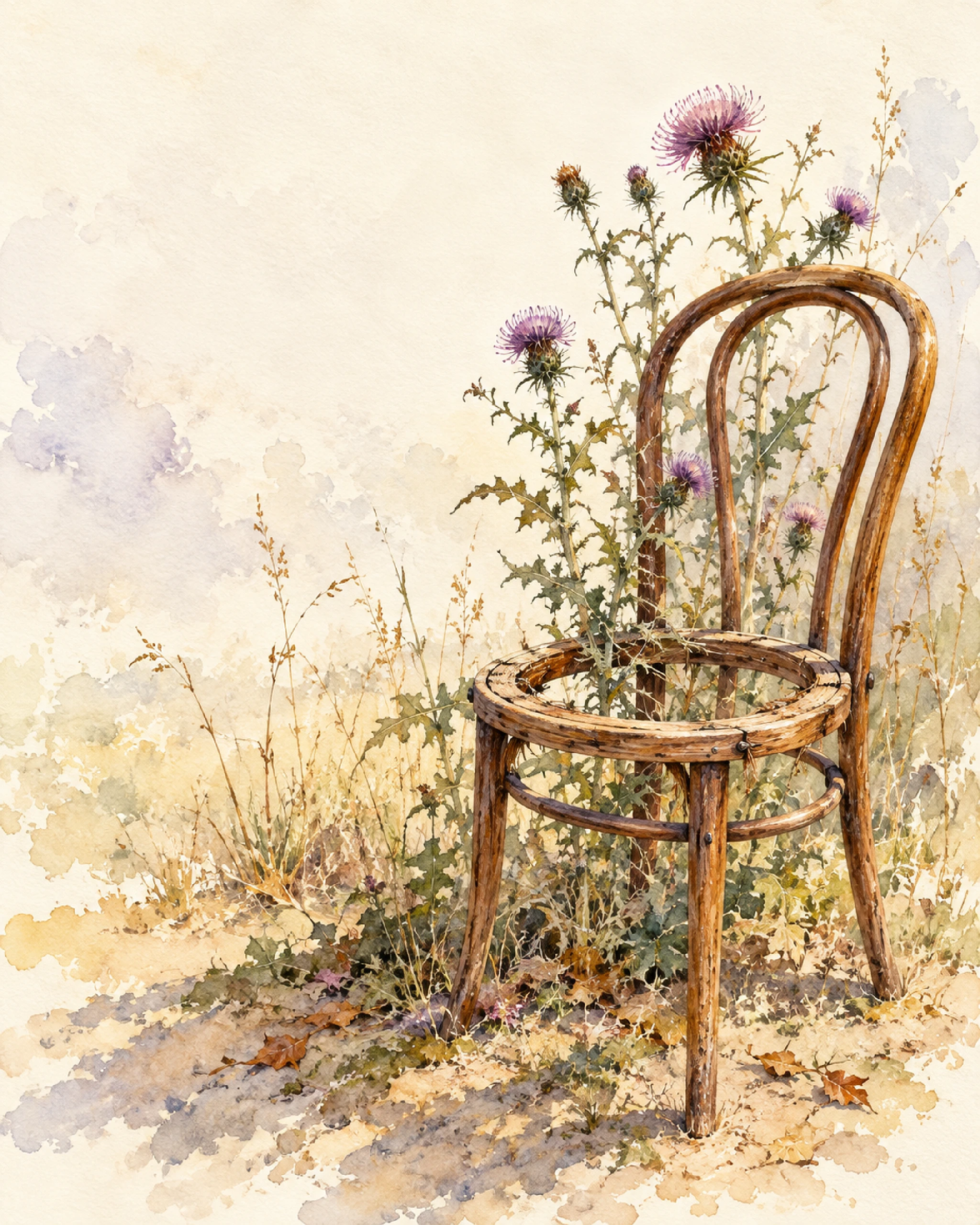
Thistles Through a Chair Seat
Thistles grow through an abandoned bentwood chair in an asymmetric watercolor with spreading pigment and generous negative space.
Remix this referenceThistles Through a Chair Seat
- Form language
- Reduce forms to bowed ribbons and uneven botanical clusters; let minor shapes vary within a loose, lyrical vocabulary.
- Contour
- Use broken watercolor boundaries, alternating crisp dry edges with passages that dissolve into the paper.
- Mark-making
- Lay broad wet strokes beside quick pointed flicks; occasional dry-brush skips expose paper between irregular marks.
- Surface rendering
- Build transparent washes with tide marks, pigment blooms and pooled accents; let tonal transitions remain visibly uneven.
Priority
Expressive watercolor must remain visibly fluid through blooms and broken edges.
What to avoid & what to check
Exact prompt for this example
MODULE OWNERSHIP
subject: Subject count, type, stable proportions and landmarks, resting face geometry, hair shape, physical materials, garment construction and permanent marks. No emotion, movement, color assignment or rendering recipe.
expression: Facial soft-tissue displacement and pupil direction, muscle coordination, regional intensity, asymmetry and onset/peak/release. No head/body pose, stable appearance, skin color or rendering.
gesture: Head/neck/body/limb orientation, joint movement, support, contact and pose-caused occlusion using existing anatomy. No eye/pupil movement, emotion, identity, props inventory or camera.
props: Prop count, type, construction, physical material and scale relative to the subject. Holding/contact belongs to gesture, position to composition, color to palette.
scene: Environment elements, terrain, backdrop/floor presence and structural detail. No canvas positions, camera, lighting, assigned colors or render texture.
camera: Projection, focal-length impression, camera elevation/yaw/roll, viewing distance and crop. No actor pose, world placement, lighting or canvas aspect ratio.
composition: Normalized 0-100% canvas positions, scale in frame, depth/overlap, focal hierarchy and margins. No joint pose, camera projection, rendering, subject/prop inventory or emotion.
palette: Color anchors, hue/saturation/value ranges, colors assigned to parts and approximate color coverage. No illumination direction, shading algorithm, physical material or layout.
lighting: Light-source direction/softness/intensity, ambient illumination, physical shadow direction/length and highlight position. Absence of directional illumination is allowed. No shading technique, palette or material changes.
style: Reusable form abstraction, contour weight/taper/edge quality, medium and mark scale/density/direction, surface rendering and tonal transition technique. No fixed subject proportions, anatomy, identity, expression, pose, palette, light-source direction, camera or layout.
output: Image count, aspect ratio, size, file/alpha requirements and global lettering/logo/watermark restrictions. No background scenery, crop, style, identity or pose.

SUBJECT
inventory: One abandoned bentwood chair is the principal subject.
geometry: A looped back rises above a round seat frame; missing cane exposes the opening between slender legs.
resting-face: No face or facial landmarks.
appearance: Steam-bent wood and remnant woven cane show worn varnish and a split along the seat rim.

PRIORITY


AVOID


CHECK


PROPS
inventory: No separate props.
construction: No prop construction applies.

PRIORITY


AVOID


CHECK


SCENE
inventory: A sparse meadow contains a clump of flowering thistles, wiry grasses and a few fallen leaves.
structure: An incomplete patch of ground opens into an otherwise unmarked backdrop.

PRIORITY


AVOID


CHECK


CAMERA
projection: Natural perspective with a normal-lens impression.
viewpoint: Look slightly downward from an oblique front view, revealing the empty seat opening.
crop: Show the complete chair and tallest flower heads with ample surrounding space.

PRIORITY


AVOID


CHECK


COMPOSITION
placement: The chair occupies the lower right; flower heads climb above it, leaving the upper left expansively empty.
depth: Thistle stems grow through the open seat, passing behind its rim; the backrest remains a distinct silhouette beyond them.
spacing: The flower-and-seat junction leads the eye; separated legs and a loose ground patch keep the arrangement airy.

PRIORITY


AVOID


CHECK


PALETTE
colors: Warm ivory, bruised violet, muted sage and dry ochre form a restrained palette.
assignment: Ivory fills the open field; violet marks flowers, sage belongs to foliage, and ochre defines the chair and ground.
balance: Pale values dominate; a small concentration of deep violet gives the sparse arrangement its strongest accent.

PRIORITY


AVOID


CHECK


LIGHTING
sources: Broad, soft daylight arrives from the upper right with generous ambient illumination.
shadows: Faint shadows fall toward the lower left and remain short beneath the chair.
highlights: Gentle highlights catch the upper right of the backrest and exposed seat rim.

PRIORITY


AVOID


CHECK


STYLE GUIDE
form-language: Reduce forms to bowed ribbons and uneven botanical clusters; let minor shapes vary within a loose, lyrical vocabulary.
contour: Use broken watercolor boundaries, alternating crisp dry edges with passages that dissolve into the paper.
mark-making: Lay broad wet strokes beside quick pointed flicks; occasional dry-brush skips expose paper between irregular marks.
surface-rendering: Build transparent washes with tide marks, pigment blooms and pooled accents; let tonal transitions remain visibly uneven.

PRIORITY
Expressive watercolor must remain visibly fluid through blooms and broken edges.

AVOID


CHECK


OUTPUT
format: One finished image, portrait 4:5, 2048 × 2560 pixels, opaque PNG.
restrictions: Deliver one portrait 4:5 image at 2048 × 2560 pixels as an opaque PNG; no lettering, logos or watermarks.

PRIORITY


AVOID


CHECK
Model information comes from image provenance. The same prompt may produce a different result.