Text to imageArt stylesStyle guide
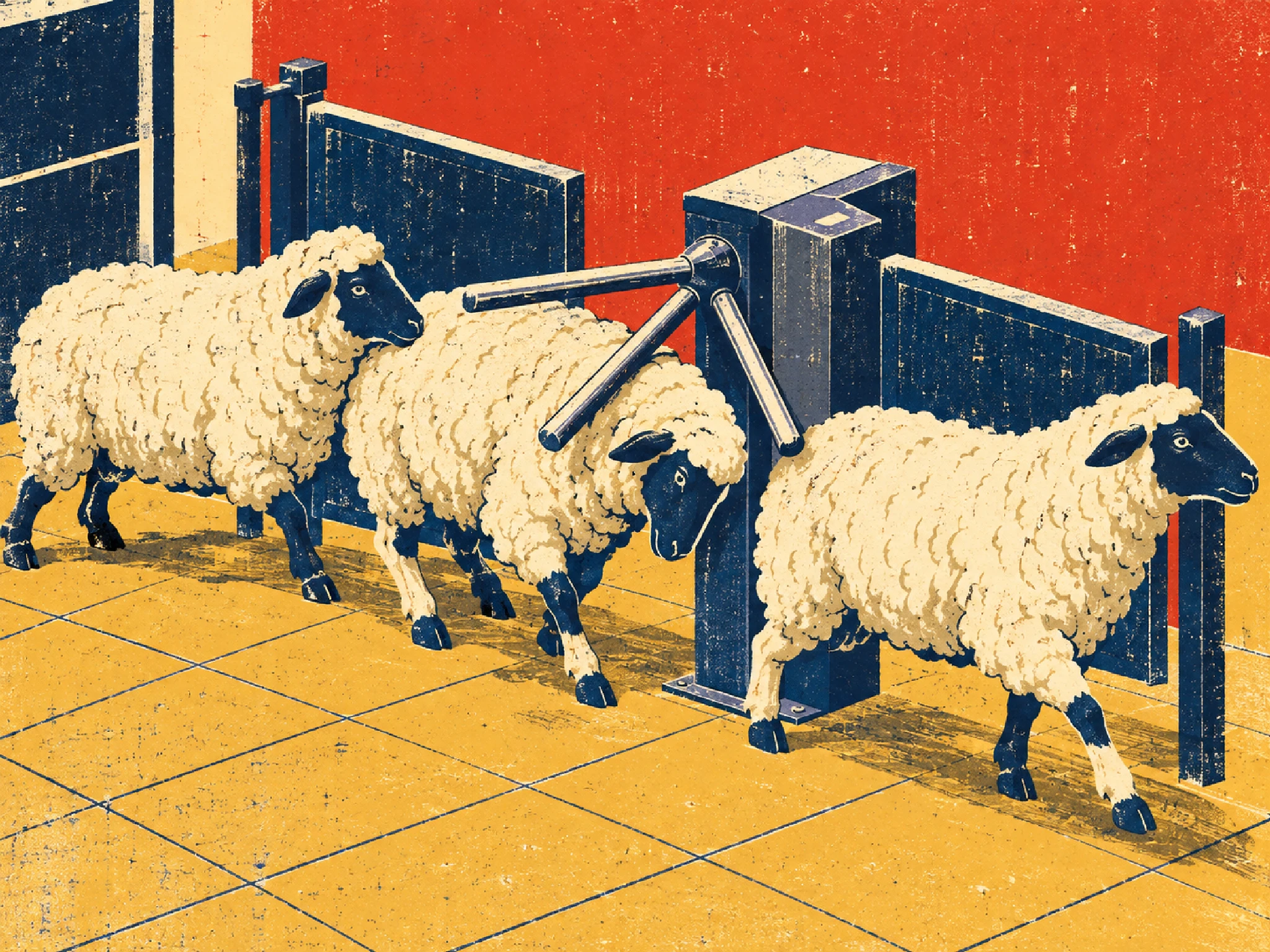
Sheep Through the Turnstile
Three sheep squeeze through a station turnstile. Rounded fleece masses collide with rigid rotating bars in a graphic screen print driven by decisive shape rhythms and imperfect ink edges.
Remix this referenceSheep Through the Turnstile
- Form language
- Reduce forms to emphatic scalloped masses and blunt wedges, alternating swelling curves with abrupt straight cuts for decisive graphic rhythms.
- Contour
- Use stencil-cut edges for most boundaries and occasional thick blunt strokes; allow slight edge chatter and selective registration slips.
- Mark-making
- Pull sparse broken squeegee streaks and irregular ink flecks through the forms, allowing natural variation in mark length and density.
- Surface rendering
- Layer opaque ink fields with narrow overprinted joins; compress tone into interlocking masses while retaining uneven ink deposits.
Priority
Make the graphic screen print evident through decisive shape rhythms and visibly layered ink.
What to avoid & what to check
Exact prompt for this example
MODULE OWNERSHIP
subject: Subject count, type, stable proportions and landmarks, resting face geometry, hair shape, physical materials, garment construction and permanent marks. No emotion, movement, color assignment or rendering recipe.
expression: Facial soft-tissue displacement and pupil direction, muscle coordination, regional intensity, asymmetry and onset/peak/release. No head/body pose, stable appearance, skin color or rendering.
gesture: Head/neck/body/limb orientation, joint movement, support, contact and pose-caused occlusion using existing anatomy. No eye/pupil movement, emotion, identity, props inventory or camera.
props: Prop count, type, construction, physical material and scale relative to the subject. Holding/contact belongs to gesture, position to composition, color to palette.
scene: Environment elements, terrain, backdrop/floor presence and structural detail. No canvas positions, camera, lighting, assigned colors or render texture.
camera: Projection, focal-length impression, camera elevation/yaw/roll, viewing distance and crop. No actor pose, world placement, lighting or canvas aspect ratio.
composition: Normalized 0-100% canvas positions, scale in frame, depth/overlap, focal hierarchy and margins. No joint pose, camera projection, rendering, subject/prop inventory or emotion.
palette: Color anchors, hue/saturation/value ranges, colors assigned to parts and approximate color coverage. No illumination direction, shading algorithm, physical material or layout.
lighting: Light-source direction/softness/intensity, ambient illumination, physical shadow direction/length and highlight position. Absence of directional illumination is allowed. No shading technique, palette or material changes.
style: Reusable form abstraction, contour weight/taper/edge quality, medium and mark scale/density/direction, surface rendering and tonal transition technique. No fixed subject proportions, anatomy, identity, expression, pose, palette, light-source direction, camera or layout.
output: Image count, aspect ratio, size, file/alpha requirements and global lettering/logo/watermark restrictions. No background scenery, crop, style, identity or pose.

SUBJECT
inventory: Three ordinary adult sheep, identified as A, B, and C; no people or other animals.
geometry: Barrel-shaped bodies, compact lower legs, narrow wedge muzzles, and short ears; individual bulk may vary naturally.
resting-face: Small lateral eyes, a divided upper lip, and a short mouth line define each sheep's resting face.
appearance: Dense crimped fleece, close-haired faces and legs, and cloven keratin hooves; no garments or permanent markings.

PRIORITY


AVOID


CHECK


EXPRESSION — ACTOR A
brows: Keep the visible brow skin smooth, without lifting or inward pinching.
lids: Keep the visible eye comfortably open, with neither squinting nor widening.
cheeks: Leave the cheek tissue loose, without lifting or tightening around the muzzle.
nose: Keep the nostrils relaxed, without flaring or wrinkling the nose.
mouth: Let the lips meet softly, with neither mouth corner pulled.
jaw: Keep the jaw closed and released, without clenching.
gaze: Direct the visible pupil toward the right edge, without an extreme sideways glance.
coordination: Maintain an even resting face; pupil direction supplies the only facial activity.
timing: Hold the neutral state at its apex, between blinks and without a chewing motion.

PRIORITY


AVOID


CHECK


EXPRESSION — ACTOR B
brows: Leave the visible brow skin level and uncreased.
lids: Keep the visible lids softly open, without squeezing them shut.
cheeks: Keep cheek tissue resting, without a smile-like lift or muzzle tension.
nose: Leave the nostrils at rest, with no flare or nose wrinkle.
mouth: Keep the lips lightly sealed and the mouth corners unpulled.
jaw: Let the closed jaw remain loose rather than visibly clenched.
gaze: Aim the visible pupil slightly downward and right, without widening the eye.
coordination: Keep the face quiet and balanced, without transferring bodily effort into a grimace.
timing: Hold the neutral state at its apex, with no blink or lip movement in this instant.

PRIORITY


AVOID


CHECK


EXPRESSION — ACTOR C
brows: Keep the visible brow skin relaxed, without raising or gathering it.
lids: Let the visible eye remain naturally open, with relaxed lid margins.
cheeks: Leave the cheeks slack, without lifting them toward the eye.
nose: Keep the nose unwrinkled and the nostrils unflared.
mouth: Keep the lips softly together, without pursing or pulling the corners.
jaw: Hold the jaw closed without a visible bite or clench.
gaze: Direct the visible pupil forward and right, without an exaggerated eye turn.
coordination: Keep upper and lower facial regions equally quiet, without a human-like smile.
timing: Hold the neutral state at its apex, between blinks and without chewing.

PRIORITY


AVOID


CHECK


GESTURE
head: A extends its neck ahead; B dips its head beneath a rotating arm; C presses its muzzle into B's fleece.
torso: A stretches forward out of the lane; B twists sideways through it; C leans into the compressed procession.
limbs: A takes a long forward step, B advances with short uneven steps, and C braces its hind hooves to push forward.
contact: B's fleece compresses against the arm and C's muzzle; A stays grounded beyond the gate. Bodies may hide incidental legs.

PRIORITY


AVOID


CHECK


PROPS
inventory: No separate props.
construction: No prop construction applies.

PRIORITY


AVOID


CHECK


SCENE
inventory: A small station entrance with one mechanical tripod turnstile, fixed divider panels, a tiled floor, and a plain wall.
structure: The turnstile has a box pedestal and a hub with three metal arms; divider panels form one narrow passage beside an open doorway.

PRIORITY


AVOID


CHECK


CAMERA
projection: Moderate perspective with a normal-lens impression and convincing depth without wide-angle stretching.
viewpoint: A raised three-quarter view with a gentle downward pitch and no camera roll.
crop: A medium-wide view includes all three sheep and the whole turnstile; station architecture continues beyond the crop.

PRIORITY


AVOID


CHECK


COMPOSITION
placement: The flock spans the lower field, with A leading rightward, B in the middle, and C bringing up the rear.
depth: B and the crossing arms form the focal knot; C overlaps B behind, while A overlaps the pedestal in front.
spacing: Compress the middle overlaps, open a generous gap ahead of A, and leave the upper wall spacious and peripheral.

PRIORITY


AVOID
No decorative border.

CHECK


PALETTE
colors: Chalk ivory, ink navy, warm vermilion, and muted mustard; vermilion carries the strongest saturation.
assignment: Ivory fleece, navy faces and hooves, navy gate hardware, a vermilion wall, and pale mustard floor tiles.
balance: Broad ivory and vermilion fields dominate; navy supplies compact anchors and mustard a quieter bridge.

PRIORITY


AVOID


CHECK


LIGHTING
sources: Broad daylight enters from the upper left, supported by soft ambient light throughout the entrance.
shadows: Short soft shadows fall toward the lower right, with contact shadows beneath hooves and at the crowded gate.
highlights: Broad highlights sit on upper-left fleece surfaces; turnstile arms receive restrained upper-edge glints.

PRIORITY


AVOID


CHECK


STYLE GUIDE
form-language: Reduce forms to emphatic scalloped masses and blunt wedges, alternating swelling curves with abrupt straight cuts for decisive graphic rhythms.
contour: Use stencil-cut edges for most boundaries and occasional thick blunt strokes; allow slight edge chatter and selective registration slips.
mark-making: Pull sparse broken squeegee streaks and irregular ink flecks through the forms, allowing natural variation in mark length and density.
surface-rendering: Layer opaque ink fields with narrow overprinted joins; compress tone into interlocking masses while retaining uneven ink deposits.

PRIORITY
Make the graphic screen print evident through decisive shape rhythms and visibly layered ink.

AVOID


CHECK


OUTPUT
format: One finished landscape image, 4:3 aspect ratio, 2048 × 1536 pixels, opaque PNG.
restrictions: No lettering, logos, or watermarks.

PRIORITY


AVOID


CHECK


FINAL INTEGRATION
gesture + composition + style: Let physical pressure motivate the overlaps, and simplify them through printmaking without losing the sequence of passage.
Model information comes from image provenance. The same prompt may produce a different result.