Text to imageProductStyle guide
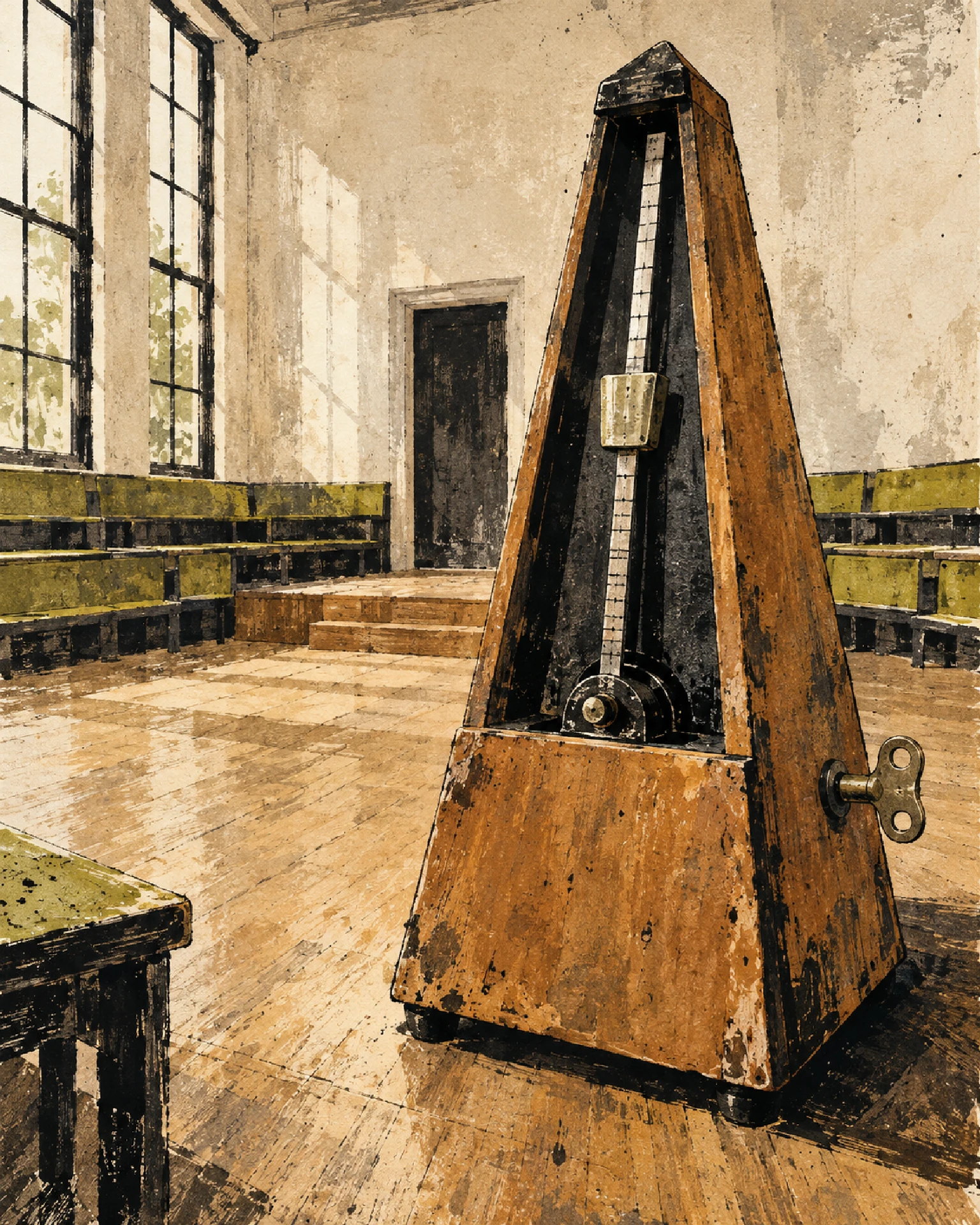
Giant Metronome in the Music Room
A mechanical metronome taller than the doorway occupies a low platform in an empty music room. Bleeding ink and displaced print layers turn a familiar practice tool into an uncanny monument.
Remix this referenceGiant Metronome in the Music Room
- Form language
- Simplify forms into forceful cutout masses and spare internal strokes; allow mild asymmetry without losing structural recognition.
- Contour
- Use uneven brush-ink contours that swell, break, and feather; combine a few sharp printed edges with visibly ragged ones.
- Mark-making
- Mix dragged dry-brush streaks, pooled ink, and loosely registered print patches; vary marks naturally and leave quiet passages.
- Surface rendering
- Build tone through translucent ink washes and overlapping print layers, with occasional bleeds and exposed paper interruptions.
Priority
Emphasize experimental ink-and-print character through varied brushwork and imperfect layer matching
What to avoid & what to check
Exact prompt for this example
MODULE OWNERSHIP
subject: Subject count, type, stable proportions and landmarks, resting face geometry, hair shape, physical materials, garment construction and permanent marks. No emotion, movement, color assignment or rendering recipe.
expression: Facial soft-tissue displacement and pupil direction, muscle coordination, regional intensity, asymmetry and onset/peak/release. No head/body pose, stable appearance, skin color or rendering.
gesture: Head/neck/body/limb orientation, joint movement, support, contact and pose-caused occlusion using existing anatomy. No eye/pupil movement, emotion, identity, props inventory or camera.
props: Prop count, type, construction, physical material and scale relative to the subject. Holding/contact belongs to gesture, position to composition, color to palette.
scene: Environment elements, terrain, backdrop/floor presence and structural detail. No canvas positions, camera, lighting, assigned colors or render texture.
camera: Projection, focal-length impression, camera elevation/yaw/roll, viewing distance and crop. No actor pose, world placement, lighting or canvas aspect ratio.
composition: Normalized 0-100% canvas positions, scale in frame, depth/overlap, focal hierarchy and margins. No joint pose, camera projection, rendering, subject/prop inventory or emotion.
palette: Color anchors, hue/saturation/value ranges, colors assigned to parts and approximate color coverage. No illumination direction, shading algorithm, physical material or layout.
lighting: Light-source direction/softness/intensity, ambient illumination, physical shadow direction/length and highlight position. Absence of directional illumination is allowed. No shading technique, palette or material changes.
style: Reusable form abstraction, contour weight/taper/edge quality, medium and mark scale/density/direction, surface rendering and tonal transition technique. No fixed subject proportions, anatomy, identity, expression, pose, palette, light-source direction, camera or layout.
output: Image count, aspect ratio, size, file/alpha requirements and global lettering/logo/watermark restrictions. No background scenery, crop, style, identity or pose.

SUBJECT
inventory: One enlarged mechanical metronome; no people or animals.
geometry: A tapered pyramidal case with a broad base, open front slot, pendulum rod, sliding weight, and side winding key.
resting-face: No facial geometry applies.
appearance: A wooden case surrounds a brass mechanism; worn corners and small surface dents may vary naturally.

PRIORITY


AVOID


CHECK


PROPS
inventory: No separate props.
construction: No prop construction applies.

PRIORITY


AVOID


CHECK


SCENE
inventory: An empty music rehearsal room with a low platform, built-in tiered benches, a doorway, and tall windows.
structure: A timber floor meets plain plaster walls; the benches follow the room perimeter and the platform has a shallow step.

PRIORITY


AVOID


CHECK


CAMERA
projection: Moderate wide-angle perspective, enough to reveal the room without pronounced edge distortion.
viewpoint: View from standing eye height across the room, with a three-quarter view of the metronome and no roll.
crop: Include the complete metronome and floor beneath it; let the nearest bench and outer windows continue beyond the crop.

PRIORITY


AVOID


CHECK


COMPOSITION
placement: Place the metronome near 65% across, filling most of the frame height; its apex rises above the doorway lintel.
depth: The metronome leads the hierarchy; foreground bench ends overlap the platform, while the distant doorway establishes scale.
spacing: Keep a spacious floor interval to the left and breathing room above the apex; bench rhythms lead toward the product.

PRIORITY


AVOID


CHECK


PALETTE
colors: Use soot black, warm ivory, ochre, and a small amount of acidic yellow-green.
assignment: Use ochre for the case and floor, black for the mechanism and structural accents, ivory for walls, and yellow-green for benches.
balance: Ivory and ochre occupy broad areas; black creates emphatic contrast, while yellow-green remains a restrained accent.

PRIORITY


AVOID


CHECK


LIGHTING
sources: Soft window light enters from the left, supported by subdued ambient light throughout the room.
shadows: A broad shadow extends rightward across the platform and floor; contact shadows remain strongest beneath the base.
highlights: Broad highlights follow left-facing case surfaces, with narrower highlights on the exposed pendulum rod.

PRIORITY


AVOID


CHECK


STYLE GUIDE
form-language: Simplify forms into forceful cutout masses and spare internal strokes; allow mild asymmetry without losing structural recognition.
contour: Use uneven brush-ink contours that swell, break, and feather; combine a few sharp printed edges with visibly ragged ones.
mark-making: Mix dragged dry-brush streaks, pooled ink, and loosely registered print patches; vary marks naturally and leave quiet passages.
surface-rendering: Build tone through translucent ink washes and overlapping print layers, with occasional bleeds and exposed paper interruptions.

PRIORITY
Emphasize experimental ink-and-print character through varied brushwork and imperfect layer matching

AVOID


CHECK


OUTPUT
format: Deliver one finished image, portrait 4:5, 1536 × 1920 pixels, opaque PNG.
restrictions: No lettering, numerals, logos, signatures, or watermarks.

PRIORITY


AVOID


CHECK


FINAL INTEGRATION
subject + composition + style: Preserve product recognition as the scale contrast and experimental marks work together.
Model information comes from image provenance. The same prompt may produce a different result.