Text to imageArt stylesStyle guide
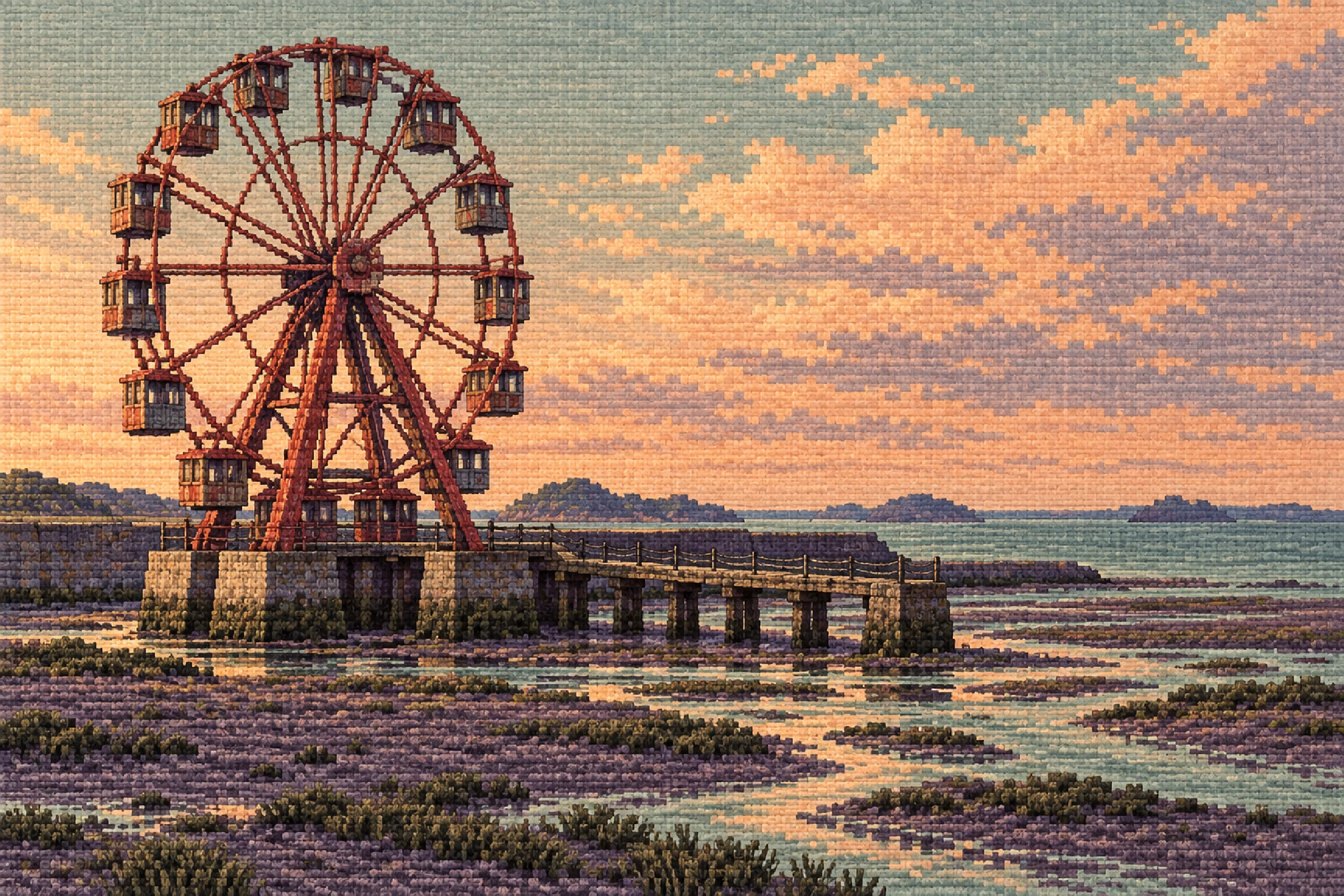
A Ferris Wheel at Low Tide
A seaside Ferris wheel stands above an exposed tidal flat. Stepped pixel edges and interlocking thread marks connect its off-center ring with an expansive sky in a woven image.
Remix this referenceA Ferris Wheel at Low Tide
- Form language
- Translate forms into low-resolution woven pixel clusters; build curves from deliberate stair steps and simplify small detail into joined blocks.
- Contour
- Keep hard stepped boundaries with occasional thread-end irregularities; use the shape edge itself instead of a continuous ink outline.
- Mark-making
- Interlace short horizontal weft dashes with quieter vertical warp breaks, allowing natural changes in thread thickness and local density.
- Surface rendering
- Use visibly fibrous, shallow-relief yarn planes; clustered pixel dithering creates tonal transitions without smoothing away the woven edges.
Priority
The woven surface and deliberate low-resolution edges must both remain visibly legible.
What to avoid & what to check
Exact prompt for this example
MODULE OWNERSHIP
subject: Subject count, type, stable proportions and landmarks, resting face geometry, hair shape, physical materials, garment construction and permanent marks. No emotion, movement, color assignment or rendering recipe.
expression: Facial soft-tissue displacement and pupil direction, muscle coordination, regional intensity, asymmetry and onset/peak/release. No head/body pose, stable appearance, skin color or rendering.
gesture: Head/neck/body/limb orientation, joint movement, support, contact and pose-caused occlusion using existing anatomy. No eye/pupil movement, emotion, identity, props inventory or camera.
props: Prop count, type, construction, physical material and scale relative to the subject. Holding/contact belongs to gesture, position to composition, color to palette.
scene: Environment elements, terrain, backdrop/floor presence and structural detail. No canvas positions, camera, lighting, assigned colors or render texture.
camera: Projection, focal-length impression, camera elevation/yaw/roll, viewing distance and crop. No actor pose, world placement, lighting or canvas aspect ratio.
composition: Normalized 0-100% canvas positions, scale in frame, depth/overlap, focal hierarchy and margins. No joint pose, camera projection, rendering, subject/prop inventory or emotion.
palette: Color anchors, hue/saturation/value ranges, colors assigned to parts and approximate color coverage. No illumination direction, shading algorithm, physical material or layout.
lighting: Light-source direction/softness/intensity, ambient illumination, physical shadow direction/length and highlight position. Absence of directional illumination is allowed. No shading technique, palette or material changes.
style: Reusable form abstraction, contour weight/taper/edge quality, medium and mark scale/density/direction, surface rendering and tonal transition technique. No fixed subject proportions, anatomy, identity, expression, pose, palette, light-source direction, camera or layout.
output: Image count, aspect ratio, size, file/alpha requirements and global lettering/logo/watermark restrictions. No background scenery, crop, style, identity or pose.

SUBJECT
inventory: One original disused Ferris wheel; no people or animals.
geometry: An open wheel ring surrounds a braced hub above an A-frame support, with box-shaped cabins around the rim.
resting-face: No face or facial anatomy.
appearance: The frame is riveted steel; the enclosed timber cabins have small glass panes and occasional missing boards.

PRIORITY


AVOID


CHECK


PROPS
inventory: No separate props.
construction: No prop construction applies.

PRIORITY


AVOID


CHECK


SCENE
inventory: An exposed coastal tidal flat surrounds concrete footings, a narrow pier, a low sea wall and distant open water beneath sky.
structure: Shallow runnels divide the mud and eelgrass beds; the pier connects the sea wall to the wheel's footings.

PRIORITY


AVOID


CHECK


CAMERA
projection: Use a gently compressed perspective with a normal-to-short-telephoto focal-length impression.
viewpoint: View from a modest elevation across the tidal flat, slightly oblique to the wheel, with no roll.
crop: Use a wide environmental crop containing the wheel's full height and ample surrounding terrain.

PRIORITY


AVOID


CHECK


COMPOSITION
placement: Anchor the wheel in the left third; its ring is the focus, followed by the pier leading into the lower right.
depth: Foreground runnels overlap the footings; the sea wall recedes behind the wheel toward a low horizon.
spacing: Leave expansive sky to the right and above; broad open areas surround compact structural passages, while broad mud expanses alternate with narrow water intervals.

PRIORITY


AVOID


CHECK


PALETTE
colors: Use faded coral, ink violet, pale apricot and muted sea green.
assignment: Give the wheel coral, mud and structural recesses violet, sky apricot, and water and eelgrass sea green.
balance: Pale colors cover broad areas, darker colors cover smaller areas, and coral provides the strongest hue accent.

PRIORITY


AVOID


CHECK


LIGHTING
sources: Soft low daylight comes from the left, supported by broad ambient sky illumination.
shadows: Long, faint structural shadows extend rightward across the tidal ground.
highlights: Subtle highlights appear on left-facing frame edges and exposed water surfaces.

PRIORITY


AVOID


CHECK


STYLE GUIDE
form-language: Translate forms into low-resolution woven pixel clusters; build curves from deliberate stair steps and simplify small detail into joined blocks.
contour: Keep hard stepped boundaries with occasional thread-end irregularities; use the shape edge itself instead of a continuous ink outline.
mark-making: Interlace short horizontal weft dashes with quieter vertical warp breaks, allowing natural changes in thread thickness and local density.
surface-rendering: Use visibly fibrous, shallow-relief yarn planes; clustered pixel dithering creates tonal transitions without smoothing away the woven edges.

PRIORITY
The woven surface and deliberate low-resolution edges must both remain visibly legible.

AVOID


CHECK


OUTPUT
format: One finished image, landscape 3:2, 2400 × 1600 pixels, opaque PNG.
restrictions: No lettering, logos or watermarks.

PRIORITY


AVOID


CHECK
Model information comes from image provenance. The same prompt may produce a different result.