Text to imagePortraitStyle guide
Adult in a Knit Cap · Lost-and-Found Edges
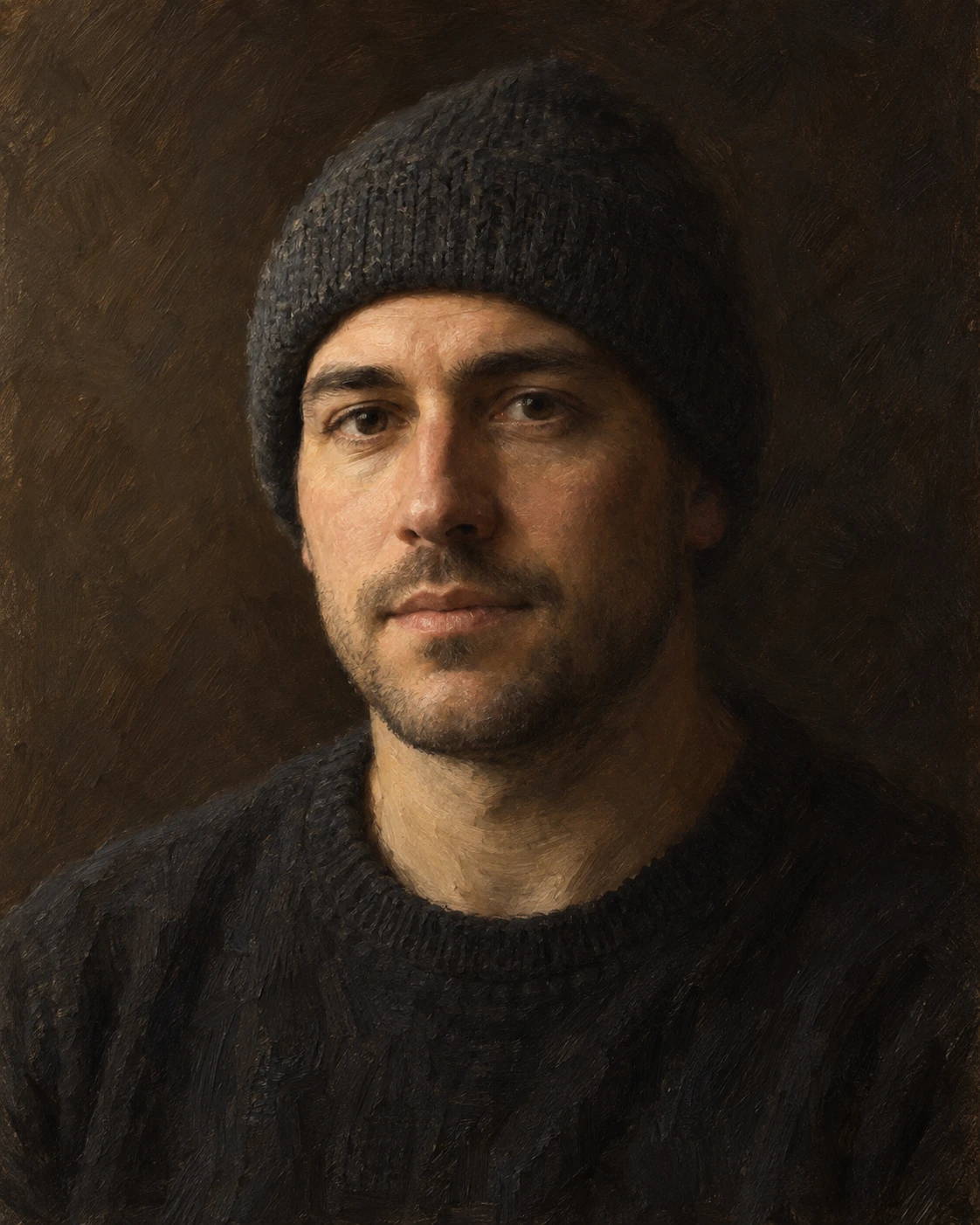
An oil portrait that merges parts of the cap and shoulder into a dark background while crisp illuminated facial edges let the viewer complete the silhouette.
Adult in a Knit Cap · Lost-and-Found Edges
- Shape & line
- Construct the head with broad connected shapes rather than an enclosing outline. Make the image-left temple and cheek boundary crisp against the background, soften the jaw transition, and let sections of the image-right cap and shoulder contour disappear before returning as short visible edges.
- Color & light
- Place a large soft key light on image-left, illuminating the forehead and image-left cheek with muted warm skin tones. Use a deep cool brown background and keep the shadowed image-right cap and sweater close to its value so their boundaries visibly merge, while retaining gentle tonal changes inside the face.
- Texture & material
- Use opaque oil brushwork with restrained surface texture: lay broad strokes across the cheek planes and suggest the cap's knit with a few broken curved marks in its lit area. Blend paint across the disappearing contours so no dark outline or bright rim reveals those sections.
- Composition
- Concentrate the strongest edge contrast around the image-left eye and adjacent cheek, then reduce edge contrast toward the lower shoulders. Keep the background plain and preserve enough visible cap and shoulder segments for the missing contours to be mentally connected into one continuous figure.
Priority
Prioritize readable facial form and a deliberate alternation of visible and disappearing silhouette edges.
What to avoid & what to check
Avoid uniform outlines, continuous rim lighting and blur spread across the entire face.
Check that image-right cap and shoulder edges merge with the background while the illuminated image-left facial edge remains clear.
Exact prompt for this example
SUBJECT
One adult wearing a plain charcoal knit cap and a dark sweater, with a relaxed closed mouth. The cap covers the hair and sits just above the eyebrows; the face remains fully readable.

COMPOSITION
A vertical head-and-shoulders portrait at eye level, with the adult centered slightly right and facing almost forward. Include the whole cap and both shoulders, leaving quiet background space around the head.

STYLE GUIDE
1. Shape & line
Construct the head with broad connected shapes rather than an enclosing outline. Make the image-left temple and cheek boundary crisp against the background, soften the jaw transition, and let sections of the image-right cap and shoulder contour disappear before returning as short visible edges.

2. Color & light
Place a large soft key light on image-left, illuminating the forehead and image-left cheek with muted warm skin tones. Use a deep cool brown background and keep the shadowed image-right cap and sweater close to its value so their boundaries visibly merge, while retaining gentle tonal changes inside the face.

3. Texture & material
Use opaque oil brushwork with restrained surface texture: lay broad strokes across the cheek planes and suggest the cap's knit with a few broken curved marks in its lit area. Blend paint across the disappearing contours so no dark outline or bright rim reveals those sections.

4. Composition
Concentrate the strongest edge contrast around the image-left eye and adjacent cheek, then reduce edge contrast toward the lower shoulders. Keep the background plain and preserve enough visible cap and shoulder segments for the missing contours to be mentally connected into one continuous figure.

PRIORITY
Preserve the requested identity, count, action, composition and output settings. Apply the style rules within those constraints; a style reference must not replace the subject or layout. Within the style: Prioritize readable facial form and a deliberate alternation of visible and disappearing silhouette edges.

AVOID
Avoid uniform outlines, continuous rim lighting and blur spread across the entire face.

OUTPUT
One image in a 4:5 aspect ratio, rendered as an oil painting, with no lettering, captions, signature or watermark.

SELF-CHECK
Check that image-right cap and shoulder edges merge with the background while the illuminated image-left facial edge remains clear.
Model information comes from image provenance. The same prompt may produce a different result.