Text to imageCharacterStyle guide
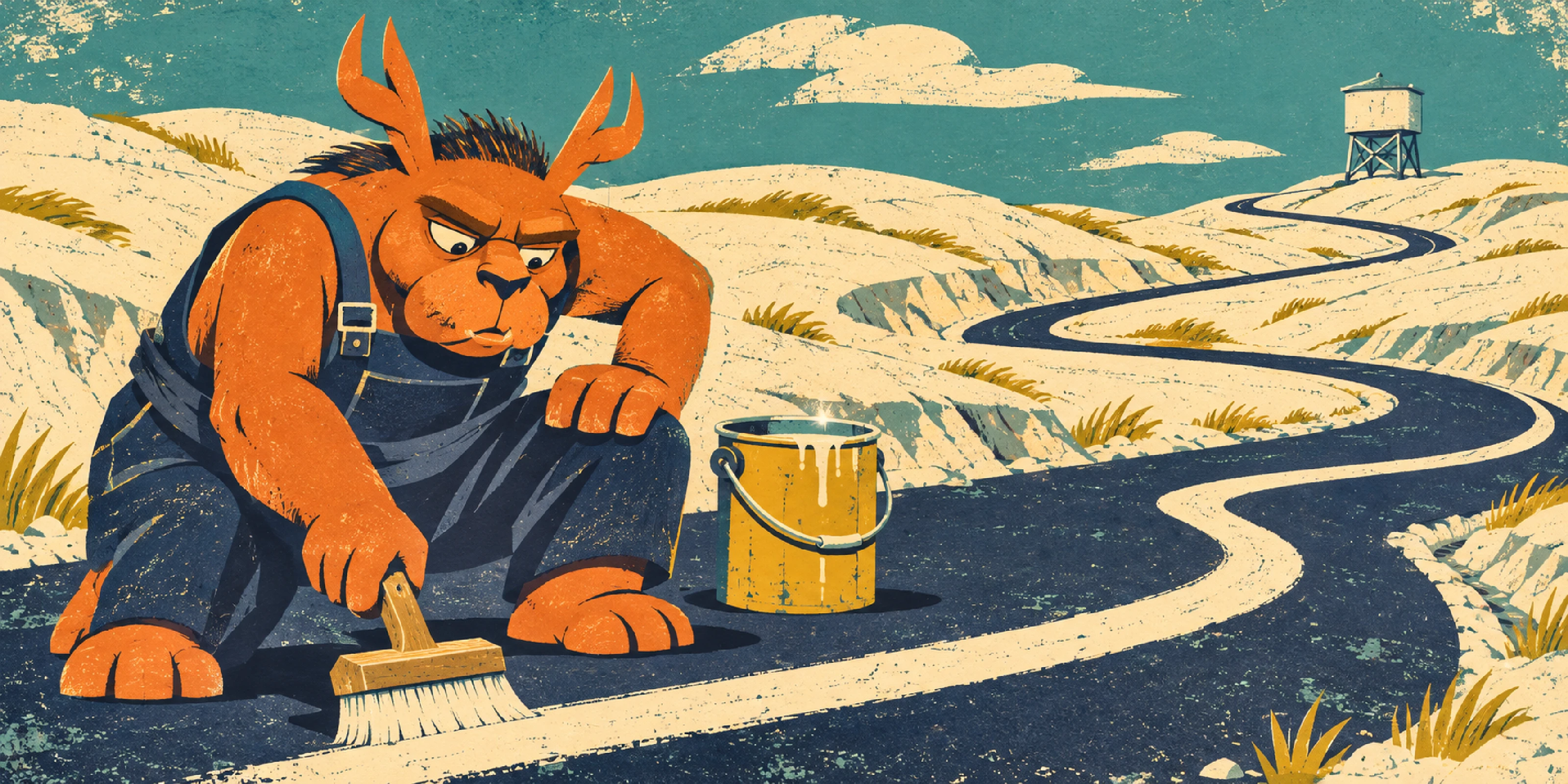
A Fork-Eared Creature Painting a Winding Road
A fork-eared creature kneels to repaint a winding hill road. Sweeping bends and boldly overlapping screen-print shapes turn a small task into a long visual journey.
Remix this referenceA Fork-Eared Creature Painting a Winding Road
- Form language
- Reduce forms to interlocking curved wedges and broad bands; alternate expansive masses with narrow interruptions.
- Contour
- Use cut-stencil boundaries with occasional clogged corners; interior contours are sparse, blunt-ended strokes.
- Mark-making
- Let irregular squeegee skips and loose clusters of coarse flecks break selected passages, varying naturally across the print.
- Surface rendering
- Build tone from opaque ink separations and translucent overprints; slight registration slips expose lively doubled edges.
Priority
Graphic screen print with decisive shape rhythms.
What to avoid & what to check
Exact prompt for this example
MODULE OWNERSHIP
subject: Subject count, type, stable proportions and landmarks, resting face geometry, hair shape, physical materials, garment construction and permanent marks. No emotion, movement, color assignment or rendering recipe.
expression: Facial soft-tissue displacement and pupil direction, muscle coordination, regional intensity, asymmetry and onset/peak/release. No head/body pose, stable appearance, skin color or rendering.
gesture: Head/neck/body/limb orientation, joint movement, support, contact and pose-caused occlusion using existing anatomy. No eye/pupil movement, emotion, identity, props inventory or camera.
props: Prop count, type, construction, physical material and scale relative to the subject. Holding/contact belongs to gesture, position to composition, color to palette.
scene: Environment elements, terrain, backdrop/floor presence and structural detail. No canvas positions, camera, lighting, assigned colors or render texture.
camera: Projection, focal-length impression, camera elevation/yaw/roll, viewing distance and crop. No actor pose, world placement, lighting or canvas aspect ratio.
composition: Normalized 0-100% canvas positions, scale in frame, depth/overlap, focal hierarchy and margins. No joint pose, camera projection, rendering, subject/prop inventory or emotion.
palette: Color anchors, hue/saturation/value ranges, colors assigned to parts and approximate color coverage. No illumination direction, shading algorithm, physical material or layout.
lighting: Light-source direction/softness/intensity, ambient illumination, physical shadow direction/length and highlight position. Absence of directional illumination is allowed. No shading technique, palette or material changes.
style: Reusable form abstraction, contour weight/taper/edge quality, medium and mark scale/density/direction, surface rendering and tonal transition technique. No fixed subject proportions, anatomy, identity, expression, pose, palette, light-source direction, camera or layout.
output: Image count, aspect ratio, size, file/alpha requirements and global lettering/logo/watermark restrictions. No background scenery, crop, style, identity or pose.

SUBJECT
inventory: One original anthropomorphic creature, actor A; no other figures.
geometry: A has fork-tipped ears, a broad hanging muzzle, a pear-shaped trunk, long forearms and stout legs.
resting-face: Wide-set eyes sit beneath thick brow pads; a blunt triangular nose meets a centrally notched upper lip.
appearance: Velvety hide, a short bristled crown and sleeveless canvas coveralls with a wraparound waist panel.

PRIORITY


AVOID


CHECK


EXPRESSION — ACTOR A
brows: Brow pads draw slightly inward, with the near brow a little lower.
lids: Upper lids lower slightly; lower lids firm without a hard squint.
cheeks: Cheeks remain mostly loose, with slight tension beside the mouth.
nose: Nostrils remain at rest; the nose bridge stays unwrinkled.
mouth: Lips press gently together, with one corner tucked inward.
jaw: Jaw stays closed without a visible clench.
gaze: Both pupils track the brush edge where it meets the fresh stripe.
coordination: Mild brow tension and a quiet mouth sustain concentrated determination.
timing: Hold the apex of steady concentration.

PRIORITY


AVOID


CHECK


GESTURE
head: The neck extends slightly forward and the head tips down toward the working hand.
torso: The torso leans forward over one grounded knee, with a small twist toward the brush.
limbs: The other foot plants flat; the right arm pushes the brush in one uninterrupted stroke while the left hand braces the raised knee.
contact: The right hand grips the handle firmly; the broad bristles flatten against the road.

PRIORITY


AVOID


CHECK


PROPS
inventory: Two props: one broad road-marking brush and one paint pail approximately knee-high to A.
construction: The brush has a wooden handle and dense rectangular bristles; the metal pail has a wire bail.

PRIORITY


AVOID


CHECK


SCENE
inventory: An exposed hill road passes through rounded chalk hills toward a solitary square water tower.
structure: Successive hairpin bends, shallow drainage cuts and sparse grass tufts articulate the terrain.

PRIORITY


AVOID


CHECK


CAMERA
projection: Use a mild wide-angle perspective with clear recession and restrained near-field enlargement.
viewpoint: View obliquely from A's front at chest height, with the camera level.
crop: Include the complete figure and tools within a broad environmental view.

PRIORITY


AVOID


CHECK


COMPOSITION
placement: A fills roughly half the frame height in the left third; the pail sits just behind the figure.
depth: The fresh stripe leads from A through overlapping road bends to the small distant tower.
spacing: Make A the first read, the stripe the second; leave generous open intervals between distant bends.

PRIORITY


AVOID


CHECK


PALETTE
colors: Use burnt orange, ink navy, pale chalk, mustard and muted teal as a compact color family.
assignment: Orange hide, navy coveralls and road, chalk hills and stripe, teal sky, mustard pail.
balance: Let pale terrain dominate; broad navy bands anchor it, with orange providing the strongest warm accent.

PRIORITY


AVOID


CHECK


LIGHTING
sources: Broad, moderately soft daylight arrives from the upper left, supported by ample ambient light.
shadows: Short cast shadows fall toward the lower right; contact shadows stay strongest beneath knee and brush.
highlights: Keep broad highlights on upper-left-facing surfaces and a small glint along the pail rim.

PRIORITY


AVOID


CHECK


STYLE GUIDE
form-language: Reduce forms to interlocking curved wedges and broad bands; alternate expansive masses with narrow interruptions.
contour: Use cut-stencil boundaries with occasional clogged corners; interior contours are sparse, blunt-ended strokes.
mark-making: Let irregular squeegee skips and loose clusters of coarse flecks break selected passages, varying naturally across the print.
surface-rendering: Build tone from opaque ink separations and translucent overprints; slight registration slips expose lively doubled edges.

PRIORITY
Graphic screen print with decisive shape rhythms.

AVOID


CHECK


OUTPUT
format: Deliver one finished image at a 2:1 aspect ratio, 3200 × 1600 pixels, as an opaque PNG.
restrictions: No lettering, logos or watermarks.

PRIORITY


AVOID


CHECK


FINAL INTEGRATION
expression + gesture: Facial concentration and the sustained working pose should read as one uninterrupted moment.
composition + style: Shape simplification should preserve the visual journey while allowing local printed irregularities.
Model information comes from image provenance. The same prompt may produce a different result.