Text to imageComicsStyle guide
Sharing the Piano Bench
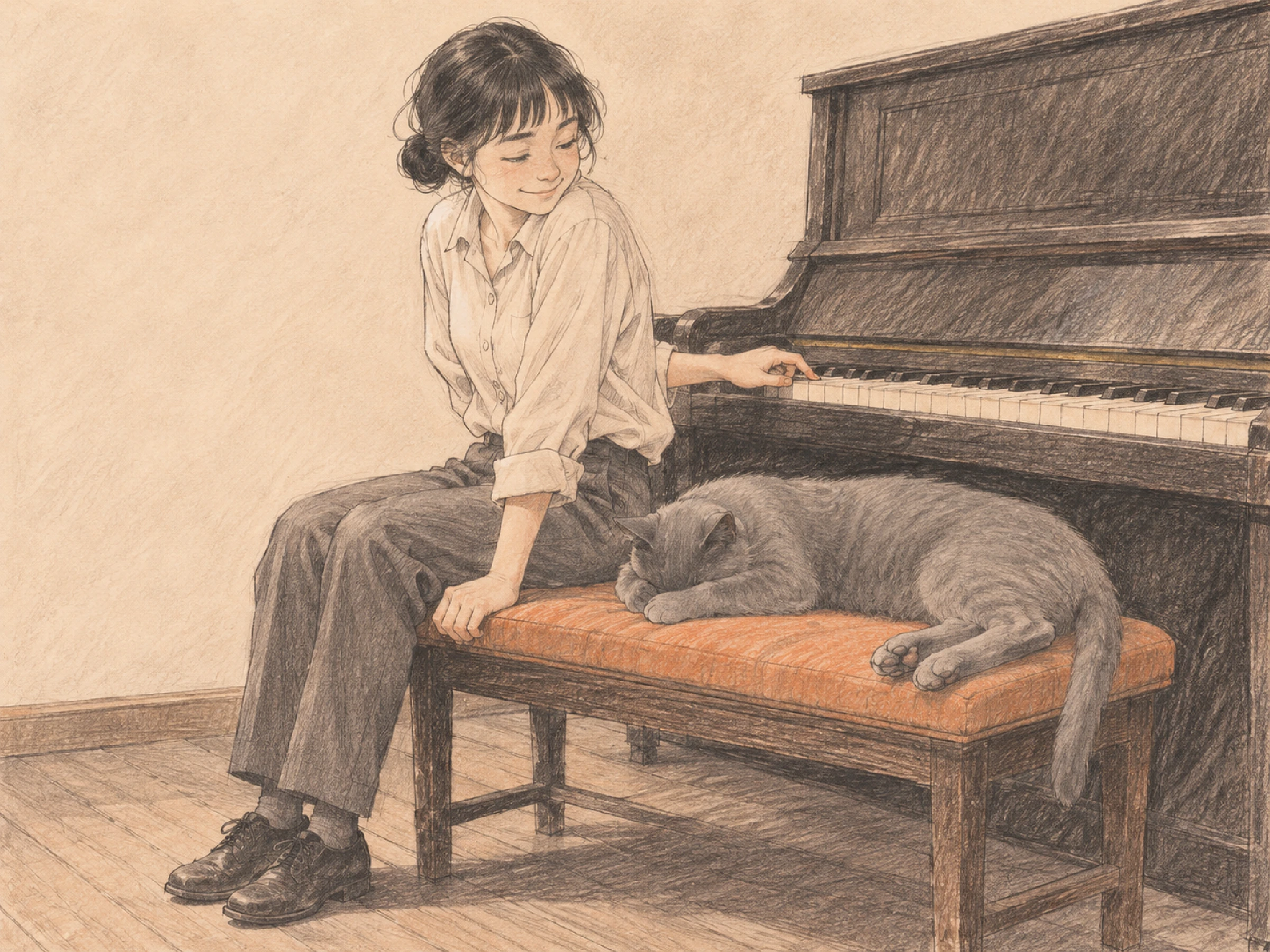
A pianist perches on the bench edge and presses one key while a sleeping cat occupies almost the entire seat. Pressure-sensitive pencil lines and an expansive empty wall give the everyday interruption a quiet comic rhythm.
Remix this referenceSharing the Piano Bench
- Form language
- Simplify forms into supple, slightly lopsided masses with selective structural breaks; small descriptive details may vary naturally.
- Contour
- Use pressure-varied pencil contours, dark at selected junctions and feathered into broken, searching edges elsewhere.
- Mark-making
- Lay loose directional hatching with occasional doubled strokes; retain incidental construction traces where they enrich the drawing.
- Surface rendering
- Build tones with rubbed graphite and open hatching, lifting passages with a kneaded eraser; add colored pencil in thin, uneven veils.
Priority
Rendering medium: pencil-led slice-of-life manga illustration with graphite and restrained colored pencil.
What to avoid & what to check
Exact prompt for this example
MODULE OWNERSHIP
subject: Subject count, type, stable proportions and landmarks, resting face geometry, hair shape, physical materials, garment construction and permanent marks. No emotion, movement, color assignment or rendering recipe.
expression: Facial soft-tissue displacement and pupil direction, muscle coordination, regional intensity, asymmetry and onset/peak/release. No head/body pose, stable appearance, skin color or rendering.
gesture: Head/neck/body/limb orientation, joint movement, support, contact and pose-caused occlusion using existing anatomy. No eye/pupil movement, emotion, identity, props inventory or camera.
props: Prop count, type, construction, physical material and scale relative to the subject. Holding/contact belongs to gesture, position to composition, color to palette.
scene: Environment elements, terrain, backdrop/floor presence and structural detail. No canvas positions, camera, lighting, assigned colors or render texture.
camera: Projection, focal-length impression, camera elevation/yaw/roll, viewing distance and crop. No actor pose, world placement, lighting or canvas aspect ratio.
composition: Normalized 0-100% canvas positions, scale in frame, depth/overlap, focal hierarchy and margins. No joint pose, camera projection, rendering, subject/prop inventory or emotion.
palette: Color anchors, hue/saturation/value ranges, colors assigned to parts and approximate color coverage. No illumination direction, shading algorithm, physical material or layout.
lighting: Light-source direction/softness/intensity, ambient illumination, physical shadow direction/length and highlight position. Absence of directional illumination is allowed. No shading technique, palette or material changes.
style: Reusable form abstraction, contour weight/taper/edge quality, medium and mark scale/density/direction, surface rendering and tonal transition technique. No fixed subject proportions, anatomy, identity, expression, pose, palette, light-source direction, camera or layout.
output: Image count, aspect ratio, size, file/alpha requirements and global lettering/logo/watermark restrictions. No background scenery, crop, style, identity or pose.

SUBJECT
inventory: A is one adult woman pianist; B is one large domestic shorthair cat.
geometry: A has an ordinary adult build, broad cheekbones, a short fringe and a low bun; B has a long torso and triangular ears.
resting-face: A has gently arched eye openings, a rounded nose tip and a fuller lower lip; B's resting facial geometry is unspecified.
appearance: A wears a cotton button shirt with turned cuffs and straight wool trousers; B has short fur without distinctive permanent markings.

PRIORITY


AVOID


CHECK


EXPRESSION — ACTOR A
brows: Brows remain loose, with one outer end lifting slightly.
lids: Upper lids settle softly; lower lids lift just a little.
cheeks: One cheek gathers subtly with the emerging smile.
nose: Nostrils stay relaxed, without a wrinkle across the bridge.
mouth: Closed lips develop a small, uneven upward curl.
jaw: The jaw stays loose with no visible clenching.
gaze: Pupils turn down and right toward B.
coordination: The uneven mouth curl leads; the cheek and lower lid respond gently.
timing: Catch the first restrained smile before it becomes a broad grin.

PRIORITY


AVOID


CHECK


EXPRESSION — ACTOR B
brows: No brow displacement is prescribed.
lids: No eyelid action is prescribed.
cheeks: Leave cheek compression unspecified.
nose: No nostril or muzzle action is prescribed.
mouth: No mouth shape is prescribed.
jaw: No jaw opening or tension is prescribed.
gaze: Pupil direction remains unspecified.
coordination: No facial muscle coordination is prescribed.
timing: Hold a resting state with no facial transition.

PRIORITY


AVOID


CHECK


GESTURE
head: A turns her head back toward B with a slight neck bend; B buries its entire face against its forelegs.
torso: A sits upright with her pelvis barely supported by the bench edge; B lies lengthwise with its belly relaxed.
limbs: A plants both feet and tucks her elbows, extending one index finger; B stretches its hind legs and lets its tail droop.
contact: A depresses one key and braces her other hand on the seat edge; B rests fully on the upholstery without touching A.

PRIORITY


AVOID


CHECK


PROPS
inventory: One upright piano and one shared piano bench; no other furnishings, separate music sheets or accessories.
construction: The piano has a wooden cabinet and inset keys; the bench has a long fabric-upholstered seat on a wooden frame, just large enough for both.

PRIORITY


AVOID


CHECK


SCENE
inventory: A modest practice room with a bare plaster wall and a wooden floor.
structure: A low skirting board joins wall and floor; a few floorboard joints establish the room.

PRIORITY


AVOID


CHECK


CAMERA
projection: Natural perspective with a normal-lens impression and restrained convergence.
viewpoint: Look obliquely along the keyboard from slightly above seated eye level, with no roll.
crop: Use a room-scale view including A's feet and the whole bench; crop through the piano cabinet at the right edge.

PRIORITY


AVOID


CHECK


COMPOSITION
placement: Group A and the bench below the middle, with A left of B; the keyboard makes a diagonal toward the right edge.
depth: A's face leads, followed by B's silhouette; the piano sits behind their overlapping seat-level shapes.
spacing: Leave the upper-left wall broadly empty, balancing the compressed lower-right grouping with generous breathing room.

PRIORITY


AVOID


CHECK


PALETTE
colors: Use warm paper ivory, graphite gray, soot black and one muted persimmon-orange accent.
assignment: Keep the room and shirt ivory, hair and piano soot black, trousers and cat graphite gray; reserve persimmon for the upholstery.
balance: Ivory dominates, gray stays subdued, black provides contrast, and persimmon remains a small accent.

PRIORITY


AVOID


CHECK


LIGHTING
sources: Broad, soft daylight enters from the left, supported by gentle room ambience.
shadows: Soft shadows fall to the right beneath the bench and feet; contact shadows are slightly deeper.
highlights: Restrained highlights touch the left cheek, shirt shoulder and upper keyboard rim.

PRIORITY


AVOID


CHECK


STYLE GUIDE
form-language: Simplify forms into supple, slightly lopsided masses with selective structural breaks; small descriptive details may vary naturally.
contour: Use pressure-varied pencil contours, dark at selected junctions and feathered into broken, searching edges elsewhere.
mark-making: Lay loose directional hatching with occasional doubled strokes; retain incidental construction traces where they enrich the drawing.
surface-rendering: Build tones with rubbed graphite and open hatching, lifting passages with a kneaded eraser; add colored pencil in thin, uneven veils.

PRIORITY
Rendering medium: pencil-led slice-of-life manga illustration with graphite and restrained colored pencil.

AVOID


CHECK


OUTPUT
format: Produce one finished 4:3 illustration at 2400 × 1800 pixels as an opaque PNG.
restrictions: No lettering, speech balloons, logos or watermarks.

PRIORITY


AVOID


CHECK


FINAL INTEGRATION
expression + gesture: Coordinate A's gaze toward B with B sleeping in the established resting pose.
Model information comes from image provenance. The same prompt may produce a different result.