Text to imageArt stylesStyle guide
An Organ Repairer Lifting a Pipe
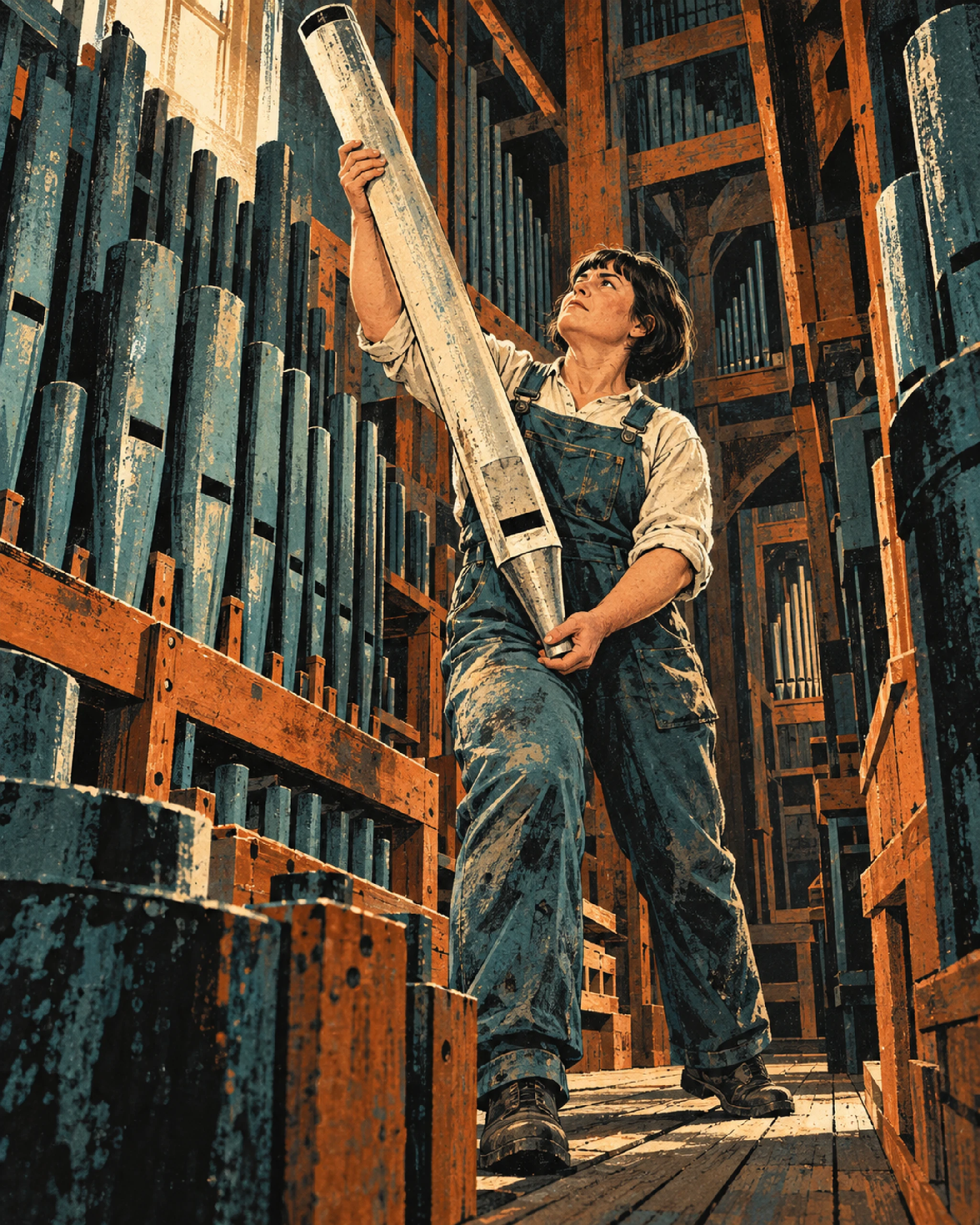
A repairer lifts a pipe inside a towering organ, her gesture cutting through vertical architecture rendered in overlapping impressions and rough ink.
Remix this referenceAn Organ Repairer Lifting a Pipe
- Form language
- Translate volumes into interlocking slabs and cut apertures, retaining enough irregularity to feel drawn rather than mechanically assembled.
- Contour
- Use swelling brush-ink contours that break, drag and occasionally disappear into adjoining solid impressions.
- Mark-making
- Mix broad bristle sweeps with sparse scratched cuts and imperfect stamped repeats; allow their lengths and spacing to vary naturally.
- Surface rendering
- Build tone through translucent overprints against dense ink deposits, letting registration slips and ragged pressure edges remain visible.
Priority
The defining treatment is experimental ink-and-print poster illustration.
What to avoid & what to check
Exact prompt for this example
MODULE OWNERSHIP
subject: Subject count, type, stable proportions and landmarks, resting face geometry, hair shape, physical materials, garment construction and permanent marks. No emotion, movement, color assignment or rendering recipe.
expression: Facial soft-tissue displacement and pupil direction, muscle coordination, regional intensity, asymmetry and onset/peak/release. No head/body pose, stable appearance, skin color or rendering.
gesture: Head/neck/body/limb orientation, joint movement, support, contact and pose-caused occlusion using existing anatomy. No eye/pupil movement, emotion, identity, props inventory or camera.
props: Prop count, type, construction, physical material and scale relative to the subject. Holding/contact belongs to gesture, position to composition, color to palette.
scene: Environment elements, terrain, backdrop/floor presence and structural detail. No canvas positions, camera, lighting, assigned colors or render texture.
camera: Projection, focal-length impression, camera elevation/yaw/roll, viewing distance and crop. No actor pose, world placement, lighting or canvas aspect ratio.
composition: Normalized 0-100% canvas positions, scale in frame, depth/overlap, focal hierarchy and margins. No joint pose, camera projection, rendering, subject/prop inventory or emotion.
palette: Color anchors, hue/saturation/value ranges, colors assigned to parts and approximate color coverage. No illumination direction, shading algorithm, physical material or layout.
lighting: Light-source direction/softness/intensity, ambient illumination, physical shadow direction/length and highlight position. Absence of directional illumination is allowed. No shading technique, palette or material changes.
style: Reusable form abstraction, contour weight/taper/edge quality, medium and mark scale/density/direction, surface rendering and tonal transition technique. No fixed subject proportions, anatomy, identity, expression, pose, palette, light-source direction, camera or layout.
output: Image count, aspect ratio, size, file/alpha requirements and global lettering/logo/watermark restrictions. No background scenery, crop, style, identity or pose.

SUBJECT
inventory: One adult woman, an organ repairer, designated A.
geometry: A has a sturdy build, broad hands, a broad oval face and a short, blunt haircut.
resting-face: Straight brows, hooded eyes, a broad nose and a wide mouth establish her resting facial structure.
appearance: She wears cotton bib overalls over a collarless shirt with rolled sleeves; retain ordinary fabric wear.

PRIORITY


AVOID


CHECK


EXPRESSION — ACTOR A
brows: Inner brow ends draw slightly together without a deep scowl.
lids: Upper lids narrow modestly; lower lids hold a little tension.
cheeks: Cheeks remain nearly still, with slight firmness beside the mouth.
nose: Nostrils stay relaxed and the nose bridge remains unwrinkled.
mouth: Lips meet firmly, with one corner compressed slightly more.
jaw: The jaw stays closed with restrained muscular tension.
gaze: Pupils track the upper end of the detached pipe.
coordination: Focused eyes carry the effort; the mouth stays quieter than the brow.
timing: Sustain the concentrated facial configuration at its apex.

PRIORITY


AVOID


CHECK


GESTURE
head: Her neck extends gently and her head tips upward along the lifted pipe.
torso: Her torso leans back slightly while turning outward.
limbs: One arm reaches high while the other bends near her waist; staggered feet support the lift.
contact: Her upper hand grips the shaft and her lower palm supports its foot, keeping the face unobstructed.

PRIORITY


AVOID


CHECK


PROPS
inventory: One detached organ pipe, roughly the length of A's torso and head together.
construction: A hollow metal tube has an open top, a rectangular mouth near its base and a tapered foot.

PRIORITY


AVOID


CHECK


SCENE
inventory: An organ's service interior contains fixed pipe banks, timber framing, wind chests and a plank walkway.
structure: Narrow passages thread between pipe banks; crossbeams and recessed chambers suggest a much larger interior.

PRIORITY


AVOID


CHECK


CAMERA
projection: Use perspective with a moderately wide lens impression and gentle spatial expansion.
viewpoint: Look slightly upward from waist height, obliquely across the service passage, without camera roll.
crop: Show A's whole figure while allowing the surrounding pipe banks to continue beyond the crop.

PRIORITY


AVOID


CHECK


COMPOSITION
placement: Place A off-center toward the right; the detached pipe makes a strong diagonal across the pipe banks.
depth: A foreground pipe bank overlaps the lower edge; successive frames open behind the figure.
spacing: Make the hands and detached pipe the first read, with an open interval around the face and denser peripheral layers.

PRIORITY


AVOID


CHECK


PALETTE
colors: Use soot black, oxidized teal, rust orange and warm paper cream, with restrained saturation.
assignment: Give pipe banks teal and black, timber rust, clothing cream and teal, and the detached pipe a pale cream face.
balance: Dark cool masses dominate; warm interruptions and pale passages keep the image from closing up.

PRIORITY


AVOID


CHECK


LIGHTING
sources: Broad daylight enters from high left, with weak ambient light inside the organ.
shadows: Pipe banks cast long, softened shadows down and right into the passage.
highlights: Keep broad highlights on the pipe's upper-left side and the knuckles.

PRIORITY


AVOID


CHECK


STYLE GUIDE
form-language: Translate volumes into interlocking slabs and cut apertures, retaining enough irregularity to feel drawn rather than mechanically assembled.
contour: Use swelling brush-ink contours that break, drag and occasionally disappear into adjoining solid impressions.
mark-making: Mix broad bristle sweeps with sparse scratched cuts and imperfect stamped repeats; allow their lengths and spacing to vary naturally.
surface-rendering: Build tone through translucent overprints against dense ink deposits, letting registration slips and ragged pressure edges remain visible.

PRIORITY
The defining treatment is experimental ink-and-print poster illustration.

AVOID


CHECK


OUTPUT
format: One portrait image, 4:5 aspect ratio, 2048 × 2560 pixels, opaque PNG.
restrictions: No lettering, logos, signatures or watermarks.

PRIORITY


AVOID


CHECK


FINAL INTEGRATION
expression + gesture: Synchronize A's sustained facial apex with the peak of the pipe lift.
Model information comes from image provenance. The same prompt may produce a different result.