Text to imageArt stylesStyle guide
Paper Rising from the Vat
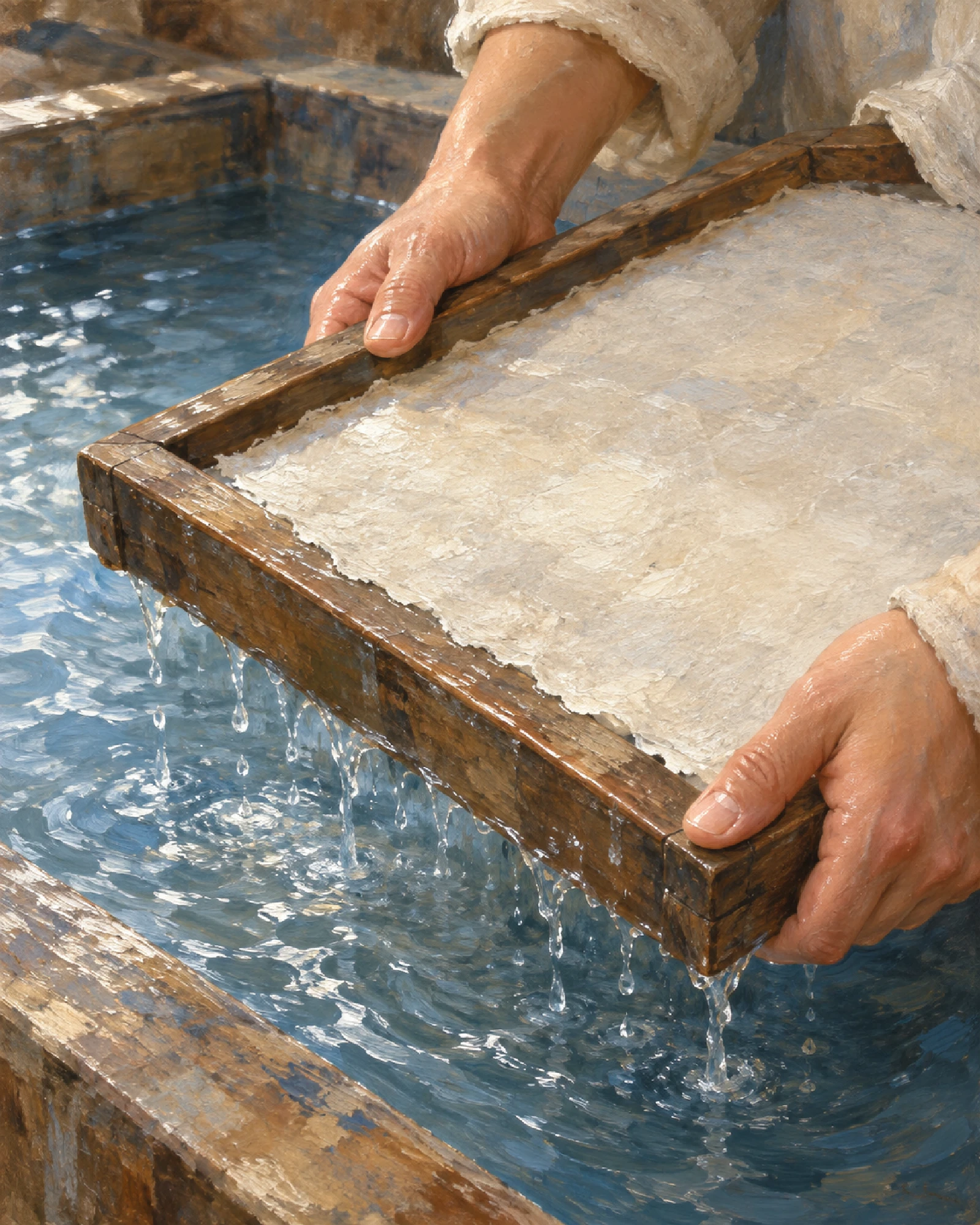
Two hands lift a mould bearing freshly formed paper, its trailing film of water captured in luminous continuous-tone painting.
Remix this referencePaper Rising from the Vat
- Form language
- Reduce forms to broad, gently swelling masses with a few descriptive irregularities; let minor details vary naturally within this simplification.
- Contour
- Build boundaries from adjoining painted tones, alternating soft lost edges with brief crisp accents instead of continuous outlines.
- Mark-making
- Use broad interwoven brush passes and occasional broken bristle strokes; vary length and pressure without a repeated texture pattern.
- Surface rendering
- Layer translucent oil-like glazes over softly blended opaque passages; continuous tonal transitions and sparse scumbles create luminous depth.
Priority
Unify translucent layers and tangible brushwork into luminous continuous-tone painting.
What to avoid & what to check
Exact prompt for this example
MODULE OWNERSHIP
subject: Subject count, type, stable proportions and landmarks, resting face geometry, hair shape, physical materials, garment construction and permanent marks. No emotion, movement, color assignment or rendering recipe.
expression: Facial soft-tissue displacement and pupil direction, muscle coordination, regional intensity, asymmetry and onset/peak/release. No head/body pose, stable appearance, skin color or rendering.
gesture: Head/neck/body/limb orientation, joint movement, support, contact and pose-caused occlusion using existing anatomy. No eye/pupil movement, emotion, identity, props inventory or camera.
props: Prop count, type, construction, physical material and scale relative to the subject. Holding/contact belongs to gesture, position to composition, color to palette.
scene: Environment elements, terrain, backdrop/floor presence and structural detail. No canvas positions, camera, lighting, assigned colors or render texture.
camera: Projection, focal-length impression, camera elevation/yaw/roll, viewing distance and crop. No actor pose, world placement, lighting or canvas aspect ratio.
composition: Normalized 0-100% canvas positions, scale in frame, depth/overlap, focal hierarchy and margins. No joint pose, camera projection, rendering, subject/prop inventory or emotion.
palette: Color anchors, hue/saturation/value ranges, colors assigned to parts and approximate color coverage. No illumination direction, shading algorithm, physical material or layout.
lighting: Light-source direction/softness/intensity, ambient illumination, physical shadow direction/length and highlight position. Absence of directional illumination is allowed. No shading technique, palette or material changes.
style: Reusable form abstraction, contour weight/taper/edge quality, medium and mark scale/density/direction, surface rendering and tonal transition technique. No fixed subject proportions, anatomy, identity, expression, pose, palette, light-source direction, camera or layout.
output: Image count, aspect ratio, size, file/alpha requirements and global lettering/logo/watermark restrictions. No background scenery, crop, style, identity or pose.

SUBJECT
inventory: One adult papermaker.
geometry: Natural adult hands with broad palms, softly pronounced knuckles and short rounded nails.
resting-face: Resting facial geometry is unspecified.
appearance: Bare hands and loose woven sleeves with thick folded cuffs; no visible permanent marks.

PRIORITY


AVOID


CHECK


GESTURE
head: Head and neck orientation is unspecified.
torso: Torso orientation is unspecified.
limbs: Both forearms rise together, wrists gently extended to tip the mould and let water drain.
contact: Fingers curl under opposite frame rails while the thumbs brace their upper edges.

PRIORITY


AVOID


CHECK


PROPS
inventory: One rectangular papermaking mould several palm widths across and one freshly formed sheet.
construction: A wooden frame supports fine mesh; the thin wet pulp sheet has a soft, irregular deckled edge.

PRIORITY


AVOID


CHECK


SCENE
inventory: An open workshop vat filled with pulp water; no additional furnishings are needed.
structure: The vat has a broad worn rim; shallow ripples meet a thinning film of draining water.

PRIORITY


AVOID


CHECK


CAMERA
projection: Natural perspective with a normal-lens impression.
viewpoint: Look closely downward from an oblique overhead position, with a level camera roll.
crop: An intimate detail crop shows both hands and lower forearms, excludes head, neck and torso, and cuts through the forearms and far end of the mould.

PRIORITY


AVOID


CHECK


COMPOSITION
placement: The paper spreads across the middle and right; the draining edge near the lower middle is the primary focus.
depth: Hands overlap the frame, the frame overlaps the vat, and the trailing water connects these depth layers.
spacing: The mould fills much of the width, leaving open water at upper left and unequal edge margins.

PRIORITY


AVOID


CHECK


PALETTE
colors: Warm ivory, petrol blue, burnt umber and muted peach form a restrained, mostly middle-value palette.
assignment: Ivory belongs to paper and sleeves, petrol blue to water, umber to the frame, and peach to the hands.
balance: Blue and ivory dominate with smaller warm accents; reserve the palest values for paper and water glints.

PRIORITY


AVOID


CHECK


LIGHTING
sources: Broad soft window light enters from the upper left, supported by gentle ambient fill.
shadows: Soft short shadows fall toward the lower right beneath the frame and fingers.
highlights: A narrow highlight follows the draining water lip; broader highlights rest on the upper planes of hands and paper.

PRIORITY


AVOID


CHECK


STYLE GUIDE
form-language: Reduce forms to broad, gently swelling masses with a few descriptive irregularities; let minor details vary naturally within this simplification.
contour: Build boundaries from adjoining painted tones, alternating soft lost edges with brief crisp accents instead of continuous outlines.
mark-making: Use broad interwoven brush passes and occasional broken bristle strokes; vary length and pressure without a repeated texture pattern.
surface-rendering: Layer translucent oil-like glazes over softly blended opaque passages; continuous tonal transitions and sparse scumbles create luminous depth.

PRIORITY
Unify translucent layers and tangible brushwork into luminous continuous-tone painting.

AVOID


CHECK


OUTPUT
format: One finished image, portrait 4:5, 1600 × 2000 pixels, opaque PNG.
restrictions: No lettering, logos, signatures or watermarks.

PRIORITY


AVOID


CHECK


FINAL INTEGRATION
gesture + props + scene: Coordinate the lifting action with the draining water so the papermaking process reads immediately.
style + lighting + palette: Coordinate painted transitions, illumination and value relationships so luminosity feels embedded in the forms.
Model information comes from image provenance. The same prompt may produce a different result.