Text to imageArt stylesStyle guide
Rope Across the Slate Yard
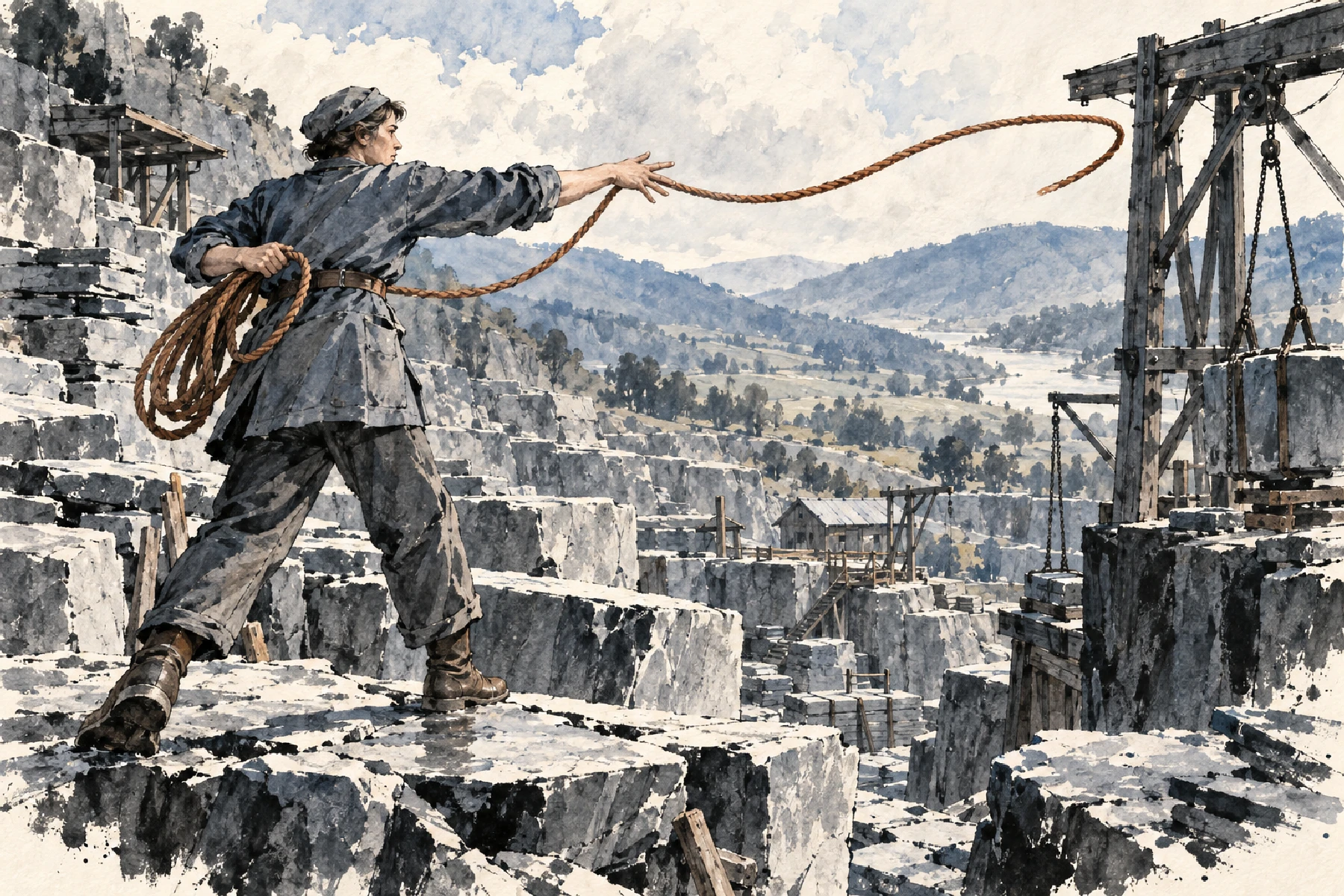
A worker casts a rope toward a distant gantry among layered stacks of slate. Broken brush lines and spreading ink washes build the yard's depth, while a broad opening of sky receives the rope's arc.
Remix this referenceRope Across the Slate Yard
- Form language
- Reduce forms into irregular wedges and broad curved masses; let small details vary within this economical vocabulary.
- Contour
- Loaded brush contours swell, taper and break; omit stretches of boundary where wash or bare paper can carry the edge.
- Mark-making
- Use brisk directional brush strokes and occasional dry-brush drag, with loose variation in length and pressure.
- Surface rendering
- Transparent ink pools, feathered blooms and overlapping washes create uneven tonal transitions beside untouched paper.
Priority
Make editorial ink wash visible through brush breaks, pooled tone and active areas of bare paper.
What to avoid & what to check
Exact prompt for this example
MODULE OWNERSHIP
subject: Subject count, type, stable proportions and landmarks, resting face geometry, hair shape, physical materials, garment construction and permanent marks. No emotion, movement, color assignment or rendering recipe.
expression: Facial soft-tissue displacement and pupil direction, muscle coordination, regional intensity, asymmetry and onset/peak/release. No head/body pose, stable appearance, skin color or rendering.
gesture: Head/neck/body/limb orientation, joint movement, support, contact and pose-caused occlusion using existing anatomy. No eye/pupil movement, emotion, identity, props inventory or camera.
props: Prop count, type, construction, physical material and scale relative to the subject. Holding/contact belongs to gesture, position to composition, color to palette.
scene: Environment elements, terrain, backdrop/floor presence and structural detail. No canvas positions, camera, lighting, assigned colors or render texture.
camera: Projection, focal-length impression, camera elevation/yaw/roll, viewing distance and crop. No actor pose, world placement, lighting or canvas aspect ratio.
composition: Normalized 0-100% canvas positions, scale in frame, depth/overlap, focal hierarchy and margins. No joint pose, camera projection, rendering, subject/prop inventory or emotion.
palette: Color anchors, hue/saturation/value ranges, colors assigned to parts and approximate color coverage. No illumination direction, shading algorithm, physical material or layout.
lighting: Light-source direction/softness/intensity, ambient illumination, physical shadow direction/length and highlight position. Absence of directional illumination is allowed. No shading technique, palette or material changes.
style: Reusable form abstraction, contour weight/taper/edge quality, medium and mark scale/density/direction, surface rendering and tonal transition technique. No fixed subject proportions, anatomy, identity, expression, pose, palette, light-source direction, camera or layout.
output: Image count, aspect ratio, size, file/alpha requirements and global lettering/logo/watermark restrictions. No background scenery, crop, style, identity or pose.

SUBJECT
inventory: One adult woman working as a rigger, designated A; no other figures.
geometry: A has a sturdy adult build with broad shoulders and compact hands.
resting-face: Straight brows, gently hooded eyes, a blunt nose and a broad mouth establish her resting facial landmarks.
appearance: Short hair beneath a fitted cloth cap; a belted canvas work coat, straight trousers and leather boots.

PRIORITY


AVOID


CHECK


EXPRESSION — ACTOR A
brows: The visible inner brow draws slightly inward; the concealed brow remains unprescribed.
lids: The visible upper lid narrows slightly, with mild lower-lid tension.
cheeks: The visible cheek stays relaxed without a smile lift.
nose: The visible nostril stays relaxed; no nose wrinkle appears.
mouth: Lips meet with a light press; the visible corner stays level.
jaw: The jaw stays settled with slight tension and no opening.
gaze: The visible pupil points toward the receiving gantry; the concealed eye remains unprescribed.
coordination: A slight brow knit and narrowed lid coordinate with a quietly pressed mouth.
timing: Hold restrained concentration at its apex.

PRIORITY


AVOID


CHECK


GESTURE
head: A turns her head and neck toward the receiving gantry, exposing her near-side profile.
torso: Her torso twists through the release, with her weight carried over the forward foot.
limbs: Her left arm follows the cast with an opening palm; her bent right arm feeds the remaining rope.
contact: Both boots brace on the ledge; the right hand retains the rope while the cast loops leave the left hand.

PRIORITY


AVOID


CHECK


PROPS
inventory: One long hemp rope, with a loose coil large enough to span A's forearm.
construction: Thick twisted strands form a flexible rope with plain ends and no attached fittings.

PRIORITY


AVOID


CHECK


SCENE
inventory: A slate quarry yard with stacked slabs, stepped rock ledges, a timber gantry and an open valley beyond.
structure: Uneven slab stacks form narrow working terraces; the gantry bridges a break between ledges.

PRIORITY


AVOID


CHECK


CAMERA
projection: Natural perspective with a moderately wide focal-length impression.
viewpoint: Slightly above ledge height, from A's left rear quarter, with a level horizon.
crop: Full-body environmental view with a readable near-side profile; nearby slabs extend beyond the lower and side edges.

PRIORITY


AVOID


CHECK


COMPOSITION
placement: A occupies about half the frame height near 30% across; the rope arcs toward the upper-right gantry.
depth: Foreground slabs overlap the working ledge; A and the rope lead into the farther gantry and valley.
spacing: The release hand and rope arc are the first read; generous open sky separates them from the dense yard.

PRIORITY


AVOID


CHECK


PALETTE
colors: Paper ivory, blue-black, muted slate blue and a restrained rust accent.
assignment: Blue-black anchors rock and timber; slate blue colors the coat and distant terrain; rust distinguishes the rope.
balance: Ivory covers the largest area, blue-black and slate blue share most of the remainder, and rust stays a small accent.

PRIORITY


AVOID


CHECK


LIGHTING
sources: Broad, soft daylight enters from the upper left, supported by diffuse outdoor ambient light.
shadows: Soft shadows fall toward the lower right; recesses between slab stacks remain noticeably darker.
highlights: Upper-left slab edges and the raised sleeve receive the clearest highlights.

PRIORITY


AVOID


CHECK


STYLE GUIDE
form-language: Reduce forms into irregular wedges and broad curved masses; let small details vary within this economical vocabulary.
contour: Loaded brush contours swell, taper and break; omit stretches of boundary where wash or bare paper can carry the edge.
mark-making: Use brisk directional brush strokes and occasional dry-brush drag, with loose variation in length and pressure.
surface-rendering: Transparent ink pools, feathered blooms and overlapping washes create uneven tonal transitions beside untouched paper.

PRIORITY
Make editorial ink wash visible through brush breaks, pooled tone and active areas of bare paper.

AVOID


CHECK


OUTPUT
format: One finished image, landscape 3:2, 1800 × 1200 pixels, opaque PNG.
restrictions: No lettering, logos or watermarks.

PRIORITY


AVOID


CHECK


FINAL INTEGRATION
gesture + composition: The arrangement should make the release and the rope's continuation readable as one uninterrupted action.
scene + style: Let structural layers remain understandable through selective marks, leaving incidental detail open to interpretation.
expression + gesture: Synchronize the facial apex with the rope leaving the casting hand.
Model information comes from image provenance. The same prompt may produce a different result.