Text to imageComicsStyle guide
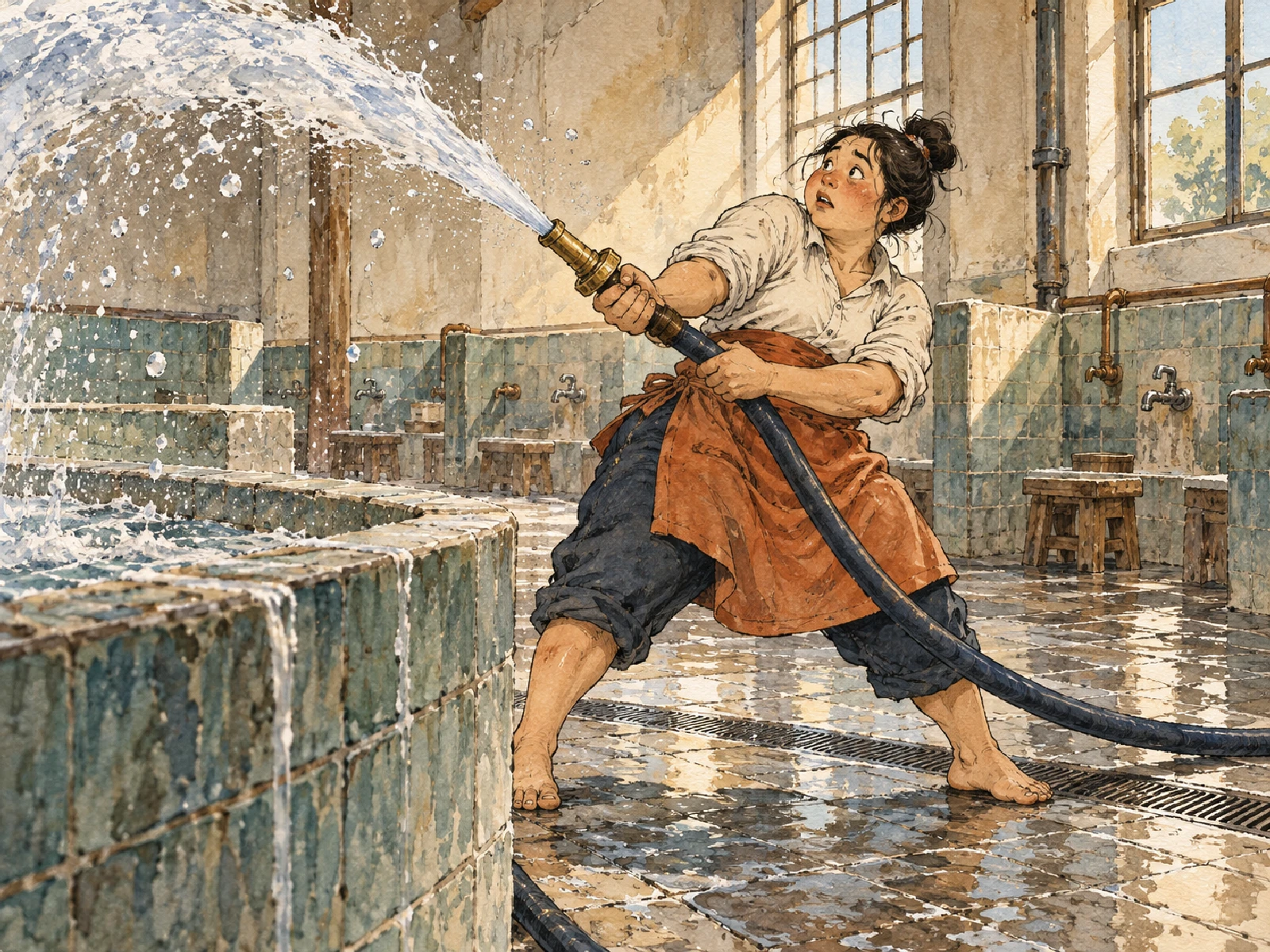
A Bathhouse Keeper Wrestling a Hose
A keeper wrestles a hose beneath a soaring jet in an empty bathhouse. Rough penwork and bleeding washes give the awkward moment its unruly energy.
Remix this referenceA Bathhouse Keeper Wrestling a Hose
- Form language
- Reduce forms to blunt masses and slightly crooked interlocking planes; allow small irregularities within a consistent, handmade vocabulary.
- Contour
- Use pressure-swollen nib lines that snag, taper and occasionally break; retain a few searching double contours instead of polishing every edge.
- Mark-making
- Build rough passages with quick hooked hatches and sparse dry-brush scuffs; let stroke length and density vary with the drawing's rhythm.
- Surface rendering
- Float transparent washes across pen boundaries, leaving backruns, pooled edges and paper gaps; use selective opaque touches over uneven tonal blooms.
Priority
Rendering medium: rough independent-comic illustration in dip pen, brush ink and watercolor wash on paper.
What to avoid & what to check
Exact prompt for this example
MODULE OWNERSHIP
subject: Subject count, type, stable proportions and landmarks, resting face geometry, hair shape, physical materials, garment construction and permanent marks. No emotion, movement, color assignment or rendering recipe.
expression: Facial soft-tissue displacement and pupil direction, muscle coordination, regional intensity, asymmetry and onset/peak/release. No head/body pose, stable appearance, skin color or rendering.
gesture: Head/neck/body/limb orientation, joint movement, support, contact and pose-caused occlusion using existing anatomy. No eye/pupil movement, emotion, identity, props inventory or camera.
props: Prop count, type, construction, physical material and scale relative to the subject. Holding/contact belongs to gesture, position to composition, color to palette.
scene: Environment elements, terrain, backdrop/floor presence and structural detail. No canvas positions, camera, lighting, assigned colors or render texture.
camera: Projection, focal-length impression, camera elevation/yaw/roll, viewing distance and crop. No actor pose, world placement, lighting or canvas aspect ratio.
composition: Normalized 0-100% canvas positions, scale in frame, depth/overlap, focal hierarchy and margins. No joint pose, camera projection, rendering, subject/prop inventory or emotion.
palette: Color anchors, hue/saturation/value ranges, colors assigned to parts and approximate color coverage. No illumination direction, shading algorithm, physical material or layout.
lighting: Light-source direction/softness/intensity, ambient illumination, physical shadow direction/length and highlight position. Absence of directional illumination is allowed. No shading technique, palette or material changes.
style: Reusable form abstraction, contour weight/taper/edge quality, medium and mark scale/density/direction, surface rendering and tonal transition technique. No fixed subject proportions, anatomy, identity, expression, pose, palette, light-source direction, camera or layout.
output: Image count, aspect ratio, size, file/alpha requirements and global lettering/logo/watermark restrictions. No background scenery, crop, style, identity or pose.

SUBJECT
inventory: A is the only person: one adult woman who maintains the bathhouse.
geometry: A has a sturdy build, broad hands, a rounded jaw and a short, broad nose.
resting-face: Her resting face has low straight brows, hooded eyes and a wide mouth with a fuller lower lip.
appearance: Her hair forms a compact bun; she wears a rolled-sleeve cotton shirt, a wrap apron and loose cropped trousers, barefoot.

PRIORITY


AVOID


CHECK


EXPRESSION — ACTOR A
brows: Both brows lift, with one rising slightly ahead of the other.
lids: Upper lids lift while lower lids tighten slightly.
cheeks: Cheeks tense gently without bunching into a smile.
nose: Nostrils widen slightly; the bridge remains unwrinkled.
mouth: Lips part into a small uneven oval, with one corner pulled sideways.
jaw: The jaw drops a little without opening into a shout.
gaze: Both pupils track the nozzle outlet.
coordination: Raised brows and guarded lids combine with the delayed opening of the mouth.
timing: Catch the onset of surprise, before the mouth fully opens.

PRIORITY


AVOID


CHECK


GESTURE
head: A draws her chin back and turns her head toward the nozzle, keeping her neck clear of her raised forearm.
torso: Her torso twists against the pull of her arms, with her weight sunk over the rear leg.
limbs: One elbow stays close to her ribs while the other reaches forward; bent knees and widely planted feet brace the effort.
contact: One hand grips the nozzle collar and the other clamps the hose behind it, aiming the outlet upward; both soles meet the floor.

PRIORITY


AVOID


CHECK


PROPS
inventory: One long cleaning hose with an attached nozzle; no separate handheld accessories.
construction: The flexible rubber tube is wrist-thick, ending in a short brass nozzle with a broad coupling collar.

PRIORITY


AVOID


CHECK


SCENE
inventory: A public bathhouse contains tiled soaking basins, washing bays, tall windows, puddles, a rising water jet and scattered droplets; the tiles are wet.
structure: Low basin walls divide the room; plaster walls, exposed pipes, recessed taps and narrow floor drains give the old interior practical detail.

PRIORITY


AVOID


CHECK


CAMERA
projection: Use perspective with a moderately wide lens impression and natural edge expansion.
viewpoint: View from approximately waist height at an oblique angle into the room, with a level horizon.
crop: Show A's full figure while cropping nearby architecture, including a basin rim, at the image edges.

PRIORITY


AVOID


CHECK


COMPOSITION
placement: Use an undivided canvas. Place A near 62% of the canvas width, occupying roughly two-thirds of its height; let the water arc sweep into the open upper left.
depth: A basin rim overlaps the hose in the foreground; A occupies the middle layer, with washing bays receding behind her.
spacing: The hands lead attention to the face, then the water arc; preserve a clear gap around the nozzle and let peripheral details vary.

PRIORITY


AVOID


CHECK


PALETTE
colors: Anchor the image in muted jade, warm ivory, rusty orange and near-black blue, with restrained saturation.
assignment: Assign jade to tiles, ivory to walls and shirt, rusty orange to the apron, dark blue to trousers and hose, and warm ochre to skin.
balance: Let pale ivory and jade dominate; concentrate orange in the apron and reserve the deepest values for sparse accents.

PRIORITY


AVOID


CHECK


LIGHTING
sources: Broad, soft daylight enters from the upper right; ambient bounce keeps the interior readable.
shadows: Soft shadows fall toward the lower left, becoming firmer at feet and basin bases.
highlights: Highlights catch upper-right-facing edges of tiles and the nozzle, and the upper-right sides of droplets.

PRIORITY


AVOID


CHECK


STYLE GUIDE
form-language: Reduce forms to blunt masses and slightly crooked interlocking planes; allow small irregularities within a consistent, handmade vocabulary.
contour: Use pressure-swollen nib lines that snag, taper and occasionally break; retain a few searching double contours instead of polishing every edge.
mark-making: Build rough passages with quick hooked hatches and sparse dry-brush scuffs; let stroke length and density vary with the drawing's rhythm.
surface-rendering: Float transparent washes across pen boundaries, leaving backruns, pooled edges and paper gaps; use selective opaque touches over uneven tonal blooms.

PRIORITY
Rendering medium: rough independent-comic illustration in dip pen, brush ink and watercolor wash on paper.

AVOID


CHECK


OUTPUT
format: Deliver one finished image at 1600 × 1200 pixels, 4:3 aspect ratio, as an opaque PNG.
restrictions: No dialogue, lettering, logos or watermarks.

PRIORITY


AVOID


CHECK


FINAL INTEGRATION
gesture + composition: Keep the hand contacts legible through the overlapping layers so the action reads at a glance.
style + expression: Preserve the small facial displacements through the loose marks so the acting survives the rough finish.
Model information comes from image provenance. The same prompt may produce a different result.