Text to imageLandscapeStyle guide
Small Rock Arch · Depth Through an Opening
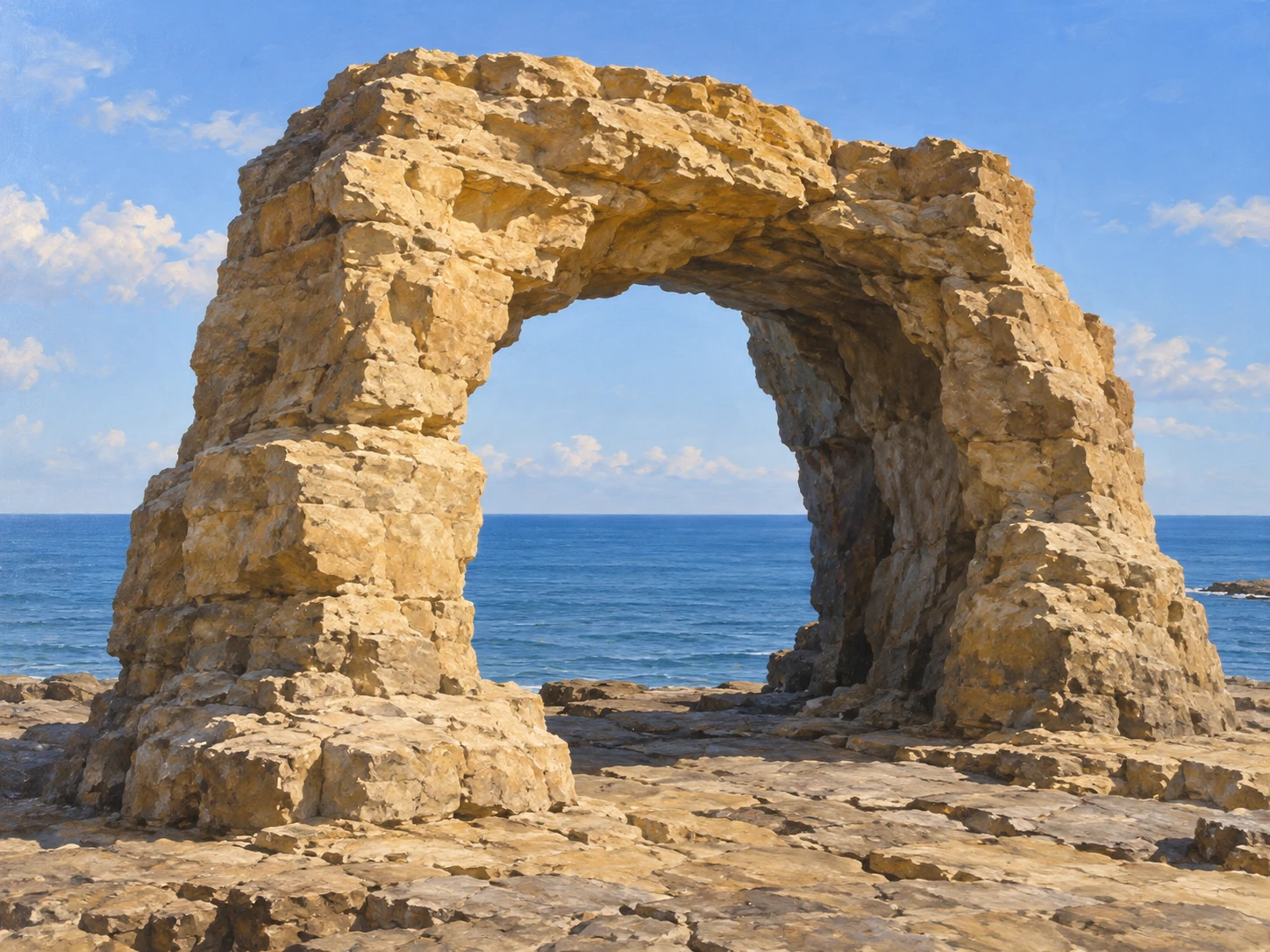
Separate a rock arch’s front rim, shaded inner wall, and distant horizon to make its opening read as a passage.
Small Rock Arch · Depth Through an Opening
- Shape & line
- Build the arch as one thick, irregular rock mass around a rounded opening. Show a pale front rim and a recessed inner wall along the opening’s image-right edge; let that wall overlap and conceal a strip of the distant sea so the aperture has visible thickness.
- Color & light
- Light the rock from upper image-left, giving the front and crown warm sandy tones while keeping the recessed image-right inner wall in a cooler, darker shadow. Paint the sea seen through the hole with the same blue and horizon height as the sea outside it, preserving a clear daylight opening.
- Texture & material
- Suggest coarse sandstone with broad matte brush patches and a few chipped edges whose shading follows the main light. Reduce texture inside the shaded passage and keep the sea smooth, so rock grain supports the solid mass without obscuring the front-rim and inner-wall boundary.
- Composition
- Leave enough open sky above the crown and rock platform below both supports to show the complete arch silhouette. Keep the aperture large enough to reveal separate areas of sky and sea, and use the horizon’s interruption at the inner wall as the clearest cue that the background lies beyond the rock.
Priority
Prioritize the visible thickness of the opening and the continuity of the distant sea.
What to avoid & what to check
Avoid flattening the aperture into a painted blue patch or outlining every rock texture.
Check that the shaded inner wall visibly occludes the sea and that both horizon segments align.
Exact prompt for this example
SUBJECT
One small coastal sandstone arch rising from a bare rock platform, with one opening passing completely through the rock. A calm sea and its distant horizon are visible through the opening and beside the arch.

COMPOSITION
Use a slightly oblique eye-level view that reveals the opening’s inner wall on image-right. Place the arch near the center, occupying most of the frame, with its entire crown and both grounded supports visible. Keep the sea horizon visible through the aperture.

STYLE GUIDE
1. Shape & line
Build the arch as one thick, irregular rock mass around a rounded opening. Show a pale front rim and a recessed inner wall along the opening’s image-right edge; let that wall overlap and conceal a strip of the distant sea so the aperture has visible thickness.

2. Color & light
Light the rock from upper image-left, giving the front and crown warm sandy tones while keeping the recessed image-right inner wall in a cooler, darker shadow. Paint the sea seen through the hole with the same blue and horizon height as the sea outside it, preserving a clear daylight opening.

3. Texture & material
Suggest coarse sandstone with broad matte brush patches and a few chipped edges whose shading follows the main light. Reduce texture inside the shaded passage and keep the sea smooth, so rock grain supports the solid mass without obscuring the front-rim and inner-wall boundary.

4. Composition
Leave enough open sky above the crown and rock platform below both supports to show the complete arch silhouette. Keep the aperture large enough to reveal separate areas of sky and sea, and use the horizon’s interruption at the inner wall as the clearest cue that the background lies beyond the rock.

PRIORITY
Preserve the requested identity, count, action, composition and output settings. Apply the style rules within those constraints; a style reference must not replace the subject or layout. Within the style: Prioritize the visible thickness of the opening and the continuity of the distant sea.

AVOID
Avoid flattening the aperture into a painted blue patch or outlining every rock texture.

OUTPUT
Create one landscape reference image in a 4:3 horizontal aspect ratio, rendered as a restrained opaque painted study, with no text, labels, border, or watermark.

SELF-CHECK
Check that the shaded inner wall visibly occludes the sea and that both horizon segments align.
Model information comes from image provenance. The same prompt may produce a different result.