Text to imageArt stylesStyle guide
Ribbon Dance with a Mule
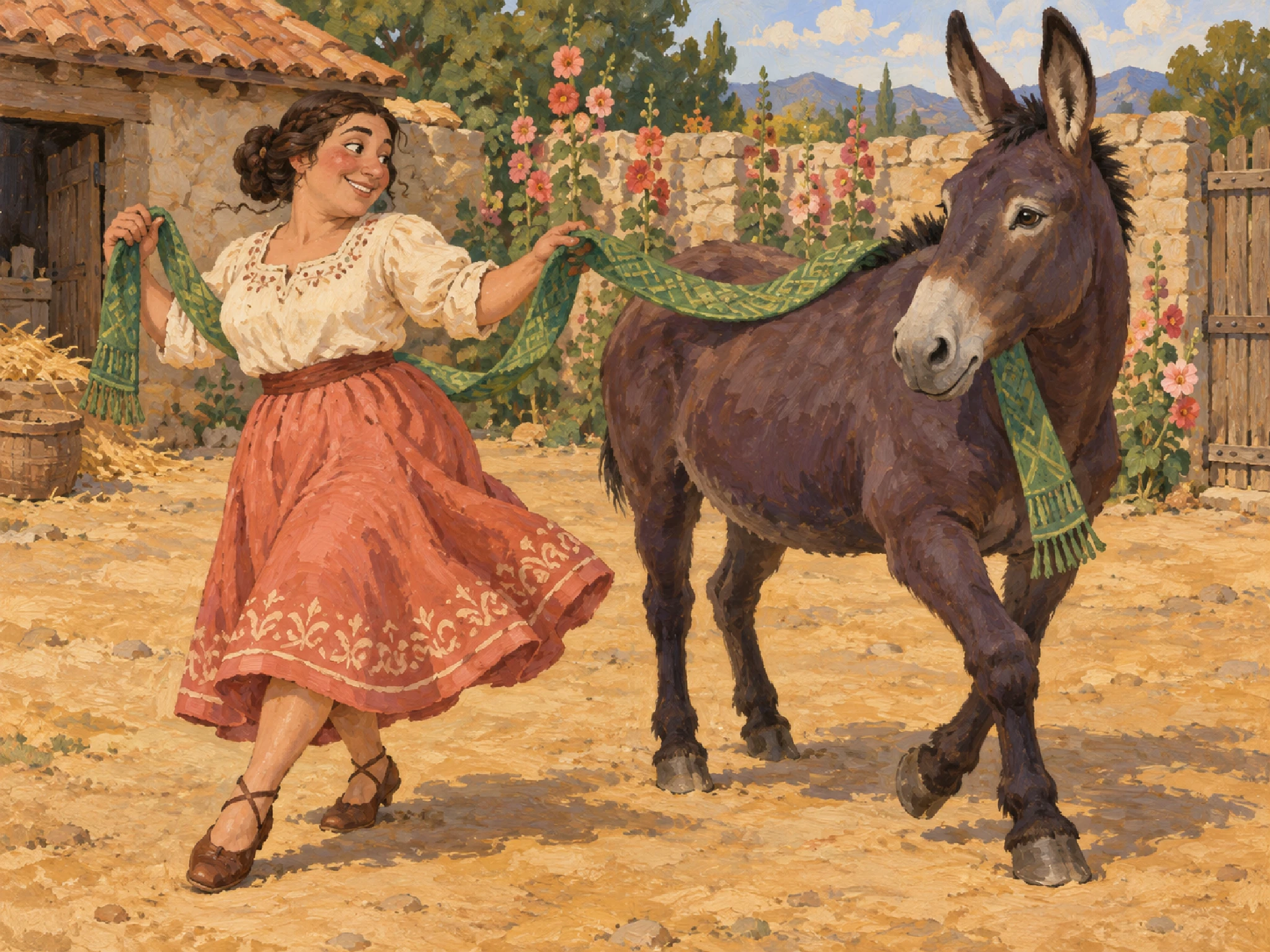
A woman sidesteps beside a mule, lifting a long ribbon across its back. Overlapping skirt, ribbon, and decorative courtyard plants animate a lively folk painting.
Remix this referenceRibbon Dance with a Mule
- Form language
- Reduce forms to generous, slightly lopsided masses; repeat simple decorative motifs with playful differences.
- Contour
- Use wandering brush contours that thicken at turns and occasionally dissolve into adjacent paint.
- Mark-making
- Build naive folk painting with opaque brush dabs, loose scallops, and sparse decorative strokes of varying size.
- Surface rendering
- Layer uneven matte paint over visible underpainting; describe volume with broad patches and softened local joins.
Priority
Preserve lively decorative simplification and natural handmade variation.
What to avoid & what to check
Exact prompt for this example
MODULE OWNERSHIP
subject: Subject count, type, stable proportions and landmarks, resting face geometry, hair shape, physical materials, garment construction and permanent marks. No emotion, movement, color assignment or rendering recipe.
expression: Facial soft-tissue displacement and pupil direction, muscle coordination, regional intensity, asymmetry and onset/peak/release. No head/body pose, stable appearance, skin color or rendering.
gesture: Head/neck/body/limb orientation, joint movement, support, contact and pose-caused occlusion using existing anatomy. No eye/pupil movement, emotion, identity, props inventory or camera.
props: Prop count, type, construction, physical material and scale relative to the subject. Holding/contact belongs to gesture, position to composition, color to palette.
scene: Environment elements, terrain, backdrop/floor presence and structural detail. No canvas positions, camera, lighting, assigned colors or render texture.
camera: Projection, focal-length impression, camera elevation/yaw/roll, viewing distance and crop. No actor pose, world placement, lighting or canvas aspect ratio.
composition: Normalized 0-100% canvas positions, scale in frame, depth/overlap, focal hierarchy and margins. No joint pose, camera projection, rendering, subject/prop inventory or emotion.
palette: Color anchors, hue/saturation/value ranges, colors assigned to parts and approximate color coverage. No illumination direction, shading algorithm, physical material or layout.
lighting: Light-source direction/softness/intensity, ambient illumination, physical shadow direction/length and highlight position. Absence of directional illumination is allowed. No shading technique, palette or material changes.
style: Reusable form abstraction, contour weight/taper/edge quality, medium and mark scale/density/direction, surface rendering and tonal transition technique. No fixed subject proportions, anatomy, identity, expression, pose, palette, light-source direction, camera or layout.
output: Image count, aspect ratio, size, file/alpha requirements and global lettering/logo/watermark restrictions. No background scenery, crop, style, identity or pose.

SUBJECT
inventory: A is one adult woman; B is one mule. They are the only figures.
geometry: A has a sturdy build and broad oval face; B has a barrel-shaped torso, long ears, and a substantial muzzle.
resting-face: A has gently arched brows and a wide mouth; B has small lateral eyes and a long, rounded muzzle.
appearance: A wears a woven linen blouse and gathered skirt, with a coiled braid; B has short hair and a bristly mane.

PRIORITY


AVOID


CHECK


EXPRESSION — ACTOR A
brows: Brows lift gently, with one slightly higher.
lids: Lower lids rise softly; upper lids remain relaxed.
cheeks: Both cheeks lift, slightly more on the higher smile side.
nose: Nose and nostrils remain relaxed.
mouth: An open smile has one corner a little higher.
jaw: The jaw releases slightly beneath the smile.
gaze: Pupils turn toward the mule's near ear.
coordination: Cheek lift supports the lower lids and uneven smile.
timing: Capture the apex of amusement before the smile releases.

PRIORITY


AVOID


CHECK


EXPRESSION — ACTOR B
brows: Brow-region tissue stays relaxed, without lifting or creasing.
lids: Visible lids remain softly open without tightening.
cheeks: Cheek and muzzle tissue remain loose, without upward bunching.
nose: Nostrils stay relaxed without flaring or wrinkling.
mouth: Lips meet softly with no pulled corners or exposed teeth.
jaw: The jaw stays loosely closed without clenching.
gaze: The visible pupil turns gently toward A.
coordination: Open lids and a relaxed muzzle maintain a quiet neutral expression.
timing: Hold a steady neutral apex with no developing facial reaction.

PRIORITY


AVOID


CHECK


GESTURE
head: A turns her head toward B; B lowers its muzzle slightly and keeps its ears upright.
torso: A's torso turns with a sideways dance step; B's trunk stays level during a short step.
limbs: A lifts both arms and crosses one foot past the planted foot; B advances one foreleg.
contact: A grips a ribbon end in each hand; its slack middle rests lightly across B's upper back.

PRIORITY


AVOID


CHECK


PROPS
inventory: One cloth ribbon, long enough to span the mule and reach both of the woman's hands.
construction: A broad woven band with soft edges and short fringe at its ends.

PRIORITY


AVOID


CHECK


SCENE
inventory: A village threshing yard with packed earth, a low storehouse, a gate, and flowering hollyhocks.
structure: An uneven enclosure joins the storehouse to the gate; tall flower stalks grow along its base.

PRIORITY


AVOID


CHECK


CAMERA
projection: Use gently compressed perspective with a normal-lens impression.
viewpoint: Look slightly downward from a modestly elevated, oblique viewpoint; keep the camera level.
crop: Show both complete figures and enough surrounding yard to establish the occasion.

PRIORITY


AVOID


CHECK


COMPOSITION
placement: Place A left of center and B right of center; the ribbon links their silhouettes.
depth: Overlap skirt, ribbon, and mule in the foreground, with enclosure and flowers layered behind.
spacing: Make the linked figures the primary focus; leave room above the ribbon and irregular side margins.

PRIORITY


AVOID


CHECK


PALETTE
colors: Use warm ochre, dusty coral, deep plum, leafy green, and chalk cream.
assignment: Give A a cream blouse and coral skirt, B a plum coat, the ribbon green, and the yard ochre.
balance: Muted warm fields dominate; the green ribbon and small coral flowers provide sharper accents.

PRIORITY


AVOID


CHECK


LIGHTING
sources: Broad afternoon light arrives softly from the upper left, with generous ambient illumination.
shadows: Short, soft shadows fall toward the lower right beneath feet, hooves, and the enclosure.
highlights: Gentle highlights touch upper-left-facing cheeks, sleeves, and the mule's back.

PRIORITY


AVOID


CHECK


STYLE GUIDE
form-language: Reduce forms to generous, slightly lopsided masses; repeat simple decorative motifs with playful differences.
contour: Use wandering brush contours that thicken at turns and occasionally dissolve into adjacent paint.
mark-making: Build naive folk painting with opaque brush dabs, loose scallops, and sparse decorative strokes of varying size.
surface-rendering: Layer uneven matte paint over visible underpainting; describe volume with broad patches and softened local joins.

PRIORITY
Preserve lively decorative simplification and natural handmade variation.

AVOID


CHECK


OUTPUT
format: One finished image, landscape 4:3, 2048 × 1536 pixels, opaque PNG.
restrictions: No lettering, logos, or watermarks.

PRIORITY


AVOID


CHECK


FINAL INTEGRATION
expression + gesture: Facial acting and bodily movement should read as one spontaneous moment.
composition + style: Keep the narrative legible while allowing painted edges and decorative rhythms to vary naturally.
Model information comes from image provenance. The same prompt may produce a different result.