Text to imageIllustrationStyle guide
A Moth Opening Its Wings from an Envelope
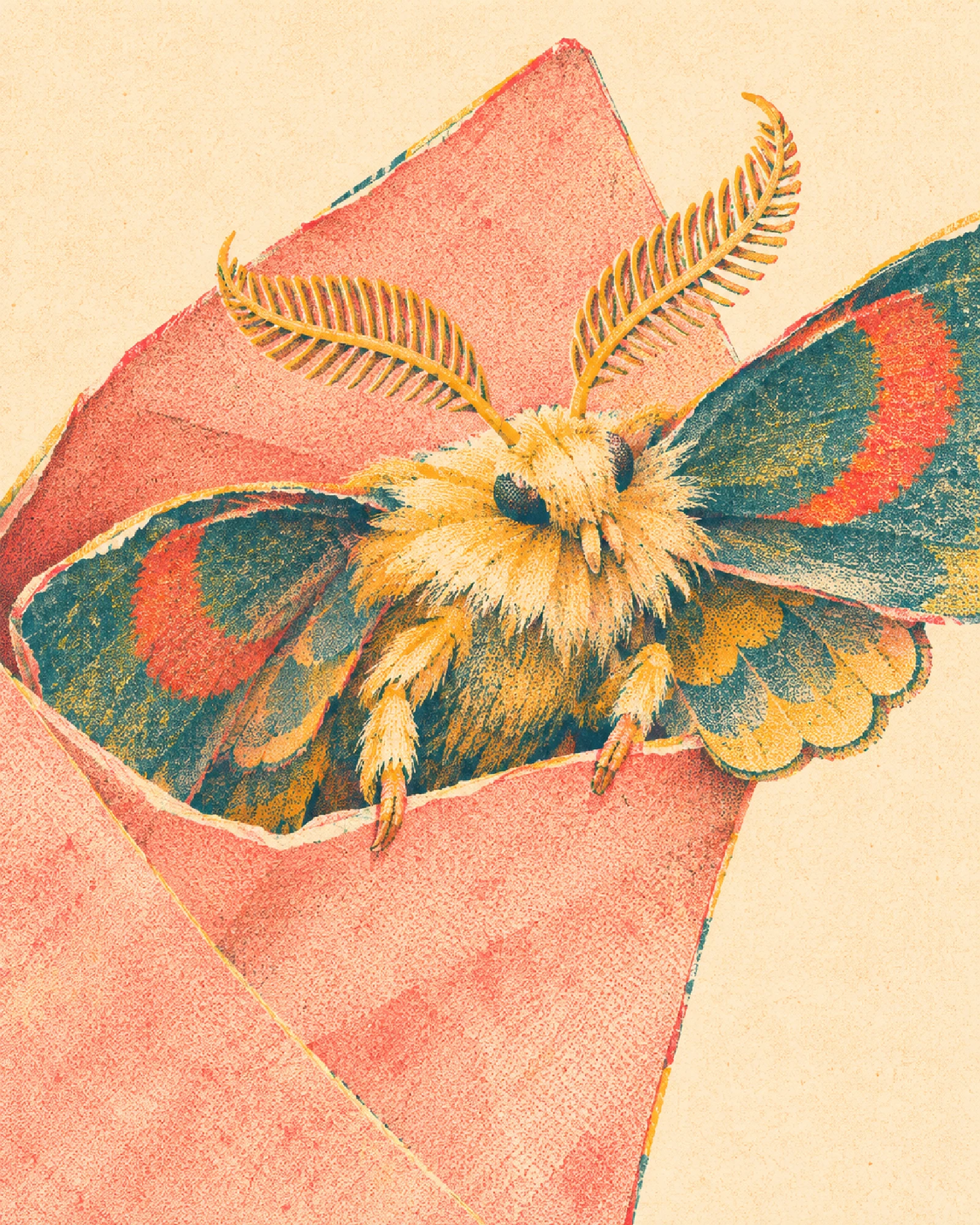
A moth opens its wings from an unsealed envelope. An intimate crop cuts through a wingtip, while grainy riso ink and wandering color registration bring the small encounter alive.
Remix this referenceA Moth Opening Its Wings from an Envelope
- Form language
- Build forms from rounded cut-paper shapes and blunt notches; let small details vary without mechanically regular edges.
- Contour
- Use slightly ragged plate boundaries rather than continuous outlines, with occasional narrow gaps between adjoining shapes.
- Mark-making
- Break ink into irregular riso grain and loose stippled patches; vary mark size and density naturally across each shape.
- Surface rendering
- Create tone through translucent ink overlaps and coarse screens; playful registration slips reveal uneven slivers along selected boundaries.
Priority
Preserve the tactile riso character through grainy ink and visibly imperfect registration.
What to avoid & what to check
Exact prompt for this example
MODULE OWNERSHIP
subject: Subject count, type, stable proportions and landmarks, resting face geometry, hair shape, physical materials, garment construction and permanent marks. No emotion, movement, color assignment or rendering recipe.
expression: Facial soft-tissue displacement and pupil direction, muscle coordination, regional intensity, asymmetry and onset/peak/release. No head/body pose, stable appearance, skin color or rendering.
gesture: Head/neck/body/limb orientation, joint movement, support, contact and pose-caused occlusion using existing anatomy. No eye/pupil movement, emotion, identity, props inventory or camera.
props: Prop count, type, construction, physical material and scale relative to the subject. Holding/contact belongs to gesture, position to composition, color to palette.
scene: Environment elements, terrain, backdrop/floor presence and structural detail. No canvas positions, camera, lighting, assigned colors or render texture.
camera: Projection, focal-length impression, camera elevation/yaw/roll, viewing distance and crop. No actor pose, world placement, lighting or canvas aspect ratio.
composition: Normalized 0-100% canvas positions, scale in frame, depth/overlap, focal hierarchy and margins. No joint pose, camera projection, rendering, subject/prop inventory or emotion.
palette: Color anchors, hue/saturation/value ranges, colors assigned to parts and approximate color coverage. No illumination direction, shading algorithm, physical material or layout.
lighting: Light-source direction/softness/intensity, ambient illumination, physical shadow direction/length and highlight position. Absence of directional illumination is allowed. No shading technique, palette or material changes.
style: Reusable form abstraction, contour weight/taper/edge quality, medium and mark scale/density/direction, surface rendering and tonal transition technique. No fixed subject proportions, anatomy, identity, expression, pose, palette, light-source direction, camera or layout.
output: Image count, aspect ratio, size, file/alpha requirements and global lettering/logo/watermark restrictions. No background scenery, crop, style, identity or pose.

SUBJECT
inventory: A is one moth with no additional animals.
geometry: Give the moth tapered forewings, rounded scalloped hindwings, a compact abdomen and conspicuous comb antennae.
resting-face: Small, exposed compound eyes have a fixed lateral orientation; unobtrusive mouthparts retain insect facial structure without human features.
appearance: Fine scales cover the wings, a furry collar surrounds the thorax, and broad crescent markings distinguish the forewings.

PRIORITY


AVOID


CHECK


EXPRESSION — ACTOR A
brows: No brow action applies to the insect face.
lids: No eyelid acting applies.
cheeks: No cheek lifting, puffing or compression applies.
nose: No nasal movement applies to the insect face.
mouth: Mouthparts remain still, without a human smile or lip action.
jaw: No expressive jaw opening is prescribed.
gaze: No pupil direction applies.
coordination: Keep facial activity neutral; no coordinated human expression applies.
timing: The apex is a held resting facial state without an expressive transition.

PRIORITY


AVOID


CHECK


GESTURE
head: A inclines its head slightly toward the envelope rim, with the antennae spreading apart.
torso: The thorax leans out of the opening while the lower abdomen remains concealed inside.
limbs: The wings open unevenly, one reaching farther outward while the other remains gently cupped.
contact: The visible forelegs brace against the paper rim, supporting the emerging body.

PRIORITY


AVOID


CHECK


PROPS
inventory: One unsealed envelope, broad enough to accommodate the moth's folded wings.
construction: Folded paper forms a shallow pocket with a triangular flap and a slightly buckled mouth. The envelope has no postage graphics.

PRIORITY


AVOID


CHECK


SCENE
inventory: A bare writing table provides the only environmental surface; no room interior is visible.
structure: The tabletop is continuous and plain, with no visible edge, drawers or decorative fittings.

PRIORITY


AVOID


CHECK


CAMERA
projection: Use shallow natural perspective with a close-focus normal-lens impression.
viewpoint: Look steeply downward from slightly ahead of the moth, with no camera roll.
crop: Crop through the right outer wing and envelope base while retaining both antenna tips.

PRIORITY


AVOID


CHECK


COMPOSITION
placement: Place the thorax near 60% width and 40% height; the envelope extends diagonally from the lower left.
depth: The moth overlaps the flap and pocket mouth; the thorax leads attention, followed by the wing crescents.
spacing: Let the wings occupy most of the width, balanced by an unoccupied tabletop wedge at the upper left.

PRIORITY


AVOID


CHECK


PALETTE
colors: Use petrol teal, tomato red and mustard yellow against warm cream, allowing muted mixed hues.
assignment: Give the wings teal fields and red crescents, the body mustard accents, and the envelope a pale red tint.
balance: Cream remains generous, teal carries the strongest darks, and red and mustard form smaller warm accents.

PRIORITY


AVOID


CHECK


LIGHTING
sources: Use diffuse frontal ambient light without a dominant directional source.
shadows: Keep contact shadows faint, with no directional cast shadows.
highlights: Broad gentle highlights fall on exposed surfaces, without isolated glints.

PRIORITY


AVOID


CHECK


STYLE GUIDE
form-language: Build forms from rounded cut-paper shapes and blunt notches; let small details vary without mechanically regular edges.
contour: Use slightly ragged plate boundaries rather than continuous outlines, with occasional narrow gaps between adjoining shapes.
mark-making: Break ink into irregular riso grain and loose stippled patches; vary mark size and density naturally across each shape.
surface-rendering: Create tone through translucent ink overlaps and coarse screens; playful registration slips reveal uneven slivers along selected boundaries.

PRIORITY
Preserve the tactile riso character through grainy ink and visibly imperfect registration.

AVOID


CHECK


OUTPUT
format: Deliver one finished image, portrait 4:5, 1600 × 2000 pixels, as an opaque PNG.
restrictions: No lettering, logos or watermarks.

PRIORITY


AVOID


CHECK


FINAL INTEGRATION
gesture + props + camera: Coordinate the emerging movement, envelope construction and close viewpoint so the contact remains immediately understandable.
palette + style: Let the assigned colors retain their roles through printing overlaps and registration variation.
Model information comes from image provenance. The same prompt may produce a different result.