Text to imageCharacterStyle guide
Balancing Lemur · Tail Counterbalance
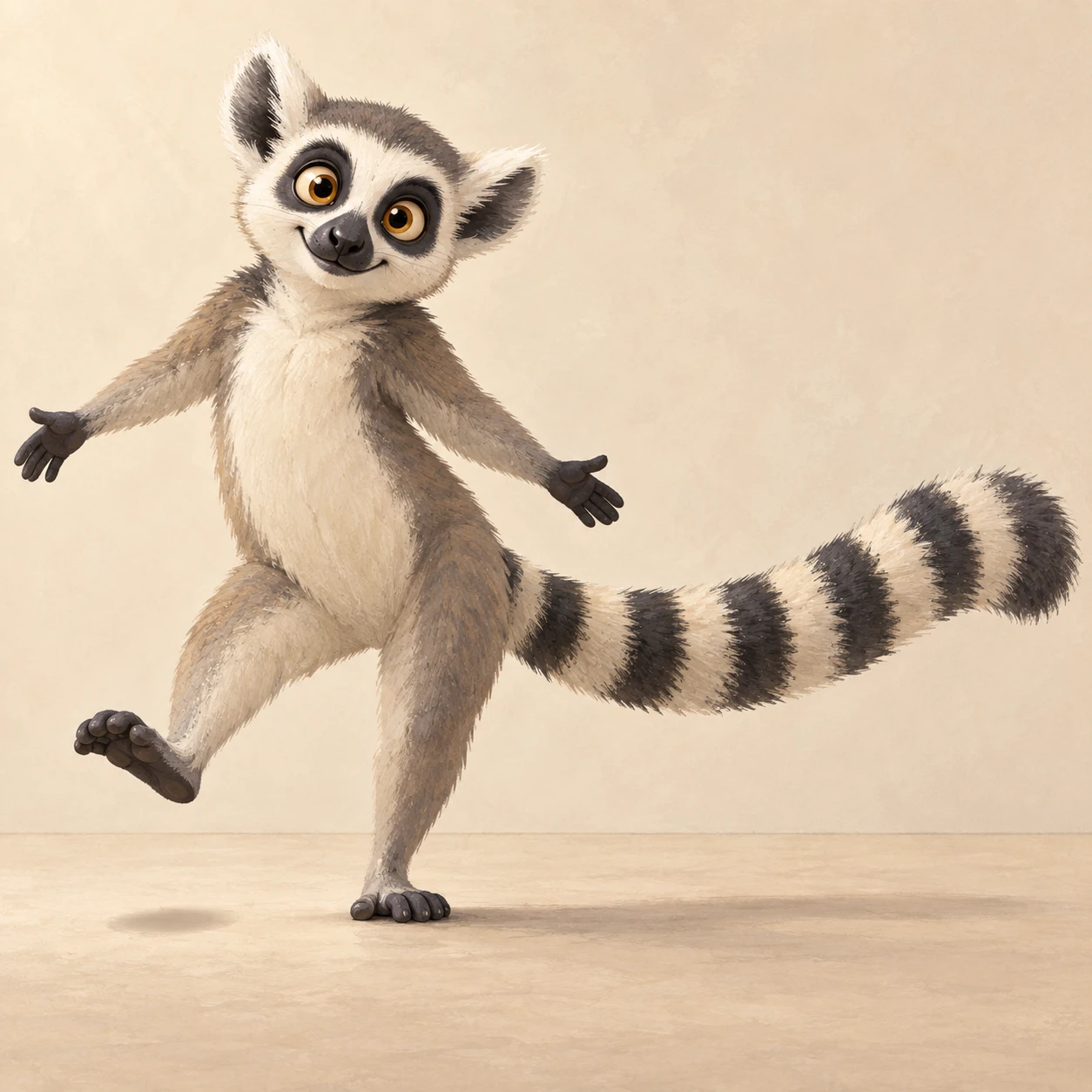
Extend a long tail opposite the body's lean to make a one-foot balancing pose clearly readable.
Balancing Lemur · Tail Counterbalance
- Shape & line
- Build the head and torso from rounded shapes, and draw a continuous lean toward image-left from the planted ankle through the hips to the head. Sweep the tail outward toward image-right in a long, shallow curve, keeping its tip below shoulder height so its opposing direction reads immediately.
- Color & light
- Use warm gray fur, a cream face and belly, and alternating charcoal and cream tail bands. Place a broad soft light at image-upper-left, making upper-left surfaces lighter and lower-right surfaces darker; add a compact floor shadow touching the planted sole and a softer detached shadow beneath the raised foot.
- Texture & material
- Render the character in matte gouache with broad opaque fills and restrained dry-brush marks following the fur direction along the cheeks, forearms, and tail. Keep the face and foot edges crisp enough to read the expression and floor contact, while allowing small bristled breaks along the furry outer contour.
- Composition
- Set the figure against a pale warm background with a simple floor line. Preserve visible background gaps between each arm and the torso, between the two feet, and beneath the tail; balance the body mass on image-left with the tail's reach on image-right without cropping either extremity.
Priority
Make the leftward body lean and rightward tail counterbalance the clearest gesture.
What to avoid & what to check
Avoid a tail that follows the body's lean or a raised foot that appears to touch the floor.
Check that one sole visibly meets the floor and the full tail extends opposite the torso's lean.
Exact prompt for this example
SUBJECT
One original, friendly ring-tailed lemur character balancing on its right foot on a flat floor. Its torso leans toward image-left, its left foot lifts toward image-left, and its long tail extends toward image-right as a visible counterbalance. Both arms remain slightly open beside the torso.

COMPOSITION
Show the entire character at eye level in a lightly turned frontal view, with the planted foot near the lower center. Leave generous space on image-right for the full tail and enough space below both feet to distinguish the planted foot from the lifted foot.

STYLE GUIDE
1. Shape & line
Build the head and torso from rounded shapes, and draw a continuous lean toward image-left from the planted ankle through the hips to the head. Sweep the tail outward toward image-right in a long, shallow curve, keeping its tip below shoulder height so its opposing direction reads immediately.

2. Color & light
Use warm gray fur, a cream face and belly, and alternating charcoal and cream tail bands. Place a broad soft light at image-upper-left, making upper-left surfaces lighter and lower-right surfaces darker; add a compact floor shadow touching the planted sole and a softer detached shadow beneath the raised foot.

3. Texture & material
Render the character in matte gouache with broad opaque fills and restrained dry-brush marks following the fur direction along the cheeks, forearms, and tail. Keep the face and foot edges crisp enough to read the expression and floor contact, while allowing small bristled breaks along the furry outer contour.

4. Composition
Set the figure against a pale warm background with a simple floor line. Preserve visible background gaps between each arm and the torso, between the two feet, and beneath the tail; balance the body mass on image-left with the tail's reach on image-right without cropping either extremity.

PRIORITY
Preserve the requested identity, count, action, composition and output settings. Apply the style rules within those constraints; a style reference must not replace the subject or layout. Within the style: Make the leftward body lean and rightward tail counterbalance the clearest gesture.

AVOID
Avoid a tail that follows the body's lean or a raised foot that appears to touch the floor.

OUTPUT
Create one finished character illustration in a square 1:1 image, with no lettering, captions, logos, or watermarks.

SELF-CHECK
Check that one sole visibly meets the floor and the full tail extends opposite the torso's lean.
Model information comes from image provenance. The same prompt may produce a different result.