Text to imageComicsStyle guide
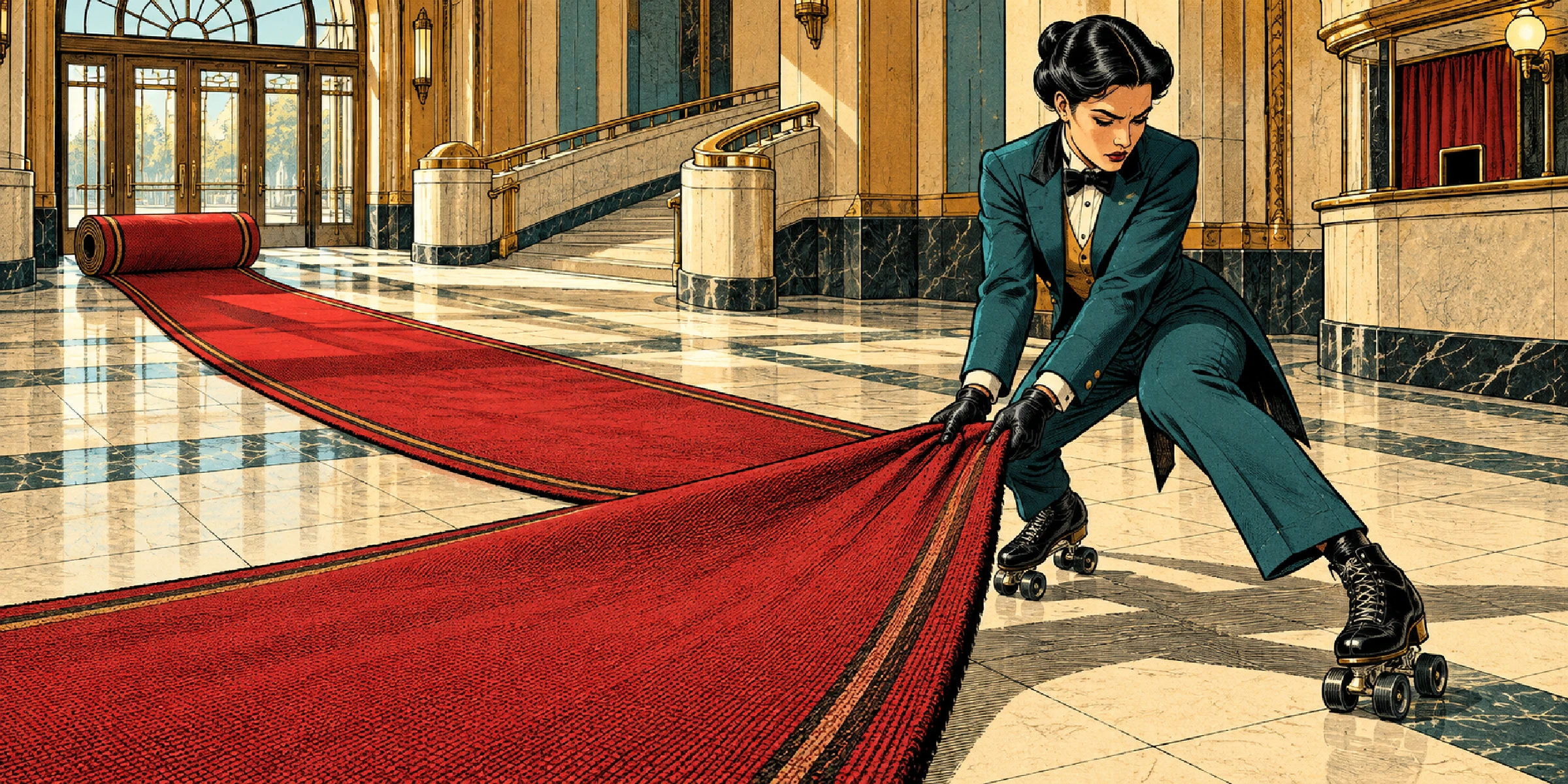
An Usher Unrolling a Carpet on Skates
A skating usher glides backward, unfurling a long carpet through a theatre lobby. Bold brush contours and restless hatching carry the eye around its bends through the panoramic space.
Remix this referenceAn Usher Unrolling a Carpet on Skates
- Form language
- Reduce complex forms to forceful wedges and broad interlocking masses; simplify small details into legible graphic rhythms.
- Contour
- Use pressure-swollen brush outlines with sharp tapered exits; break selected edges and reserve fine pen lines for interior divisions.
- Mark-making
- Group brisk pen hatching into directional bursts, with occasional dry-brush skips; let stroke length and spacing vary naturally.
- Surface rendering
- Build tones from bold spotted blacks, open paper and selective coarse halftone; allow slightly uneven printed edges within this language.
Priority
Rendering medium: American comic illustration in brush-and-pen ink with printed color and selective halftone.
What to avoid & what to check
Exact prompt for this example
MODULE OWNERSHIP
subject: Subject count, type, stable proportions and landmarks, resting face geometry, hair shape, physical materials, garment construction and permanent marks. No emotion, movement, color assignment or rendering recipe.
expression: Facial soft-tissue displacement and pupil direction, muscle coordination, regional intensity, asymmetry and onset/peak/release. No head/body pose, stable appearance, skin color or rendering.
gesture: Head/neck/body/limb orientation, joint movement, support, contact and pose-caused occlusion using existing anatomy. No eye/pupil movement, emotion, identity, props inventory or camera.
props: Prop count, type, construction, physical material and scale relative to the subject. Holding/contact belongs to gesture, position to composition, color to palette.
scene: Environment elements, terrain, backdrop/floor presence and structural detail. No canvas positions, camera, lighting, assigned colors or render texture.
camera: Projection, focal-length impression, camera elevation/yaw/roll, viewing distance and crop. No actor pose, world placement, lighting or canvas aspect ratio.
composition: Normalized 0-100% canvas positions, scale in frame, depth/overlap, focal hierarchy and margins. No joint pose, camera projection, rendering, subject/prop inventory or emotion.
palette: Color anchors, hue/saturation/value ranges, colors assigned to parts and approximate color coverage. No illumination direction, shading algorithm, physical material or layout.
lighting: Light-source direction/softness/intensity, ambient illumination, physical shadow direction/length and highlight position. Absence of directional illumination is allowed. No shading technique, palette or material changes.
style: Reusable form abstraction, contour weight/taper/edge quality, medium and mark scale/density/direction, surface rendering and tonal transition technique. No fixed subject proportions, anatomy, identity, expression, pose, palette, light-source direction, camera or layout.
output: Image count, aspect ratio, size, file/alpha requirements and global lettering/logo/watermark restrictions. No background scenery, crop, style, identity or pose.

SUBJECT
inventory: One original adult woman, a theatre usher; no additional people.
geometry: A broad-shouldered, long-legged build with large hands and a compact, angular head.
resting-face: Wide-set eyes, a long straight nose, a broad upper lip and a short squared chin define the resting face.
appearance: Hair forms a swept wedge and small bun; a wool tailcoat has stiff lapels, with tapered trousers and leather gloves.

PRIORITY


AVOID


CHECK


EXPRESSION — ACTOR A
brows: Inner brow ends draw down, with one brow slightly higher.
lids: Upper lids narrow and lower lids tighten without closing the eyes.
cheeks: Cheeks remain taut without a smile lift.
nose: Nostrils remain relaxed; the nose does not wrinkle.
mouth: Closed lips press together, slightly harder at one corner.
jaw: The jaw sets gently without exposing teeth.
gaze: Pupils aim down toward the carpet edge between her hands.
coordination: Focused eyes and compressed lips carry the effort; cheek tension stays restrained.
timing: Hold the apex of a brief, concentrated effort.

PRIORITY


AVOID


CHECK


GESTURE
head: Her neck extends forward and her chin dips toward her hands.
torso: She glides backward with lowered hips, torso leaning away from the carpet's pull.
limbs: Both arms reach low; bent knees separate as one skate rolls outward and the other supports her.
contact: Gloved hands grip the carpet's free edge; both skates remain in contact with the floor.

PRIORITY


AVOID


CHECK


PROPS
inventory: One long carpet, partly rolled, and one pair of boot-mounted roller skates.
construction: The heavy woven carpet has a hollow roll core; each leather skate has a metal chassis and four wheels.

PRIORITY


AVOID


CHECK


SCENE
inventory: An empty theatre lobby with tiled flooring, a broad access ramp, glazed entrance doors and a ticket alcove.
structure: The shallow ramp curves between thick balustrades; tall door frames and stepped wall recesses establish the hall.

PRIORITY


AVOID


CHECK


CAMERA
projection: Use perspective with a moderately wide lens impression and gentle edge expansion.
viewpoint: Look slightly downward from an oblique angle across the hall; keep the camera level.
crop: Use a wide environmental full-body view with the usher's hands and skates entirely visible.

PRIORITY


AVOID


CHECK


COMPOSITION
placement: Place the usher in the right foreground at about half-frame height; distant entrance doors anchor the left.
depth: The carpet sweeps from her hands through the middle distance to its roll near the doors, linking three depths.
spacing: Lead from the usher's silhouette along the carpet to the entrance; leave broad floor gaps around each bend.

PRIORITY


AVOID


CHECK


PALETTE
colors: Anchor the image in ink black, warm cream, muted teal, cherry red and ochre.
assignment: Give the carpet cherry red, uniform teal, hair black, face warm ochre, and architecture cream with ochre accents.
balance: Cream dominates; teal forms a secondary mass, red stays a narrow accent, and black supplies the deepest values.

PRIORITY


AVOID


CHECK


LIGHTING
sources: Broad daylight enters through the entrance from the upper left, with moderate ambient fill.
shadows: Soft-edged cast shadows extend toward the lower right; contact shadows remain short beneath wheels and carpet.
highlights: Broad highlights touch upper-left-facing planes; small glints appear on exposed skate frames.

PRIORITY


AVOID


CHECK


STYLE GUIDE
form-language: Reduce complex forms to forceful wedges and broad interlocking masses; simplify small details into legible graphic rhythms.
contour: Use pressure-swollen brush outlines with sharp tapered exits; break selected edges and reserve fine pen lines for interior divisions.
mark-making: Group brisk pen hatching into directional bursts, with occasional dry-brush skips; let stroke length and spacing vary naturally.
surface-rendering: Build tones from bold spotted blacks, open paper and selective coarse halftone; allow slightly uneven printed edges within this language.

PRIORITY
Rendering medium: American comic illustration in brush-and-pen ink with printed color and selective halftone.

AVOID


CHECK


OUTPUT
format: One finished illustration, 2:1 aspect ratio, 2400 × 1200 pixels, opaque PNG; no lettering, logos or watermarks.
restrictions: One finished illustration, 2:1 aspect ratio, 2400 × 1200 pixels, opaque PNG; no lettering, logos or watermarks.

PRIORITY


AVOID


CHECK


FINAL INTEGRATION
gesture + props + composition: Make the carpet's continuous construction, the usher's grip and the spatial sweep read as one coherent action.
style + lighting + expression: Let the inking interpret the illumination while retaining the small facial displacements that carry the performance.
Model information comes from image provenance. The same prompt may produce a different result.