Text to imagePortraitStyle guide
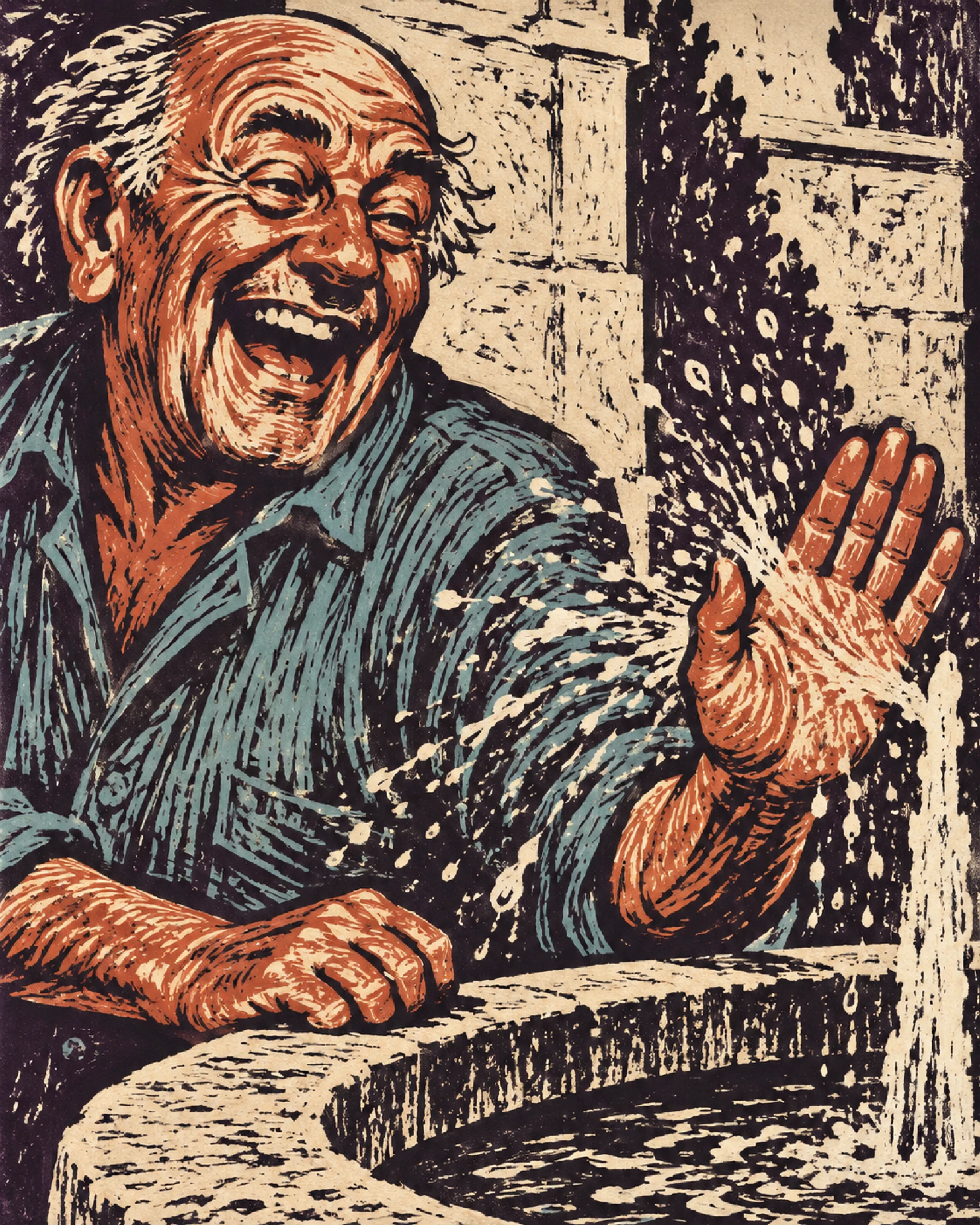
Man in the Fountain Spray
A man laughs as the fountain jet he deflects with his palm splashes his face. Bold linocut masses and rhythmic cuts interweave his face, hand, and water.
Remix this referenceMan in the Fountain Spray
- Form language
- Reduce volumes to interlocking, slightly irregular wedges and broad masses, preserving a hand-cut sense of weight.
- Contour
- Use heavy, uneven contour bridges with abrupt carved gaps; let some neighboring dark shapes merge.
- Mark-making
- Cut rhythmic hooked grooves and short gouge fans; vary their width and spacing naturally within each passage.
- Surface rendering
- Build tone through ink masses and exposed-paper cuts, with broken ink pickup and occasional rough overprint edges.
Priority
The finished image must read as a bold linocut with carved rhythmic marks.
What to avoid & what to check
Exact prompt for this example
MODULE OWNERSHIP
subject: Subject count, type, stable proportions and landmarks, resting face geometry, hair shape, physical materials, garment construction and permanent marks. No emotion, movement, color assignment or rendering recipe.
expression: Facial soft-tissue displacement and pupil direction, muscle coordination, regional intensity, asymmetry and onset/peak/release. No head/body pose, stable appearance, skin color or rendering.
gesture: Head/neck/body/limb orientation, joint movement, support, contact and pose-caused occlusion using existing anatomy. No eye/pupil movement, emotion, identity, props inventory or camera.
props: Prop count, type, construction, physical material and scale relative to the subject. Holding/contact belongs to gesture, position to composition, color to palette.
scene: Environment elements, terrain, backdrop/floor presence and structural detail. No canvas positions, camera, lighting, assigned colors or render texture.
camera: Projection, focal-length impression, camera elevation/yaw/roll, viewing distance and crop. No actor pose, world placement, lighting or canvas aspect ratio.
composition: Normalized 0-100% canvas positions, scale in frame, depth/overlap, focal hierarchy and margins. No joint pose, camera projection, rendering, subject/prop inventory or emotion.
palette: Color anchors, hue/saturation/value ranges, colors assigned to parts and approximate color coverage. No illumination direction, shading algorithm, physical material or layout.
lighting: Light-source direction/softness/intensity, ambient illumination, physical shadow direction/length and highlight position. Absence of directional illumination is allowed. No shading technique, palette or material changes.
style: Reusable form abstraction, contour weight/taper/edge quality, medium and mark scale/density/direction, surface rendering and tonal transition technique. No fixed subject proportions, anatomy, identity, expression, pose, palette, light-source direction, camera or layout.
output: Image count, aspect ratio, size, file/alpha requirements and global lettering/logo/watermark restrictions. No background scenery, crop, style, identity or pose.

SUBJECT
inventory: One original older adult man, actor A.
geometry: Broad shoulders, a rounded bald crown, prominent cheekbones, a broad nose, and long earlobes.
resting-face: At rest, heavy upper lids sit above deep-set eyes; the broad mouth has a thin upper lip.
appearance: Wiry side hair, bare facial skin, and a woven work shirt with a soft collar and rolled cuffs.

PRIORITY


AVOID


CHECK


EXPRESSION — ACTOR A
brows: Brows lift slightly, with one arch higher than the other.
lids: Lower lids rise strongly; upper lids narrow the eyes without fully closing them.
cheeks: Cheeks bunch upward into pronounced folds beside the nose.
nose: Nostrils widen slightly without a disgust wrinkle.
mouth: Mouth corners pull up and outward around an open laugh; upper teeth show.
jaw: Jaw drops freely, keeping the open mouth broad rather than round.
gaze: Pupils turn toward the raised palm through the narrowed lids.
coordination: Cheek lift, eye narrowing, and mouth opening share one spontaneous laugh.
timing: Capture the apex of laughter just as the splash arrives.

PRIORITY


AVOID


CHECK


GESTURE
head: Head recoils a little and turns toward the raised hand; the neck remains loose.
torso: Upper torso twists away from the jet while the nearer shoulder rises.
limbs: One elbow bends to present an open palm; the other forearm braces against the basin rim.
contact: The jet strikes the heel of the open palm and fans outward; the bracing arm bears light weight.

PRIORITY


AVOID


CHECK


PROPS
inventory: No separate props.
construction: No prop construction applies.

PRIORITY


AVOID


CHECK


SCENE
inventory: A public fountain with a stone basin, a narrow water jet, and airborne spray.
structure: A thick curved basin lip and a plain masonry wall establish a modest courtyard setting.

PRIORITY


AVOID


CHECK


CAMERA
projection: Mildly compressed perspective with a portrait-lens impression.
viewpoint: Close three-quarter view at eye height, with a level camera.
crop: Frame from the upper chest upward, retaining the complete raised hand and a fragment of the basin.

PRIORITY


AVOID


CHECK


COMPOSITION
placement: The large face occupies the upper left; the palm counters it at lower right, with the face dominant.
depth: Foreground spray overlaps the hand and lower cheek; the shoulder overlaps the basin and distant wall.
spacing: Keep a small open pocket beside the eyes; let the basin and spray continue beyond the frame.

PRIORITY


AVOID


CHECK


PALETTE
colors: Deep aubergine, warm chalk, burnt vermilion, and a restrained mineral turquoise.
assignment: Aubergine anchors the darks; vermilion describes skin, turquoise the shirt, and chalk the water and wall.
balance: Let chalk and aubergine dominate, with a warm face and a smaller cool garment accent.

PRIORITY


AVOID


CHECK


LIGHTING
sources: Broad daylight comes from high left, with gentle courtyard ambient fill.
shadows: Short shadows fall down and right beneath the brow, nose, chin, and raised palm.
highlights: Highlights catch the left forehead, cheek ridge, palm edge, and exposed spray.

PRIORITY


AVOID


CHECK


STYLE GUIDE
form-language: Reduce volumes to interlocking, slightly irregular wedges and broad masses, preserving a hand-cut sense of weight.
contour: Use heavy, uneven contour bridges with abrupt carved gaps; let some neighboring dark shapes merge.
mark-making: Cut rhythmic hooked grooves and short gouge fans; vary their width and spacing naturally within each passage.
surface-rendering: Build tone through ink masses and exposed-paper cuts, with broken ink pickup and occasional rough overprint edges.

PRIORITY
The finished image must read as a bold linocut with carved rhythmic marks.

AVOID


CHECK


OUTPUT
format: One 4:5 image, 1600 × 2000 pixels, opaque PNG.
restrictions: No lettering, logos, signatures, or watermarks.

PRIORITY


AVOID


CHECK
Model information comes from image provenance. The same prompt may produce a different result.