Text to imageComicsStyle guide
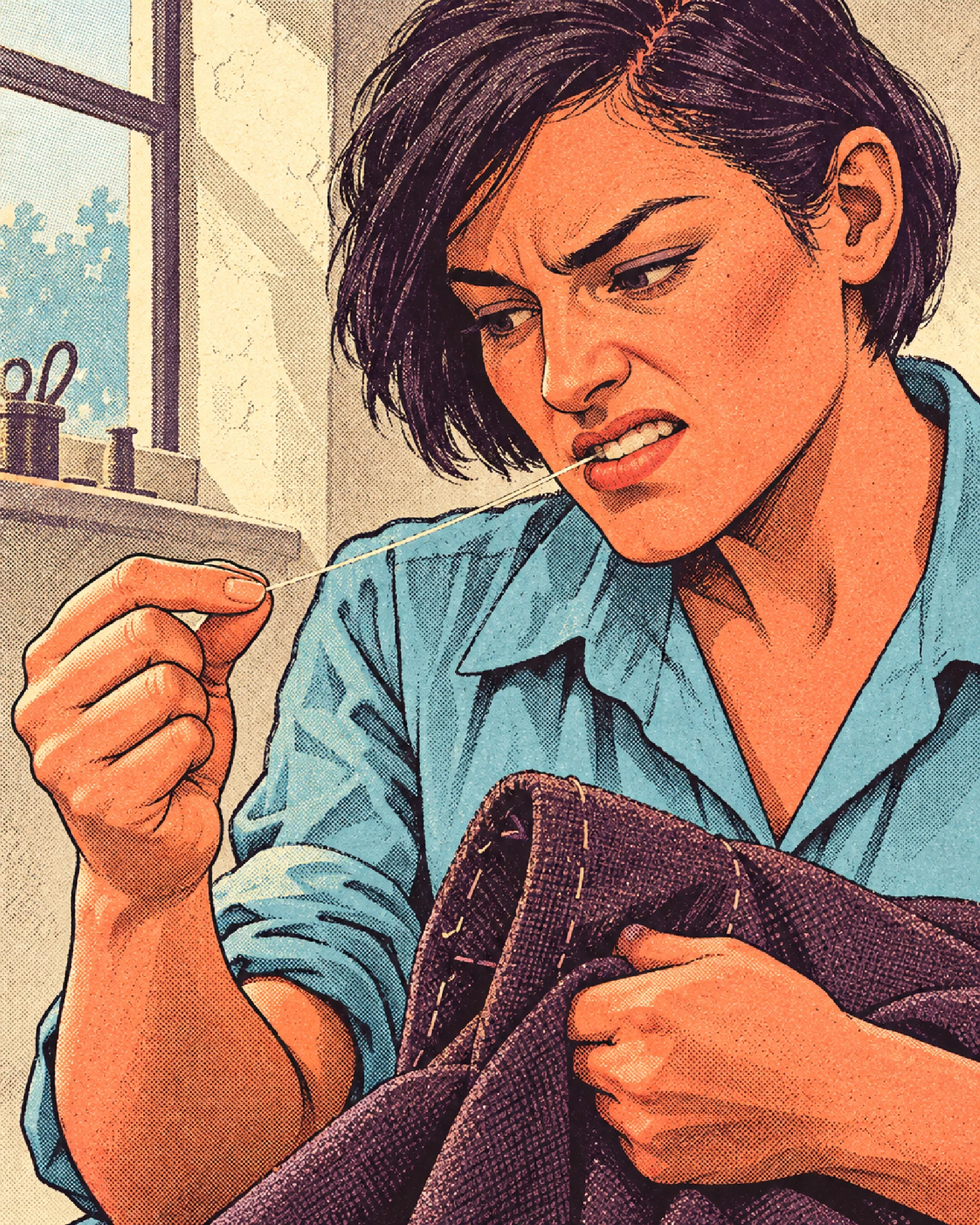
A Tailor Biting Through Thread
An intimate portrait of a tailor biting through thread stretched between her lips and fingertips. Rough brushwork, coarse halftones, and slightly slipped printing colors turn a small effort into a vivid comic moment.
Remix this referenceA Tailor Biting Through Thread
- Form language
- Build forms from blunt wedges and rounded blocks, simplifying small details while allowing irregular, hand-drawn shape variation.
- Contour
- Use assertive brush-ink contours with swollen turns, abrupt tapers, and occasional dry breaks; interior lines stay lighter.
- Mark-making
- Coarse offset halftone dots meet sparse, directional brush hatching; let dot edges clog and ink marks vary naturally.
- Surface rendering
- Step tones between exposed paper, dotted midtones, and pooled solids; slight ink misregistration and uneven absorption reveal cheap comic printing.
Priority
Rendering medium: Retro halftone comic illustration in brush ink and offset color printing.
What to avoid & what to check
Exact prompt for this example
MODULE OWNERSHIP
subject: Subject count, type, stable proportions and landmarks, resting face geometry, hair shape, physical materials, garment construction and permanent marks. No emotion, movement, color assignment or rendering recipe.
expression: Facial soft-tissue displacement and pupil direction, muscle coordination, regional intensity, asymmetry and onset/peak/release. No head/body pose, stable appearance, skin color or rendering.
gesture: Head/neck/body/limb orientation, joint movement, support, contact and pose-caused occlusion using existing anatomy. No eye/pupil movement, emotion, identity, props inventory or camera.
props: Prop count, type, construction, physical material and scale relative to the subject. Holding/contact belongs to gesture, position to composition, color to palette.
scene: Environment elements, terrain, backdrop/floor presence and structural detail. No canvas positions, camera, lighting, assigned colors or render texture.
camera: Projection, focal-length impression, camera elevation/yaw/roll, viewing distance and crop. No actor pose, world placement, lighting or canvas aspect ratio.
composition: Normalized 0-100% canvas positions, scale in frame, depth/overlap, focal hierarchy and margins. No joint pose, camera projection, rendering, subject/prop inventory or emotion.
palette: Color anchors, hue/saturation/value ranges, colors assigned to parts and approximate color coverage. No illumination direction, shading algorithm, physical material or layout.
lighting: Light-source direction/softness/intensity, ambient illumination, physical shadow direction/length and highlight position. Absence of directional illumination is allowed. No shading technique, palette or material changes.
style: Reusable form abstraction, contour weight/taper/edge quality, medium and mark scale/density/direction, surface rendering and tonal transition technique. No fixed subject proportions, anatomy, identity, expression, pose, palette, light-source direction, camera or layout.
output: Image count, aspect ratio, size, file/alpha requirements and global lettering/logo/watermark restrictions. No background scenery, crop, style, identity or pose.

SUBJECT
inventory: One adult woman, a tailor.
geometry: Broad cheekbones, a rounded chin, a long nose, and sturdy adult hands give her a recognizable construction.
resting-face: At rest, her brows are straight, upper eyelids broad, and lower lip fuller than the upper.
appearance: Short wedge-cut hair tucked behind one ear; a cotton work shirt with an open collar and rolled sleeves.

PRIORITY


AVOID


CHECK


EXPRESSION — ACTOR A
brows: Brows draw slightly inward, with one sitting a little lower.
lids: Lower lids tighten into a concentrated squint without closing the eyes.
cheeks: One cheek gathers toward the mouth while the other remains comparatively relaxed.
nose: Nostrils stay relaxed, with only a faint crease beside the working side of the mouth.
mouth: Lips retract unevenly to expose the front teeth; one corner pulls outward.
jaw: The jaw closes into a small, firm bite, with mild tension at its hinge.
gaze: Pupils look down and left toward the thread near her fingertips.
coordination: Keep the mouth's effort stronger than the brow tension, suggesting absorbed concentration.
timing: Capture the peak of the bite, just before the concentrated tension releases.

PRIORITY


AVOID


CHECK


GESTURE
head: Tip her head forward and slightly toward her left hand, keeping the neck comfortably bent.
torso: Lean the upper torso into the task, with one shoulder slightly higher than the other.
limbs: Raise the left hand with thumb and forefinger pinched; bend the right arm beneath the gathered sleeve.
contact: Left fingertips pinch the thread's free end, front teeth catch its middle, and the right hand supports the sewn sleeve.

PRIORITY


AVOID


CHECK


PROPS
inventory: One short length of sewing thread attached to one unfinished garment sleeve.
construction: Fine cotton thread and a supple woven-wool sleeve with a folded cuff, small enough to gather in one hand.

PRIORITY


AVOID


CHECK


SCENE
inventory: A tailoring workroom suggested by a plaster wall and a deep window recess; no floor is visible.
structure: A plain wall return and the thick window jamb provide the only architectural detail.

PRIORITY


AVOID


CHECK


CAMERA
projection: Natural perspective with a normal-lens impression and restrained foreshortening.
viewpoint: An intimate viewing distance at mouth height, slightly to her left, with a level camera.
crop: Crop through the crown and upper torso while retaining the complete pinching hand and the bite.

PRIORITY


AVOID


CHECK


COMPOSITION
placement: Set the face in the upper-right half, the pinching hand lower-left, and the sleeve across the lower-right edge.
depth: Let hand and sleeve overlap the torso; keep the wall clearly behind this compressed foreground group.
spacing: Make the mouth-thread junction the focus, followed by the fingertips; preserve an open wedge above the hand.

PRIORITY


AVOID


CHECK


PALETTE
colors: Warm paper cream, deep aubergine, persimmon coral, and pale cyan form a compact, expressive ink palette.
assignment: Use coral for skin, aubergine for hair and sleeve, cyan for the shirt, and cream for thread and wall.
balance: Cream occupies the largest share; aubergine supplies substantial dark masses, coral a broad accent, and cyan a smaller interval.

PRIORITY


AVOID


CHECK


LIGHTING
sources: Soft window light enters broadly from upper left, supported by gentle room ambience.
shadows: Short shadows fall down and right beneath the nose, fingers, and fabric folds.
highlights: Broad highlights rest on the left cheek and upper surfaces of the knuckles.

PRIORITY


AVOID


CHECK


STYLE GUIDE
form-language: Build forms from blunt wedges and rounded blocks, simplifying small details while allowing irregular, hand-drawn shape variation.
contour: Use assertive brush-ink contours with swollen turns, abrupt tapers, and occasional dry breaks; interior lines stay lighter.
mark-making: Coarse offset halftone dots meet sparse, directional brush hatching; let dot edges clog and ink marks vary naturally.
surface-rendering: Step tones between exposed paper, dotted midtones, and pooled solids; slight ink misregistration and uneven absorption reveal cheap comic printing.

PRIORITY
Rendering medium: Retro halftone comic illustration in brush ink and offset color printing.

AVOID


CHECK


OUTPUT
format: One finished image, portrait 4:5, 1600 × 2000 pixels, opaque PNG; no lettering, logos, or watermarks.
restrictions: One finished image, portrait 4:5, 1600 × 2000 pixels, opaque PNG; no lettering, logos, or watermarks.

PRIORITY


AVOID


CHECK


FINAL INTEGRATION
expression + gesture: Coordinate facial effort and hand contact so they describe one continuous action.
palette + style: Let the limited inks remain identifiable through the varied print marks.
Model information comes from image provenance. The same prompt may produce a different result.