Text to imageComicsStyle guide
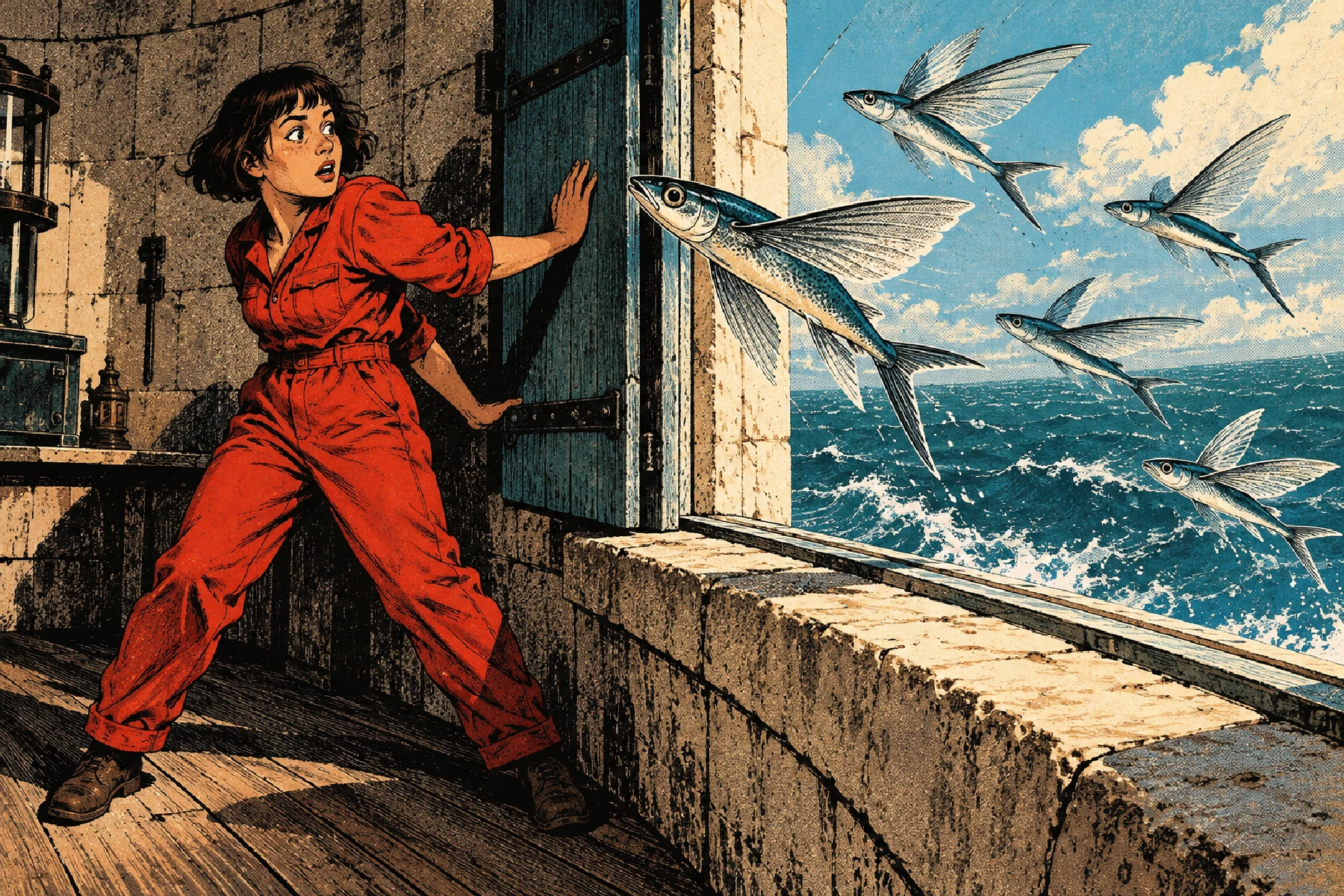
Fish Through the Storm Shutter
Five flying fish sweep through a lighthouse window as its keeper pushes open a storm shutter. Bold American comic brushwork and coarse printed halftones capture the interruption against a spacious opening onto the sea.
Remix this referenceFish Through the Storm Shutter
- Form language
- Reduce forms to forceful interlocking masses and broad planes; let small irregular accents interrupt the larger graphic shapes.
- Contour
- Use loaded brush contours with abrupt thick-to-thin turns, blunt hooks and occasional broken edges; interior lines stay leaner.
- Mark-making
- Cluster short tapered hatching in selected passages and drag a few dry-brush streaks through broad ink areas; vary marks naturally.
- Surface rendering
- Combine spot-color plates, solid ink masses and coarse halftone midtones; irregular paper gaps and slight edge misregistration give printed bite.
Priority
Rendering medium: Bold American comic illustration in brush ink with spot-color halftone printing.
What to avoid & what to check
Exact prompt for this example
MODULE OWNERSHIP
subject: Subject count, type, stable proportions and landmarks, resting face geometry, hair shape, physical materials, garment construction and permanent marks. No emotion, movement, color assignment or rendering recipe.
expression: Facial soft-tissue displacement and pupil direction, muscle coordination, regional intensity, asymmetry and onset/peak/release. No head/body pose, stable appearance, skin color or rendering.
gesture: Head/neck/body/limb orientation, joint movement, support, contact and pose-caused occlusion using existing anatomy. No eye/pupil movement, emotion, identity, props inventory or camera.
props: Prop count, type, construction, physical material and scale relative to the subject. Holding/contact belongs to gesture, position to composition, color to palette.
scene: Environment elements, terrain, backdrop/floor presence and structural detail. No canvas positions, camera, lighting, assigned colors or render texture.
camera: Projection, focal-length impression, camera elevation/yaw/roll, viewing distance and crop. No actor pose, world placement, lighting or canvas aspect ratio.
composition: Normalized 0-100% canvas positions, scale in frame, depth/overlap, focal hierarchy and margins. No joint pose, camera projection, rendering, subject/prop inventory or emotion.
palette: Color anchors, hue/saturation/value ranges, colors assigned to parts and approximate color coverage. No illumination direction, shading algorithm, physical material or layout.
lighting: Light-source direction/softness/intensity, ambient illumination, physical shadow direction/length and highlight position. Absence of directional illumination is allowed. No shading technique, palette or material changes.
style: Reusable form abstraction, contour weight/taper/edge quality, medium and mark scale/density/direction, surface rendering and tonal transition technique. No fixed subject proportions, anatomy, identity, expression, pose, palette, light-source direction, camera or layout.
output: Image count, aspect ratio, size, file/alpha requirements and global lettering/logo/watermark restrictions. No background scenery, crop, style, identity or pose.

SUBJECT
inventory: One adult woman, actor A, and five flying fish.
geometry: A has a sturdy build, broad hands and a square chin; the fish have slender bodies, forked tails and long paired pectoral fins.
resting-face: A has straight brows, deep-set eyes, a broad nose bridge and a wide mouth with a fuller lower lip.
appearance: A wears a short blunt haircut and heavy cotton coveralls with a fold-down collar; the fish have scaled bodies and translucent fins.

PRIORITY


AVOID


CHECK


EXPRESSION — ACTOR A
brows: Both brows rise, with one slightly higher.
lids: Upper lids lift clearly; lower lids stay loose.
cheeks: Cheeks lift only faintly, without a smile crease.
nose: The nose remains unwrinkled, with relaxed nostrils.
mouth: Lips part in a small uneven opening.
jaw: The jaw drops slightly without clenching.
gaze: Both pupils track the nearest passing fish.
coordination: Raised brows and open lids dominate; the mouth response stays smaller.
timing: Hold the brief peak of surprise before any smile develops.

PRIORITY


AVOID


CHECK


GESTURE
head: A turns her head toward the passing fish, keeping her neck extended naturally.
torso: Her torso twists away from the shutter while her weight stays over a staggered stance.
limbs: Her right arm extends to push; her left elbow bends for support. The fish spread their fins with varied tail flexes.
contact: Her right palm presses the shutter face, her left palm braces the sill, and both feet bear on the floor.

PRIORITY


AVOID


CHECK


PROPS
inventory: No separate props.
construction: No prop construction applies.

PRIORITY


AVOID


CHECK


SCENE
inventory: A lighthouse maintenance room with a tall sea window, a hinged storm shutter, a stone sill and an open sea beyond.
structure: Curved masonry encloses a worn plank floor; the thick window reveal and inward-opening shutter establish the room's depth.

PRIORITY


AVOID


CHECK


CAMERA
projection: Natural perspective with a moderately wide lens impression.
viewpoint: View from inside the room at chest height, oblique to the window wall, with a level horizon.
crop: A medium-wide view includes A from head to feet, the open window and the entire fish passage.

PRIORITY


AVOID


CHECK


COMPOSITION
placement: A anchors the left third; the window opens across the right half, and the fish form a loose arc between them.
depth: The nearest fish overlaps the window reveal; smaller fish recede toward the sea. A's face and the nearest fish lead the hierarchy.
spacing: Leave a broad uninterrupted sea interval around the fish arc, with breathing room above A and beneath her feet.

PRIORITY


AVOID
No panel borders.

CHECK


PALETTE
colors: Use ink black, warm ivory, storm teal, signal vermilion and muted copper as the compact color anchors.
assignment: Teal belongs to sea and fish backs; ivory to masonry and fish bellies; vermilion to coveralls; copper to skin; black to hair and ink.
balance: Ivory and subdued teal dominate; vermilion supplies one concentrated saturated accent amid firm dark values.

PRIORITY


AVOID


CHECK


LIGHTING
sources: Broad daylight enters from the right through the window, with weak ambient fill inside the room.
shadows: A and the shutter cast substantial shadows leftward across the nearby wall and floor, with softened outer edges.
highlights: Light catches A's window-facing cheek and knuckles, the fish backs and the exposed sill edge.

PRIORITY


AVOID


CHECK


STYLE GUIDE
form-language: Reduce forms to forceful interlocking masses and broad planes; let small irregular accents interrupt the larger graphic shapes.
contour: Use loaded brush contours with abrupt thick-to-thin turns, blunt hooks and occasional broken edges; interior lines stay leaner.
mark-making: Cluster short tapered hatching in selected passages and drag a few dry-brush streaks through broad ink areas; vary marks naturally.
surface-rendering: Combine spot-color plates, solid ink masses and coarse halftone midtones; irregular paper gaps and slight edge misregistration give printed bite.

PRIORITY
Rendering medium: Bold American comic illustration in brush ink with spot-color halftone printing.

AVOID


CHECK


OUTPUT
format: One finished illustration, landscape 3:2, 1800 × 1200 pixels, opaque PNG.
restrictions: No lettering, speech balloons, logos or watermarks.

PRIORITY


AVOID


CHECK


FINAL INTEGRATION
expression + gesture + composition: Coordinate the reaction and physical action while keeping the facial response legible within the larger arrangement.
style + palette + lighting: Translate the illumination into the chosen print vocabulary while preserving clear separation between neighboring color areas.
Model information comes from image provenance. The same prompt may produce a different result.