Text to imageCharacterStyle guide
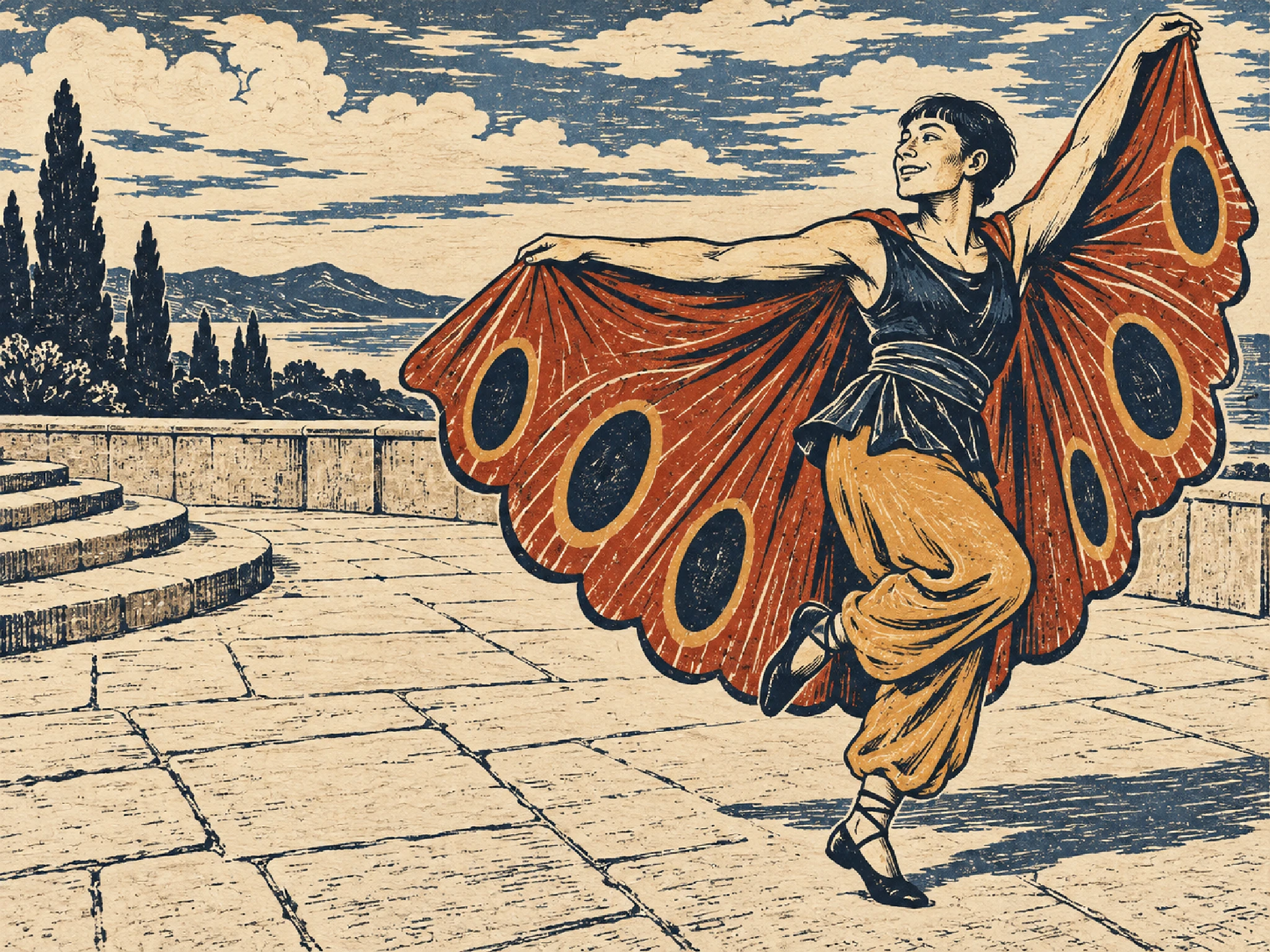
Dancer Opening a Moth Cape
A dancer opens a moth-wing cape on a stone terrace. Bold linocut masses and rhythmic carved marks carry the movement through generous open space.
Remix this referenceDancer Opening a Moth Cape
- Form language
- Reduce forms to interlocking bold masses and long elastic curves, retaining small irregularities that make the shapes feel hand-cut.
- Contour
- Use broad, uneven ink edges interrupted by sharp gouge bites; let interior lines taper to blunt carved stops.
- Mark-making
- Carve rhythmic runs of curved slivers and short wedges, varying their length and spacing naturally between generous unmarked passages.
- Surface rendering
- Build tone from solid ink and widening carved gaps; uneven ink transfer and slight block misregistration keep the print tactile.
Priority
Make bold linocut masses and rhythmic carving visibly define the medium.
What to avoid & what to check
Exact prompt for this example
MODULE OWNERSHIP
subject: Subject count, type, stable proportions and landmarks, resting face geometry, hair shape, physical materials, garment construction and permanent marks. No emotion, movement, color assignment or rendering recipe.
expression: Facial soft-tissue displacement and pupil direction, muscle coordination, regional intensity, asymmetry and onset/peak/release. No head/body pose, stable appearance, skin color or rendering.
gesture: Head/neck/body/limb orientation, joint movement, support, contact and pose-caused occlusion using existing anatomy. No eye/pupil movement, emotion, identity, props inventory or camera.
props: Prop count, type, construction, physical material and scale relative to the subject. Holding/contact belongs to gesture, position to composition, color to palette.
scene: Environment elements, terrain, backdrop/floor presence and structural detail. No canvas positions, camera, lighting, assigned colors or render texture.
camera: Projection, focal-length impression, camera elevation/yaw/roll, viewing distance and crop. No actor pose, world placement, lighting or canvas aspect ratio.
composition: Normalized 0-100% canvas positions, scale in frame, depth/overlap, focal hierarchy and margins. No joint pose, camera projection, rendering, subject/prop inventory or emotion.
palette: Color anchors, hue/saturation/value ranges, colors assigned to parts and approximate color coverage. No illumination direction, shading algorithm, physical material or layout.
lighting: Light-source direction/softness/intensity, ambient illumination, physical shadow direction/length and highlight position. Absence of directional illumination is allowed. No shading technique, palette or material changes.
style: Reusable form abstraction, contour weight/taper/edge quality, medium and mark scale/density/direction, surface rendering and tonal transition technique. No fixed subject proportions, anatomy, identity, expression, pose, palette, light-source direction, camera or layout.
output: Image count, aspect ratio, size, file/alpha requirements and global lettering/logo/watermark restrictions. No background scenery, crop, style, identity or pose.

SUBJECT
inventory: One adult human dancer, actor A, wearing a moth-wing cape over a sleeveless tunic and loose trousers.
geometry: A long-limbed build with broad hands, a square chin, and a compact head creates a recognizable silhouette.
resting-face: Almond eyes, straight brows, a short broad nose, and a wide mouth with a shallow cupid's bow define the resting face.
appearance: Short hair has a blunt crescent fringe; the woven cape has scalloped hems and sewn oval appliqués. Minor details may vary.

PRIORITY


AVOID


CHECK


EXPRESSION — ACTOR A
brows: Outer brow ends rise gently without a startled arch.
lids: Lower lids lift slightly; upper lids remain relaxed and the eyes stay open.
cheeks: Cheeks gather upward with a small fold beside each mouth corner.
nose: The nose remains relaxed, without bridge wrinkling or nostril flare.
mouth: A lightly parted smile spreads farther at one corner.
jaw: The jaw releases slightly beneath the parted smile.
gaze: Both pupils turn toward the raised cape corner.
coordination: Cheek lift and mouth widening agree; the brows provide a gentler accent.
timing: Capture the apex of a small delighted smile.

PRIORITY


AVOID


CHECK


GESTURE
head: The head turns toward the higher hand, with the neck extending naturally from the turning shoulders.
torso: The torso twists through a sweeping turn while the pelvis remains over the supporting leg.
limbs: One arm rises and the other reaches sideways; one foot supports the body while the other knee bends with its heel lifted.
contact: Each hand grips a cape corner, drawing the cloth open; the supporting sole meets the stone terrace.

PRIORITY


AVOID


CHECK


PROPS
inventory: No separate props.
construction: No prop construction applies.

PRIORITY


AVOID


CHECK


SCENE
inventory: An outdoor stone rehearsal terrace with shallow curved steps and a low parapet.
structure: Broad paving slabs have irregular joints; the parapet is plain, and open sky completes the backdrop.

PRIORITY


AVOID


CHECK


CAMERA
projection: Gentle perspective with a normal-lens impression.
viewpoint: View from slightly above eye height, obliquely across the terrace, with a level horizon.
crop: A full-figure view includes the entire cape, both feet, and enough terrace to establish the setting.

PRIORITY


AVOID


CHECK


COMPOSITION
placement: The dancer occupies the right third; the cape sweeps into the middle, leaving the left third spacious.
depth: The face leads, the cape follows, and the terrace recedes behind them; cloth overlaps part of the torso.
spacing: Keep a clear gap around the head and raised hand, with comfortable margins beyond the cape and feet.

PRIORITY


AVOID


CHECK


PALETTE
colors: Use ink navy, brick vermilion, muted saffron, and warm paper cream.
assignment: Give the cape vermilion with navy oval motifs, trousers saffron, hair navy, skin warm cream, and terrace muted cream.
balance: Cream forms the largest color field; navy anchors the image, vermilion carries the main accent, and saffron stays limited.

PRIORITY


AVOID


CHECK


LIGHTING
sources: Broad daylight enters softly from the upper left, with gentle ambient fill.
shadows: A short, soft-edged ground shadow extends toward the lower right; cloth recesses remain visibly darker.
highlights: Light favors the upper-left edges of the face, hands, and exposed cloth ridges.

PRIORITY


AVOID


CHECK


STYLE GUIDE
form-language: Reduce forms to interlocking bold masses and long elastic curves, retaining small irregularities that make the shapes feel hand-cut.
contour: Use broad, uneven ink edges interrupted by sharp gouge bites; let interior lines taper to blunt carved stops.
mark-making: Carve rhythmic runs of curved slivers and short wedges, varying their length and spacing naturally between generous unmarked passages.
surface-rendering: Build tone from solid ink and widening carved gaps; uneven ink transfer and slight block misregistration keep the print tactile.

PRIORITY
Make bold linocut masses and rhythmic carving visibly define the medium.

AVOID


CHECK


OUTPUT
format: Produce one finished image, 4:3 landscape, 2048 × 1536 pixels, as an opaque PNG.
restrictions: No lettering, logos, signatures, or watermarks.

PRIORITY


AVOID


CHECK


FINAL INTEGRATION
subject + gesture: Let garment construction accommodate the opening movement while preserving the character's recognizable silhouette.
expression + style: Keep the small facial displacements legible within the carved simplification.
Model information comes from image provenance. The same prompt may produce a different result.