Text to imageCharacterStyle guide
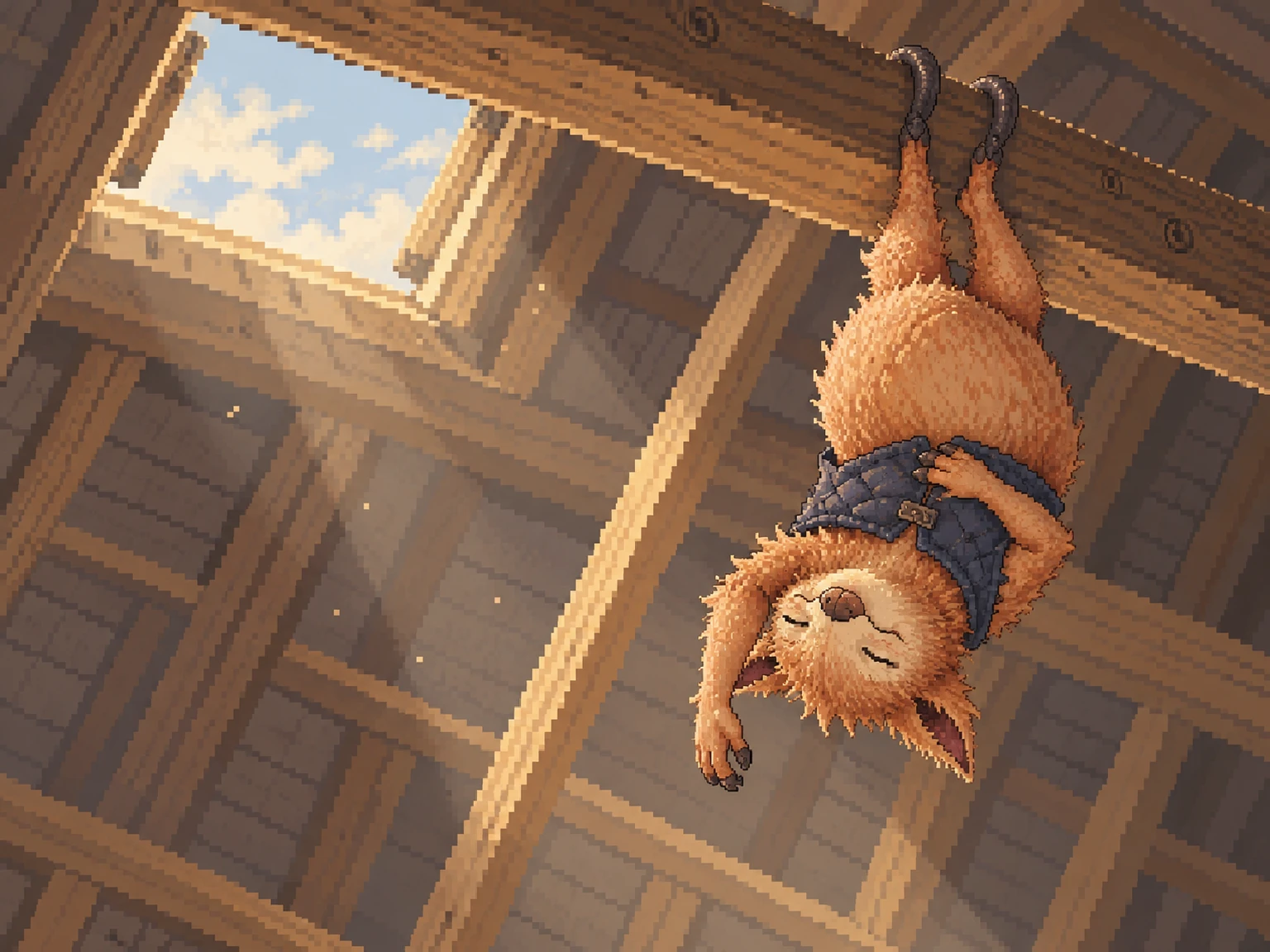
Hook-Footed Creature Resting Under a Beam
A small creature rests upside down beneath an attic beam. Interlaced pixel clusters and generous open space make its peculiar everyday ritual feel cozy.
Remix this referenceHook-Footed Creature Resting Under a Beam
- Form language
- Reduce volumes to interlocking pixel masses, preserving a few expressive silhouette notches instead of smoothing every curve.
- Contour
- Build deliberate low-resolution stair steps from crisp square units; vary step lengths and use selective broken outlines.
- Mark-making
- Alternate short horizontal and vertical pixel runs like interlaced strands, allowing irregular starts, gaps and clustered knots.
- Surface rendering
- Turn tones through sparse woven dithering between solid clusters; vary the weave naturally while retaining the visible pixel unit.
Priority
The defining treatment is woven pixel art with deliberate low-resolution edges.
What to avoid & what to check
Exact prompt for this example
MODULE OWNERSHIP
subject: Subject count, type, stable proportions and landmarks, resting face geometry, hair shape, physical materials, garment construction and permanent marks. No emotion, movement, color assignment or rendering recipe.
expression: Facial soft-tissue displacement and pupil direction, muscle coordination, regional intensity, asymmetry and onset/peak/release. No head/body pose, stable appearance, skin color or rendering.
gesture: Head/neck/body/limb orientation, joint movement, support, contact and pose-caused occlusion using existing anatomy. No eye/pupil movement, emotion, identity, props inventory or camera.
props: Prop count, type, construction, physical material and scale relative to the subject. Holding/contact belongs to gesture, position to composition, color to palette.
scene: Environment elements, terrain, backdrop/floor presence and structural detail. No canvas positions, camera, lighting, assigned colors or render texture.
camera: Projection, focal-length impression, camera elevation/yaw/roll, viewing distance and crop. No actor pose, world placement, lighting or canvas aspect ratio.
composition: Normalized 0-100% canvas positions, scale in frame, depth/overlap, focal hierarchy and margins. No joint pose, camera projection, rendering, subject/prop inventory or emotion.
palette: Color anchors, hue/saturation/value ranges, colors assigned to parts and approximate color coverage. No illumination direction, shading algorithm, physical material or layout.
lighting: Light-source direction/softness/intensity, ambient illumination, physical shadow direction/length and highlight position. Absence of directional illumination is allowed. No shading technique, palette or material changes.
style: Reusable form abstraction, contour weight/taper/edge quality, medium and mark scale/density/direction, surface rendering and tonal transition technique. No fixed subject proportions, anatomy, identity, expression, pose, palette, light-source direction, camera or layout.
output: Image count, aspect ratio, size, file/alpha requirements and global lettering/logo/watermark restrictions. No background scenery, crop, style, identity or pose.

SUBJECT
inventory: One original small, furred, hook-footed attic creature, actor A.
geometry: A pear-shaped trunk, narrow shins and strongly hooked toes distinguish its small wedge-shaped head and short triangular ears.
resting-face: A broad muzzle, shallow brow ridge and small oval eyes form a compact face.
appearance: Soft fur grows in irregular tufts; a sleeveless quilted vest has a simple overlapping front. Small tuft variations are welcome.

PRIORITY


AVOID


CHECK


EXPRESSION — ACTOR A
brows: Brow tension releases into shallow, even arcs.
lids: Both lids settle almost closed without squeezing.
cheeks: Cheeks remain soft with a slight lift beside the mouth.
nose: The nose stays unwrinkled, with relaxed nostrils.
mouth: Closed lips ease into a small, uneven smile.
jaw: The jaw releases without opening the mouth.
gaze: Pupils are concealed by the nearly closed lids.
coordination: Quiet eyes and a lingering mouth-corner lift convey settled relief.
timing: Capture the release just after facial effort has subsided.

PRIORITY


AVOID


CHECK


GESTURE
head: The neck hangs loosely, with the inverted face turned gently outward to face left.
torso: The body hangs upside down in a relaxed curve beneath the hips.
limbs: Bent knees gather near the belly; one arm drapes freely while the other palm rests on the abdomen.
contact: Both hooked feet curl securely over the beam and support the hanging body.

PRIORITY


AVOID


CHECK


PROPS
inventory: No separate props.
construction: No prop construction applies.

PRIORITY


AVOID


CHECK


SCENE
inventory: An airy attic with exposed timber beams, sloping roof boards and a small open ventilation hatch.
structure: A substantial crossbeam spans the roof cavity; sparse rafters suggest the enclosure. The floor is outside the visible space.

PRIORITY


AVOID


CHECK


CAMERA
projection: Use a restrained perspective with the spacious impression of a normal lens.
viewpoint: Look slightly upward from below the beam, with a modest oblique view and no roll.
crop: A medium-wide view includes the complete creature and ample surrounding roof cavity.

PRIORITY


AVOID


CHECK


COMPOSITION
placement: Place the creature near 72% canvas width, its face below the midpoint; the beam occupies the upper band.
depth: The creature overlaps the beam underside; distant rafters recede quietly. The face leads, followed by the hooked-foot silhouette.
spacing: Leave the left half broadly open, with unequal gaps between rafters and comfortable space around the arms.

PRIORITY


AVOID


CHECK


PALETTE
colors: Use dusty apricot, deep indigo, muted straw and warm chalk as the main anchors.
assignment: Apricot belongs to the fur, indigo to the vest, straw to the timbers and warm chalk to the open attic fields.
balance: Pale warm hues dominate; the compact indigo area supplies the darkest accent. Keep saturation gently restrained.

PRIORITY


AVOID


CHECK


LIGHTING
sources: Soft daylight enters from the upper left through the hatch, supported by gentle ambient fill.
shadows: The beam and body cast broad, soft-edged shadows down and right.
highlights: Quiet highlights touch the muzzle's left surface, the belly and exposed beam edge.

PRIORITY


AVOID


CHECK


STYLE GUIDE
form-language: Reduce volumes to interlocking pixel masses, preserving a few expressive silhouette notches instead of smoothing every curve.
contour: Build deliberate low-resolution stair steps from crisp square units; vary step lengths and use selective broken outlines.
mark-making: Alternate short horizontal and vertical pixel runs like interlaced strands, allowing irregular starts, gaps and clustered knots.
surface-rendering: Turn tones through sparse woven dithering between solid clusters; vary the weave naturally while retaining the visible pixel unit.

PRIORITY
The defining treatment is woven pixel art with deliberate low-resolution edges.

AVOID


CHECK


OUTPUT
format: One finished image, landscape 4:3, 1536 × 1152 pixels, opaque PNG.
restrictions: No lettering, logos or watermarks.

PRIORITY


AVOID


CHECK


FINAL INTEGRATION
subject + gesture + composition: Let the distinctive anatomy remain legible through its support contacts and surrounding negative space.
expression + style: Preserve the restrained facial acting when translating small features into pixel clusters.
Model information comes from image provenance. The same prompt may produce a different result.