Text to imageArt stylesStyle guide
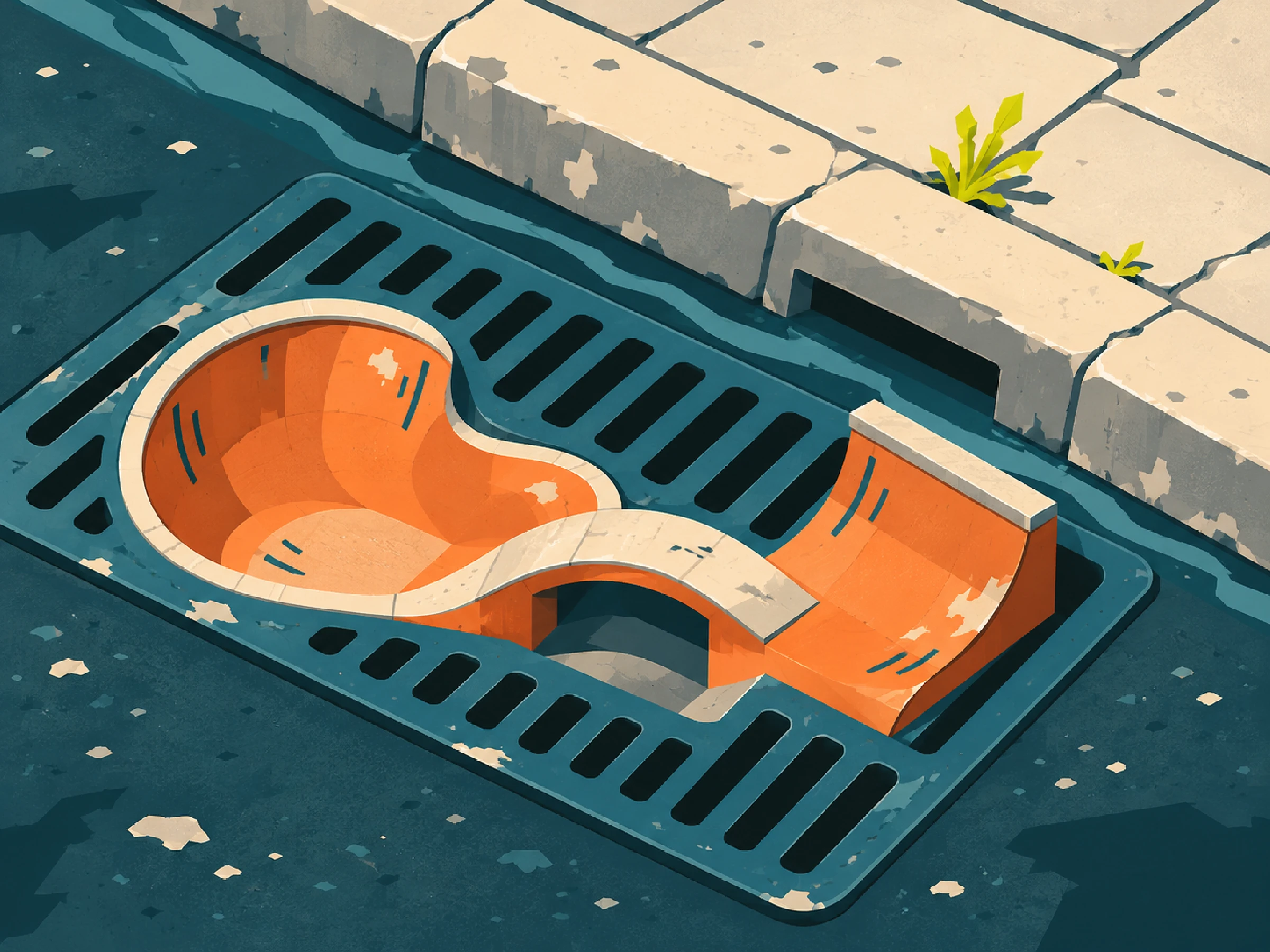
A Skatepark Inside a Street Drain
A miniature skatepark unfolds inside a curbside drain. Crisp vector shapes and playful asymmetry overturn the scale of an ordinary street.
Remix this referenceA Skatepark Inside a Street Drain
- Form language
- Build forms from decisive curved cutouts and blunt polygonal planes; use unequal repetitions and slightly mismatched arcs.
- Contour
- Use crisp vector boundaries without universal outlines; add occasional short, heavy internal strokes with clean ends.
- Mark-making
- A few oversized chips and tapered dashes suggest wear; vary their shapes naturally instead of repeating a texture pattern.
- Surface rendering
- Use broad solid fields and stepped tonal inserts; describe curved surfaces with eccentric nested shapes rather than smooth modeling.
Priority
Make crisp vector abstraction and playful asymmetry the defining visual treatment.
What to avoid & what to check
Exact prompt for this example
MODULE OWNERSHIP
subject: Subject count, type, stable proportions and landmarks, resting face geometry, hair shape, physical materials, garment construction and permanent marks. No emotion, movement, color assignment or rendering recipe.
expression: Facial soft-tissue displacement and pupil direction, muscle coordination, regional intensity, asymmetry and onset/peak/release. No head/body pose, stable appearance, skin color or rendering.
gesture: Head/neck/body/limb orientation, joint movement, support, contact and pose-caused occlusion using existing anatomy. No eye/pupil movement, emotion, identity, props inventory or camera.
props: Prop count, type, construction, physical material and scale relative to the subject. Holding/contact belongs to gesture, position to composition, color to palette.
scene: Environment elements, terrain, backdrop/floor presence and structural detail. No canvas positions, camera, lighting, assigned colors or render texture.
camera: Projection, focal-length impression, camera elevation/yaw/roll, viewing distance and crop. No actor pose, world placement, lighting or canvas aspect ratio.
composition: Normalized 0-100% canvas positions, scale in frame, depth/overlap, focal hierarchy and margins. No joint pose, camera projection, rendering, subject/prop inventory or emotion.
palette: Color anchors, hue/saturation/value ranges, colors assigned to parts and approximate color coverage. No illumination direction, shading algorithm, physical material or layout.
lighting: Light-source direction/softness/intensity, ambient illumination, physical shadow direction/length and highlight position. Absence of directional illumination is allowed. No shading technique, palette or material changes.
style: Reusable form abstraction, contour weight/taper/edge quality, medium and mark scale/density/direction, surface rendering and tonal transition technique. No fixed subject proportions, anatomy, identity, expression, pose, palette, light-source direction, camera or layout.
output: Image count, aspect ratio, size, file/alpha requirements and global lettering/logo/watermark restrictions. No background scenery, crop, style, identity or pose.

SUBJECT
inventory: One miniature skatepark integrated into a single street-drain grille; no people or animals.
geometry: A kidney-shaped bowl, an offset quarter-pipe and a narrow bridge fit inside a broad slotted frame.
resting-face: No faces or facial landmarks.
appearance: The miniature ramps are cast concrete; the surrounding grille is cast iron with rounded slot ends.

PRIORITY


AVOID


CHECK


PROPS
inventory: No separate props.
construction: No prop construction applies.

PRIORITY


AVOID


CHECK


SCENE
inventory: An ordinary asphalt street, a raised pavement curb, paving slabs and sparse weeds in a pavement joint.
structure: The curb has a shallow drainage opening; a thin runoff channel follows its base.

PRIORITY


AVOID


CHECK


CAMERA
projection: Parallel projection keeps the miniature structures diagrammatically clear without wide-angle stretching.
viewpoint: Look steeply downward from the street side, with a slight oblique yaw and no roll.
crop: Include the complete grille and enough surrounding pavement to establish its everyday scale.

PRIORITY


AVOID


CHECK


COMPOSITION
placement: The drain fills the lower-left half; the curb cuts diagonally toward the upper right through spacious pavement.
depth: The frame overlaps the recessed ramps; the bowl is the first focal point, followed by the bridge and curb.
spacing: Leave generous asphalt around the frame and open gaps between ramps so the small world remains readable.

PRIORITY


AVOID


CHECK


PALETTE
colors: Chalk cream, tangerine, deep petrol blue and a small acid-yellow accent; mostly clear middle values.
assignment: Cream pavement, petrol asphalt and grille, tangerine ramps, and acid-yellow weeds.
balance: The cool street dominates; warm ramps make a concentrated interruption, with yellow used sparingly.

PRIORITY


AVOID


CHECK


LIGHTING
sources: Broad daylight enters from the upper left with enough ambient fill to reveal the recessed park.
shadows: Short shadows fall toward the lower right; the deepest shadows sit beneath the bridge and frame lip.
highlights: Restrained highlights follow the upper-left bowl rim and the exposed top of the grille.

PRIORITY


AVOID


CHECK


STYLE GUIDE
form-language: Build forms from decisive curved cutouts and blunt polygonal planes; use unequal repetitions and slightly mismatched arcs.
contour: Use crisp vector boundaries without universal outlines; add occasional short, heavy internal strokes with clean ends.
mark-making: A few oversized chips and tapered dashes suggest wear; vary their shapes naturally instead of repeating a texture pattern.
surface-rendering: Use broad solid fields and stepped tonal inserts; describe curved surfaces with eccentric nested shapes rather than smooth modeling.

PRIORITY
Make crisp vector abstraction and playful asymmetry the defining visual treatment.

AVOID


CHECK


OUTPUT
format: One finished image, landscape 4:3, 2400 × 1800 pixels, opaque PNG.
restrictions: No lettering, logos or watermarks.

PRIORITY


AVOID


CHECK
Model information comes from image provenance. The same prompt may produce a different result.