Text to imageLandscapeStyle guide
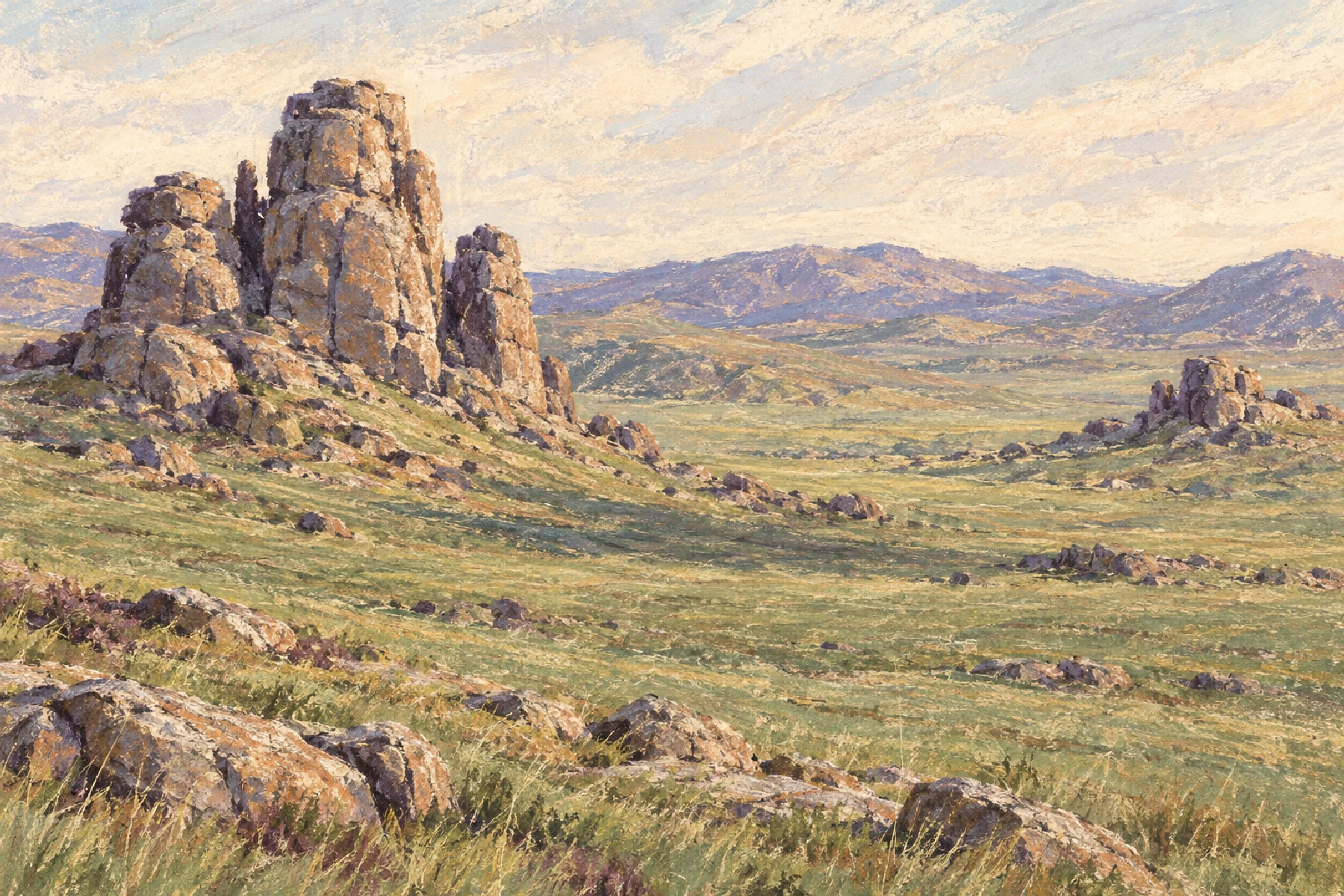
Stone Towers in a Grass Basin
Weathered stone towers rise from a spacious grass basin. Rubbed oil pastel and scratched passages create a dreamlike rhythm between the rocks and open ground.
Remix this referenceStone Towers in a Grass Basin
- Form language
- Simplify forms into uneven interlocking masses, retaining a few telling breaks rather than describing every small feature.
- Contour
- Alternate blunt pastel edges with rubbed, dissolving boundaries; allow occasional broken contour fragments.
- Mark-making
- Drag broad oil-pastel strokes, rub selected passages sideways, and scratch sparse wandering lines through the waxy layers.
- Surface rendering
- Build opaque waxy deposits over rubbed veils, letting scratched underlayers interrupt soft tonal transitions with natural variation.
Priority
Make rubbed oil pastel and selective scratching visibly define the image.
What to avoid & what to check
Exact prompt for this example
MODULE OWNERSHIP
subject: Subject count, type, stable proportions and landmarks, resting face geometry, hair shape, physical materials, garment construction and permanent marks. No emotion, movement, color assignment or rendering recipe.
expression: Facial soft-tissue displacement and pupil direction, muscle coordination, regional intensity, asymmetry and onset/peak/release. No head/body pose, stable appearance, skin color or rendering.
gesture: Head/neck/body/limb orientation, joint movement, support, contact and pose-caused occlusion using existing anatomy. No eye/pupil movement, emotion, identity, props inventory or camera.
props: Prop count, type, construction, physical material and scale relative to the subject. Holding/contact belongs to gesture, position to composition, color to palette.
scene: Environment elements, terrain, backdrop/floor presence and structural detail. No canvas positions, camera, lighting, assigned colors or render texture.
camera: Projection, focal-length impression, camera elevation/yaw/roll, viewing distance and crop. No actor pose, world placement, lighting or canvas aspect ratio.
composition: Normalized 0-100% canvas positions, scale in frame, depth/overlap, focal hierarchy and margins. No joint pose, camera projection, rendering, subject/prop inventory or emotion.
palette: Color anchors, hue/saturation/value ranges, colors assigned to parts and approximate color coverage. No illumination direction, shading algorithm, physical material or layout.
lighting: Light-source direction/softness/intensity, ambient illumination, physical shadow direction/length and highlight position. Absence of directional illumination is allowed. No shading technique, palette or material changes.
style: Reusable form abstraction, contour weight/taper/edge quality, medium and mark scale/density/direction, surface rendering and tonal transition technique. No fixed subject proportions, anatomy, identity, expression, pose, palette, light-source direction, camera or layout.
output: Image count, aspect ratio, size, file/alpha requirements and global lettering/logo/watermark restrictions. No background scenery, crop, style, identity or pose.

SUBJECT
inventory: No discrete actors; the landscape itself is the subject.
geometry: No actor proportions or identity landmarks apply.
resting-face: No faces are present.
appearance: No actor appearance or garments apply.

PRIORITY


AVOID


CHECK


PROPS
inventory: No separate props.
construction: No prop construction applies.

PRIORITY


AVOID


CHECK


SCENE
inventory: A broad upland grass basin contains weathered granite towers, scattered low stones, distant slopes, and open sky.
structure: The towers have stacked rounded crowns and narrow fissures; shallow grass hollows connect across an otherwise unbroken basin.

PRIORITY


AVOID


CHECK


CAMERA
projection: Use a gently compressed perspective with a moderate long-lens impression.
viewpoint: Look across the basin from a low hillside, slightly downward, with a level horizon.
crop: Use a distant landscape view that includes the complete tallest tower and a broad stretch of ground.

PRIORITY


AVOID


CHECK


COMPOSITION
placement: Concentrate the tallest rock group in the left third; a much smaller outcrop answers it near the far right.
depth: Let low foreground stones overlap the grass basin, with the tall group as the first focus and distant slopes as a quiet finish.
spacing: Leave a generous uninterrupted grass interval between the rock groups and ample breathing room above their crowns.

PRIORITY


AVOID


CHECK


PALETTE
colors: Anchor the image in muted celadon, dusty apricot, deep plum, and pale cream.
assignment: Give the grass celadon, the towers apricot with plum recesses, and the sky pale cream.
balance: Let restrained pale and middle values dominate, keeping deep plum limited to small concentrated passages.

PRIORITY


AVOID


CHECK


LIGHTING
sources: Broad soft light arrives from the upper right, supported by gentle ambient illumination.
shadows: The towers cast soft elongated shadows toward the lower left; fissures retain deeper shade.
highlights: Keep broad subdued highlights on upper-right crowns and exposed ledges.

PRIORITY


AVOID


CHECK


STYLE GUIDE
form-language: Simplify forms into uneven interlocking masses, retaining a few telling breaks rather than describing every small feature.
contour: Alternate blunt pastel edges with rubbed, dissolving boundaries; allow occasional broken contour fragments.
mark-making: Drag broad oil-pastel strokes, rub selected passages sideways, and scratch sparse wandering lines through the waxy layers.
surface-rendering: Build opaque waxy deposits over rubbed veils, letting scratched underlayers interrupt soft tonal transitions with natural variation.

PRIORITY
Make rubbed oil pastel and selective scratching visibly define the image.

AVOID


CHECK


OUTPUT
format: One finished illustration; landscape 3:2 aspect ratio, 1800 × 1200 pixels, opaque PNG.
restrictions: No lettering, logos, signatures, or watermarks.

PRIORITY


AVOID


CHECK


FINAL INTEGRATION
composition + style: Let the open intervals reveal the medium's quieter passages while preserving the composition's clear focal hierarchy.
Model information comes from image provenance. The same prompt may produce a different result.